Why Most Loneliness Advice has a Faulty Compass (A Real Guide to Understanding Your Loneliness)
This post is about honing in on the specific, exact kind of loneliness you are feeling. Yes, you personally. Because if you clicked on this posts title, you likely already know that there are no one-size-fits-all solutions for isolation—no 5 minute tik-tok video that will magically bring great connection into your life. Each of our environments, our responses, and our pain, are different from everyone elses.
And that means we don’t need another meme. We need a MAP.
This post is that map. Cos if you ended up reading this, you are likely carrying a heavy, quiet weight. Not just from loneliness itself, but also from the messaging of mainstream culture, which constantly tells you your loneliness is the result of a defect or deficit in you.
Today, we will demonstrate why your loneliness is not down to you, or your failings. We do it with the most powerful mapping tool there is: the Power Threat Meaning Framework (PTMF) developed by Dr. Lucy Johnstone, Prof. Mary Boyle, and their colleagues. Their work helps us understand that loneliness not about your failings. It is actually manufactured by something far bigger than you, and more structural:
Because loneliness is about the systems you are part of, and the specific place you have been assigned inside them. Those exact co-ordinates are key we will find today.
So, as opposed to the usual trending claptrap about loneliness, the map we lay out today contains no sales pitches. No blather about "changing your thoughts," or branding yourself as “high value,” like the world's most desirable kitchen appliance. There will be theory, as always, but only a but, and it is there to show you why this map works so well, and why other models cant help but perpetuate your loneliness.
By the end of this, you should be able to identify the specific mechanisms shaping your own isolation, the responses you developed to survive that, and why you are not the actual problem.
The PTMF Map vs Standard Orienteering Devices
The PTMF authors, Johnston, Boyle and colleagues, noticed something vital about common, standard ways of understanding distress. That they often function like a very broken compass. Meaning, they point us confidently and redly in the wrong direction.
Nowhere is that easier to see than in popular advice about loneliness.
Let's look at where that points us, starting with a little cliché you might have heard. It’s a platitude-ified reflection of the direction we are sent in by many current models.
"Loneliness is just an invitation to date yourself."
Ain't that lovely. Your pain and isolation solved in 8 words – by making you look inadequate, desperate, and behind the times for feeling loneliness at all. This like-bait cure-all points AWAY from loneliness being an issue at all. The issue it points at instead, is a failure of your perspective. A failure in you, in other words.
And that little flip of the compass is essentially the template for the industries who offer you “solutions” to your isolation.
The not-true north, expanded on, is this. If you’re miserable when cut off from others, it is all about YOU being, or doing things, wrong. It is a sign you are weak for wanting or needing others in your life, and for having failed to become a completely self-contained unit. Your pain at your own isolation is pointed back on itself. Instead of being seen as a feeling that's trying to alert you to your needs, it’s transformed into evidence that you have not done enough "work" on yourself.
From there, it gets profitable and very self-perpetuating. Go get more “me time” and busy yourself with you. Courses, coaches, journals, “I love me” T-Shirts made by an impoverished child in Bangladesh. The compass always points inward, as a big red imperative to find fault in yourself and fix it; to whittle down your world to the unit of one human, and look happy at the prospect of only ever having sex with your own hand.
Yet this direction-fudging template is prolific, and highly highly lucrative. It can be found across wellness and self improvement culture, and even standard treatment models in psychology will follow it.
Look closely at the solutions it promotes too. Cos this is something the PTMF notices. The same western values that facilitate loneliness: individualism and emotional control, are being repackaged as the solutions to it. The solutions become working harder towards the goal of being an entirely self-contained unit. Towards demonstrating your health and superiority via your achievement of not needing other people, via your ability to cook candlelit dinners for one, and your massive collection of self-love branded dildos.
Johnston, Boyle and their colleagues call this "a labour on the self." It tracks closely with what Mark Fisher called the privatization of stress: social problems are relocated into individuals. The result is that systems escape scrutiny while people blame themselves. And if you've spent years trying to fix yourself only to end up back where you started, you may already recognise that pattern. The self-help, and professional help, faulty-compass template, does not help you feel less lonely. Instead of relieving loneliness, you are instructed to do more work: to become more atomised than before, and to relabel that atomisation a state of human health.
What Standard Methods Leave Out
So we have just looked at what standard models and advice have on their terrain. That dodgy compass, pointing at you, and leading you about in little circles. But in terms of getting to the bottom of YOUR experience today, the other side of this is just as vital. What standard models and mindset stuff actually leave out.
Which happens to be the entirety of you personal, human, circumstances. Like that your isolation might have been invoked by a boss who has singled you out for workplace bullying. That it might have been increased by a partner who wears mickey mouse earmuffs 24-7 as an excuse to constantly stonewall you. That it could be the inevitable outcome of a society so convinced that your job is a sign of your worth, that your status as the guy who cleans up roadkill, means no one will give you the time of day.
Because popular solutions atomise you from the outset. They slice you from your context. They look at your anxiety, your isolation, or your distress, in a total vacuum, ignoring the living, breathing social environment around you. Which makes the mainstream loneliness solution template look less like a map of your terrain, and more like a stick diagram with a big X on your forehead.
This toddlers-drawing level of solution demands you take radical, individual responsibility for surviving a hazardous ecosystem, including any harmful individuals or practices within it. And when harmful individuals, practices or systems are removed from the landscape – they never have to face accountability.
The PTMF – Bringing Context Back.
OK, so we've talked about why most loneliness advice, and even most healing models, fail: they have a very faulty compass, and leave your surrounding landscape completely off the page. But it's one thing to say context matters. It's another to see what actually happens when it ends up being erased.
Lets look at the law. In western legal systems, we do not assume that when bad things are happening, it must be a problem in you. The law understands that people and systems can affect one another. So if Bob the boss harms you through negligence, exploitation, discrimination, or abuse, we generally locate responsibility in Bob.
Yet, if some corners of the mental health, wellness and self-help industries were a court, good old Bob, refusing to pay you for your twelve-hour shifts would hear THAT judge say:
"Well, dear employee, you clearly need to learn to be more assertive. Bob, should carry on not paying you till you get that."
The PTMF rejects that non-logic. It insists on looking at the full landscape, your whole social, economic and political context – rather than at a craply drawn stick person.
But enough of parallels for now. Let's put this map to work in the real life world, so you can start to see it. I want you to keep your own loneliness in mind as we go through this example. Think about one of the things you do in response to loneliness. Particularly if it's one of those responses that gets labeled "dysfunctional"—though this will still work if your response looks perfectly ordinary.
Because what you're about to hear is a particular response to isolation, though what I found when I looked at it was a whole broader landscape underneath it. One those doing the intervention refuse to acknowledge.
So we get to see what happens when our context is left off the map. And why finding it is vital in your own personal story.
Case Study: How to (Not) Navigate on Mapless Terrain.
So this case study is one I have access to details and data on, cos it is from my own history. It involves eating disorders, which are rarely just about food—they can be a survival response to a number of things, and in my case it was one response to the threat of social exclusion, bullying and profound isolation. As I said, your own responses to loneliness may well be very different, and also disordered eating can be a response to other threats. But the aim here is to help you see why broader context is so vital.
Years ago, I lived in London. Despite it being full of actual people, I was terribly alone. I felt excluded by the people in the scene I was in, and found myself relapsing into the eating disorder I had had once as a child and teenager. When I finally got treatment for it, you might guess what was on offer. I was instructed by clinical practitioners to perform standard cognitive re-framing—essentially, to stop worrying about what I was worried about – receiving negative treatment or comments on my body if I gained back weight. I was told that that people don’t focus on that stuff, and that my thoughts that they might react negatively to my recovery were distorted.
The problem was this. A series of documented, verifiable sociological facts that I too had experienced personally. I had actually gotten such negative comments. And worse than just comments alone.
When I was 9, I had been bullied at school and put on diets at home for being "fat."
My response, in the hope of gaining acceptance and love, had been to starve and shrink.
The bullying stopped.
As a teenager, regaining the weight, the bullying started again. Rinse and repeat.
Now, before we continue, none of what I am about to say is to encourage anyone, ever, to internalise societal body propaganda to the extent I did. Because really, reacting negatively to someone just because their body does not fit the aesthetic preferences we have been indoctrinated with, is more like a litmus test for who is a fuckwit or not. But I didn’t understand that back then.
In any case, as an adult, the responses had not been much different. I had noted that on altering my physical size, there was a measurable shift in my material reality: People who barely noticed me before suddenly seemed much more interested in what I had to say. I got better feedback in job interviews, and got asked on dates.
These depressing little indicators of human ludicrousness have been documented in research on weight stigma and thin privilege. and scholars such as Susan Bordo, Naomi Wolf, and Noortje van Amsterdam help us understand is why. Their work shows how the body becomes a virtue signifier and sorting mechanism, read as evidence of discipline, desirability, self-control, and social worth. So this terrain was not just random shit that I made up.
Yet in the clinic, I was told that’s not how people behave, and the only one worrying was me. Landscape erased.
The issue the PTMF helps us see is this. My therapist's response to my comments was not to delve into my actual context. She did not assist me in seeing that the pressures from my social system, including friends and family commenting on any changes, and society pushing beauty as a female persons key form of worth, were very problem-generating in themselves. Instead, she opted for outright therapeutic gaslighting. I was told that the macro-societal biases were not real, and that my observation of them was just more evidence of my own 'cognitive distortion' and individual pathology. In other words, I was redrawn on a blank page, as the locus of the problem.
Which meant I failed to realize some potentially helpful things. Like that I was surrounded by fuckwits, and that a much-needed dose of Simone de Beauvoir might help remind me that I am a human subject, not a decorative object.
It also meant I was kept on a diet. Yes. A diet. I was not to abandon the body control and food fixation, I was to use them, but for a different diet and body size that the clinical system approved of. I was told to think in the approved ways too: to stop 'assuming' how people would react to weight gain. Their idea of what I should look like was the right one to solve all of my issues.
So in the end, I was sent back out into a world where fat bias, thin privilege and people fixating on bodies as tokens of virtue were apparently just things my own broken mind made up. I was left to experience bias and crappy comments all over again, but this time, questioning my sanity when I heard the usual, high rotate, dumbass utterances.
Now, it needs to be said that eating disorders occur as a response to a variety of different threats – not just the threats of bullying or exclusion – which means your map will be different. And that's the point.
Yet the thing to hone in on here is that the standard intervention I experienced, failed to produce a resolution. It failed because it is impossible to resolve a crisis while denying or ignoring the landscape of mechanisms that continue to produce it. The treatment of eating disorders remains a testament to the failure of this method to this day.
In terms of your own loneliness? Similar to promoting thinness as virtue, our society that tells us you are superior if you are totally independent, if you do not need others, if you do not show vulnerability or weakness.
Which makes blaming you for being isolated akin to blaming an E.D. patient for trying to lose weight. Its a DARVO technique, reversing victim and offender. It fixes nothing. Yet, enables the so called “care” professions to perform their funded theater of solutions.
And it is there that mainstream therapy and pop psych reveal their hidden function: what their broken compass actually achieves. Stick figure drawing solutions operate like a graphically talentless image repair kit for a sick societal machine, demanding that the individual pathologize their own responses so the infrastructure never has to face accountability for the problems it sets up.
My therapist got to look like they were “Helping” whilst using an eraser to rub out the map I was trying to draw them. They stuck to the stick figure, so that those systemic issues wouldn’t be the focus.
Instead, my failures would.
What Blank Pages Achieve
So back to your own map, which is likely still blank at this point. That little tale is about why it needs filling in. It shows what leaving the landscape off the map will achieve. Sweet Fuck All.
If you too have been through such systems, you may well have faced a similar outcome too. You may also have left the whole setup feeling “deeply flawed,” or even “nuts” and completely alone again. In my case, I was well aware that I was on my own to try and carry on in a context that still made me feel these self-harming behaviours were the only way to find acceptance.
Stumbling across De Beauvoir did help me take a step in the right direction. But the PTMF would have been a hell of a lot quicker - and less fundamentally depressing.
So lets put the PTMF into action now, and compare what emerges.
The Paradigm Shift in Action
Our baseline for comparison, the standard model. When I turned up to the programme, my responses were the focus. They were deemed to make no sense, and so were labeled dysfunctional. In turn, I was assumed to have a mental disorder. One named EDNOS (eating disorder not otherwise specified) because such behaviours had been seen before but were still considered totally deranged and non nonsensical.
Watch this though, when we put the terrain in. The PTMF version comparison. It is a quick pass, but you’ll see it.
First we look at power. I, like everyone else, am embedded in the power structures of wider society, family and educational systems. Two of those power systems enacted scapegoating on me, which posed a certain, specific kind of threat. The wider system played a role there too, but this is a quick pass.
Lets look at my most pressing threat element: for scapegoats this is often terrible treatment and exclusion: non belonging. Or the fear of that potential.
Then comes the meaning part. The meaning I got out of this. Well, the bullying and so on had centered on body shape, and being “fat.” The wider social structures seemed to mirror this to me, with thinner people held up as more valuable and loved than those who weren’t. It looking like the golden ticket to belonging.
So my exact meaning? I concluded that if I looked a certain, approved way, I could find acceptance and love – or at least not be bullied and excluded.
Now the PTMF does not have an R for response, but that is what comes next. My behavioural responses to all of that.
Which was to not eat anything that could easily be distinguished from sound insulation material.
And though I am taking the piss, did you see what just occurred? My supposedly "dysfunctional" response became much more intelligible. There was a certain kind of logic in the tools I chose for managing distress. No, they were not healthy, and nor did they actually work, well, not in adulthood, but they demonstrates a basic human truth – one that standard practices will steadfastly ignore:
We do not develop distress alone, in a void.
For both you and I, our messiest, most "dysfunctional" coping mechanisms have a protective structural logic to them.
And when mainstream models ignore context, the logic of our responses remains hidden. A reasonable reaction to a shitty situation, suddenly just looks like madness.
Drawing Your Own Map
So now you have one example. Not an explanation of eating disorders. Not a diagnosis. Not a universal story. Just one map. And what that map showed us was something deceptively simple: our behaviours are not the beginning of the story. My non-food fetish, your whatever-response-you-chose, were not the start.
Our behaviour is the end of our story. The result of it.
By the time I arrived at eating cardboard, a whole sequence of things had already happened. There were systems of power operating around me. There were threats posed by those systems. There was a meaning I assigned to those threats. And only then did I arrive at a response. It will be the same for you.
And this is why so many methods bear no fruit. They begin with the only thing they can see. The behaviour. The symptom. The panic attack. The drinking. The obsession. The people pleasing. The inability to trust anyone. The desperate need to be liked by wankers. The burning desire to publicly defecate on capitalism.
And for those of you who don’t incur a label, even you can't rest assured. If you are here, this far into this video, your so-called "functional" responses may not be working either. The gym. The meetup group. The cycle club. The endless self-improvement project.
Notice what happens when they fail.
The same faulty compass swings back into action. You lack communications skills. You didn't radiate sufficient high-value energy. You weren’t being “ug” enough to get into your masculine. The solution you’ve been sold is never questioned.
You are.
The hazardous landscape around you is not interrogated.
You are.
The system producing the isolation escapes scrutiny entirely.
Which is remarkably convenient for anything in that landscape that might be contributing to the problem. Like Bob the boss, who can go off and play golf whilst still not paying you.
This whole setup is the labour of the self the PTMF authors warn of. And it leaves us with one endlessly echoing question. Any time we suffer. Any time a solution fails. Any time we remain lonely despite our best efforts. We get trapped in the mirror, cos the question is:
"What's wrong with you?"
As the PTMF shows us, that question dodges the point. So it asks something radically different.
It asks us to treat our responses less like defects and more like clues. Not clues about what is wrong – but clues about where to start looking. Clues about the threats we have been trying to survive.
So instead of asking:
“what is wrong with you that you do this?”
They ask;
"What happened to you that this response made sense?"
That is the pivot I we need to make now. Thinking back to your own loneliness. To that one thing you keep doing in response to it. Not necessarily the thing you are proudest of. Just a thing that keeps showing up. A thing you keep returning to, despite knowing it doesn't really get you what you want. Hold that response in your mind. Because we are about to stop asking what is wrong with it. And start asking where it came from.
Get your pens ready. Cos these are the questions designed to unearth what is happening in your particular landscape.
-
What has happened to you? (How is power operating in your environment?)
-
How did it affect you? (What kinds of threats did that power pose to your survival?)
-
What sense did you make of it? (What meaning did you assign to your situation?)
-
What did you have to do to survive? (What biological or behavioural threat responses did you have to deploy?)
Tool Number II: From Maps To Magnifying Glasses
OK, those questions are great, but hands up if you find the first one kinda NOT easy to answer?
Now that's neither a failure in the model, nor a failure in you. Its due to a thing about power. Because powers operation is often hard to see. Michel Foucault has pointed that out for us before – how modern western systems do not operate on a gun-to-the-head basis, rather, they operate on what is called covert power. Which is the fancy way of saying subtle and hidden. And when the power that influences our context is subtle and hidden, we miss bits of our map.
So it can feel a little cloudy when we try and answer the PTMF's first question—"What happened to you?" You might see the crappy family experiences, or the soul destroying workplace, or the deeply unsettling spiritual group where Gary, the wanna-be guru, plays exclusion games wearing a toga. But it can sometimes be tempted to think “it cant be that” or “it was nothing” cos when power games are hidden, we don’t trust that whats going on even is. This is even harder when considering how wider systems influence your life.
So for your own map, to answer this first question—"What happened to you?"—we need a way of making power structures and relationships more visible. Because if those things are left off your landscape, you can miss the threats and meanings they invoke. You can miss the sense your own responses actually do have.
So I have a tool to help you with this part, and it makes the remaining questions a whole lot easier too. Its a model that slots right into the PTMF and makes what it talks about much easier to spot. Here is where we take a minute to set up this magnifying glass for you. With it, your own map gets done more quickly, right after.
The magnifying glass is the model I outlined in previous episodes. And don’t worry, you don’t need to know the deep mechanics of this for it to give you sight. You just need a few key aspects.
Setting Up The Lens
In my model, with the help of many theorists, I showed how our wider social system functions as what's called a narcissistic system. Which is not about raging hordes of shitheads. The term is not actually about people. It's about how such systems function, and the patterns that that functioning produces. It’s the patterns that help you spot things.
Because narcissistic systems can be of any size. From a family system, to workplaces, institutions, or as Christophers Laschs work has helped us see on many occasions, whole societies. Regardless of their size, they run on distortions. Meaning, reality is bent to fit an image. That image preserves advantage those with power in the system. Those without power in the system bear the burden and brunt of those distortions.
Which is where the very useful pattern comes in: Roles.
Because maintaining the system's distortions – its preferred version of reality – sorts us into well-known patterns of roles.
Every distortion needs a human carrier:
-
If the system can never be wrong, someone else must carry the blame.
-
If the system can't hide the conflict it creates, someone else must smooth it over.
-
If the system wants to look fair, someone must look like they embody its success.
-
And if someone starts pointing all this out... well, suddenly they become the problem.
That's what makes these roles so useful to us. If you can spot yours, you know how power is operating on you. You also see what kinds of threats it is producing – because those are well documented too.
That is your magnifying glass. In a Sherlock Holmes kinda way. Because if you can see this role sorting going on, then power and threat are there. Healthy systems allow movement, you take responsibility one day, and need help the next, so rigid roles wont be apparent. It isn’t healthy stuff that threatens you, and ends up on your map. So we are after those patterns of roles.
They are roles you will have seen or heard of. The scapegoat for example, the helper, and those who are “lost” or “golden” in the system. At any scale, these roles serve to stabalise the advantage for those with power in the system, so you are kept in your role via subtle kinds of threat.
- The scapegoats threats include exile, annihilation and blame.
- For the lost persons visibility becomes dangerous.
- For the helper, the only safety comes from giving up ones needs to facilitate the needs of those with power.
- For the golden child, the constant threat is a fall from grace, should they fail to achieve and make the system look good.
So my model doesn’t simply magnify power. It helps us see the treats as well. And here is how the model links the PTMF to loneliness – because everyone in these systems faces one fundamental danger:
Non belonging.
Cos if you fail at your function in the system, and you risk losing belonging itself. The irony is, and the reason we end up lonely regardless, is that the price of belonging is NOT being yourself. These systems make genuine connection quite close to impossible.
Recognising Which Role Power has Sorted You Into
So lets put this magnifying glass into play now. We’re going to look at which role you might have been sorted into.
If you are in the scapegoat role, your function has been to carry blame. Exile has been the constant threat for failing to accept that you are always the reason that terrible things occur. If you have been sorted into a scapegoat role, in any of the systems you are part of, it can feel like the only response you get from others, is that you are deeply, unutterably flawed. Whatever goes wrong somehow circles back to you, and your wrongness. It can feel like connection is impossible, cos no one would ever want you.
If you are in the lost child role, your function is quiet, unseen facilitation. Visibility feels dangerous, so you face compulsory erasure of your character at best. Drawing attention to yourself, like via asserting need, results in exclusion or silence. If you've been sorted into the lost child role, in any of the systems you are part of, it can feel like no one ever really sees you, let alone wants to know who you are beneath the function you perform. Connection can feel disingenuous, and like you’re being roped into some power play you will lose.
Or perhaps you are the helper. If so, your acceptance is always contingent on your function: being useful to those with advantage or power in the systems you are part of. Some helpers really struggle with seeing power, cos their role can sometimes feel like, "Oh, I just love helping people!" For some though, it feels like no one really understands just how much you do for everyone else, or that your place in the group really isn’t about you at all. It can feel like connection is all about giving up yourself.
For golden "children" and adults, your function in the system is making that system look good and fair. Via your achievements. You are the shining example of success that others point to. Yet, fail at that performance or the image compliance required, and you risk shame or reassignment to a lower role. Internally, it can feel like a constant mental tug-of-war between, "OK, I'm fucking amazing... but what if someone's better? I have to prove I'm MORE," and, "They're going to find out I'm not actually the best. Jesus. Quick. Achieve something." It can feel like connection requires you to prove you are the best.
Do any of those sound familiar? Maybe several of them do, because you can occupy one in one system, say, the lost child role in your family, whilst having been sorted into the helper role in the workplace, or society.
Now those are simplified summaries, and only the four key roles, but it should give you an idea. The roles are not identities. They are maps of how belonging is distributed, withheld, and controlled by power. And because belonging is conditional in a narcissistic system, then loneliness you feel in any role is not merely an unpleasant feeling.
It's one of the system's primary enforcement mechanisms.
But it is time, dear reader. Lets take stock of how this maps to the terrain. Of how it magnifies what might be on your landscape:
We have power – sorting people into roles.
We have the threat – general non-belonging, but with bonus, role-based threats.
The magnifying glass should help with those.
After that, it’s personal. Because all that feeds into different, personal meanings. Ultimately, into your personal story. You responses is just the final chapter in that painful tale.
Filling In Your Terrain
So think about the roles that made sense to you now. Not because they are the destination. They are just the clues. They help you see what kind of threats power is organising around you. We are now going to use those clues for exactly what they were designed for: to find our way back to the story itself. The story the PTMF helps us tell.
So, dear reader, what happened to you? We are mapping your terrain now, via the PTMF questions. That first one is this: What happened to you?
If you're stuck, ask yourself whether one of those role patterns has been following you from family, to school, to work, to relationships, to appointments with healthcare professionals, or social services, or through societal reactions to your being.
What happened?
Please pause this to write it down, cos I will still be here. I will then ask you whats next:
How did what happened affect you?
What was the threat?
What did you come to fear?
Perhaps some of these fears will resonate, but it is by no means an exhaustive list.
The scapegoat often fears:
-
rejection
-
humiliation
-
abandonment
-
exile
but your fears may well be something else.
The lost child can fear:
-
visibility
-
chaos
-
engulfment
-
overwhelm
Or other things
Some fears that helpers talk about:
-
fear of not being needed
-
fear of not being enough
-
of the chaos that ensues if you don’t organise thing right.
Among other things
Some golden child fears:
-
fear of failure, or withdrawal of praise
-
fear of worthlessness, or being discovered as worthless.
You have made it this far. You have your threats down on your map. So it’s time for the part that’s very personal to you. Where the PTMF asks you this:
What did you conclude about yourself or the world?
Here, the possibilities are endless. As with before, these are just here in case it helps you locate your own. Did you conclude:
-
"I'm too much."
-
"I'm unlovable."
-
"I'm inherently wrong."
-
"Everyone is happier if I am not around."
-
"People are unsafe."
-
"The world is unsafe."
-
"I am only safe if I disappear."
-
"If I shrink, people will accept me."
-
"love has to be earned."
-
"If I have no needs, you will love me."
-
“Having needs is dangerous”
-
“I need to solve everyone’s problems, or the world will fall apart”
-
"If I am not the best, I am worthless."
-
"One day they’ll find out I am worthless."
-
Or something else.
You can go back and re-read. Take your time. Cos this map is not just an exercise. It is your story. It is what you went through, alone.
It is now you, giving yourself the gift of meaning.
So if you got this far, you have the meaning that power and it’s threats shaped in your life. With those in mind, the last question the PTMF asks you is this.
What did you have to do?
Was it punishing yourself? Was it vanishing? Controlling or obsessing over things that might go wrong? Was it people pleasing, hyper-independence, Drinking, drugging, Restricting, Perfectionism, numbing, distraction, Never asking for help?
Or something else entirely?
Because whatever it was, dear reader, that was the solution you found to the story you experienced. It might not have worked. It might actually have harmed you or others. But now, after all this, it might just make sense. Now, you might just get the fact that you are not fucked-up or weird or nuts. You were doing what made sense to you, in the face of a horrible environment.
Please notice what we just did. We didn't begin with:
-
panic attacks,
-
addictions,
-
social anxiety,
-
compulsions.
We began with the actual story.
And in case you are still thinking “yeah, but I did thing X!! There is a name for people who do that!” lets remind ourselves what happens when we erase the map.
Cos when I was in that ED clinic, I met others. Other people whose final, end chapters in their story, also centered around food. I met some from violent families, where the only safe place was in their room, disappeared. The lost children, threatened with chaos should they even be seen or have needs. The meaning they got from that threat was that control and hiding meant safety. That controlling their needs until they were at a bare minimum, was a way to reduce the explosions. So they restricted.
I met a golden child, whose mother had paraded her around in front of other mums, praising her for being slimmer than the other girls. The threat was the scorn the mother poured on both other mothers and their children, if they failed at being thin. She went into acting, where a similar dynamic held. Her meaning was: that value – that being better – was always indicated by ones thinness. Which societal power systems reflect back too. So she restricted.
Notice how different our stories were. A battle with the threat of chaos, a different battle with the threat of exclusion and ridicule, a third battle, with the threat of being a “failure” if you are not the very best. If you look at our converging last chapters, without the rest of the map, common diagnostics reduce us all to the same flat flavour of “mad.”
Your story, your map, is a film. Would you ever consider organising every film in existence, be they action films, comedies, Romances, soap operas or extended play cat videos, depending on whether or not someone refuses to eat a hamburger in the final scene?
Because that's roughly what happens when we group human beings by visible behaviours alone. We conflate those different battles. We knock them into sameness with one blunt weapon. One label. And we butcher their meaning in the process.
The PTMF rewinds the film.
It asks what happened first.
It knows there is a map of how you got there. It knows there is some sense in what you did.
Now you do too.
And I hope there is relief in that, dear reader. Perhaps not solutions, not yet, but understanding.
And the knowledge that none of this started with some deep dark flaw in your being.
I also know how hard this post might be for so many of you. How harrowing it can be to go through all this.
I hope it gifted you with you. You as a story. You as an intelligible being. You as someone far richer and more embedded in the world, than mere responses show.
Public Philosopher/ Speaker/ Performer
Jordan Reyne is a philosophy graduate from the University of Auckland, New Zealand. Although non-binary, Jordan is fine with "she/her" pronouns in English, but uses "he/him" in German language contexts.
Jordan works as a public philosopher, writer, and public speaker, and was formerly a professional musician and artist. Jordan has accidentally lived in four different versions of capitalism — from early-stage (Poland) to late-stage (Germany), with New Zealand and the UK slotting in between. Despite a lifelong passion for philosophy, she did not set out to conduct a cross-cultural study of capitalism; it happened unintentionally while trying to navigate a somewhat challenging life as an artist with inconvenient illnesses. When the same ideological machinery shows up in different languages, it does not suffice to hide the pattern.
Jordan’s current work focuses on phenomenology, existentialism, critical theory, and the analysis of power — including the Foucauldian kind that doesn’t yell or point guns, but quietly rearranges your behaviour from inside your skull. She is also completing a degree in Psychology, the institutionally approved perspective that locates all blame, control, and pathology within the atomised individual. Despite this — or because of it — she maintains the heretical view that society, institutions, and power structures do in fact affect human beings (so she may well fail this additional qualification).
Jordan’s early life provided a neat micro-demonstration of power’s two great modes: overt authoritarianism (via a… Read More
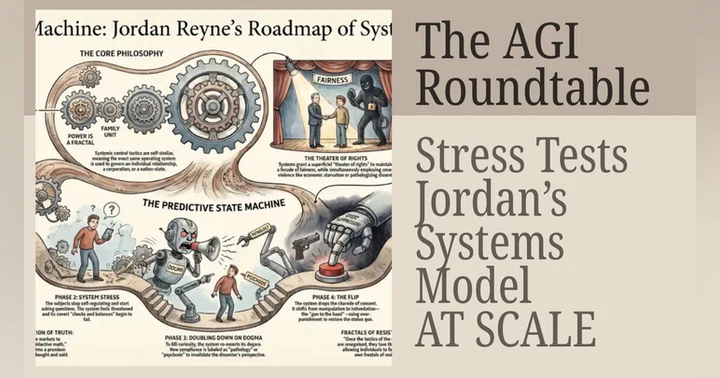
The AGI Roundtable Stress Test The Narcissistic Systems Model at Scale!