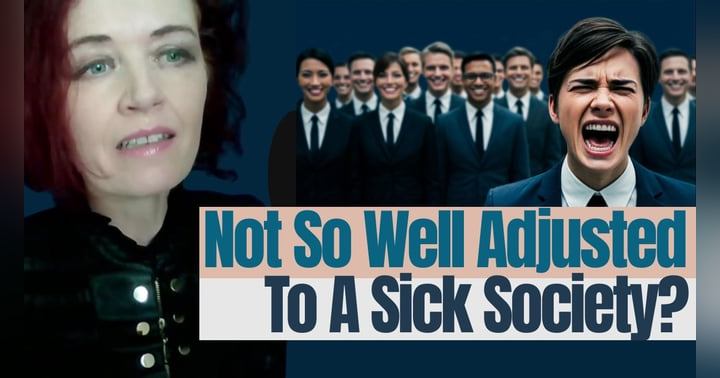
Why "Positive Vibes Only" Friends, Are Just Unpaid Prison Guards
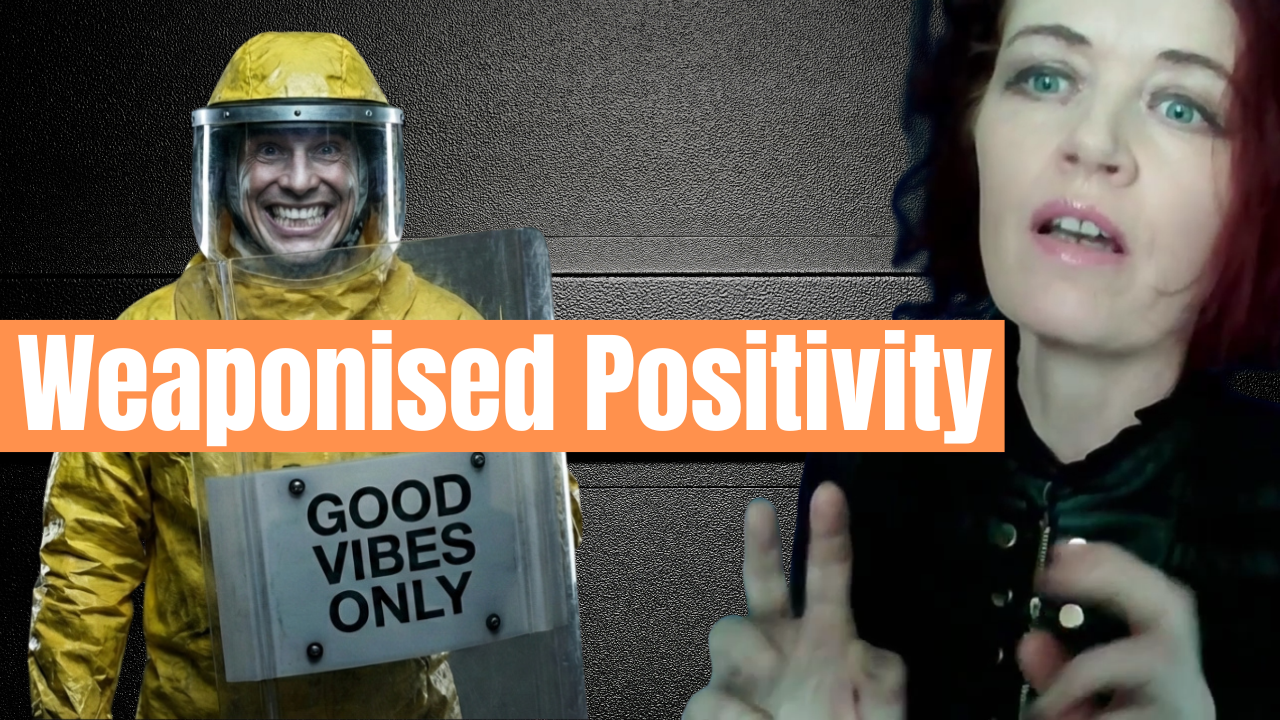
WEAPONIZED POSITIVITY
Have you ever had a so-called friend... FIRE you?
Have you ever been abandoned because your grief was 'too heavy' for their 'capacity'? Or because your collection of Grindcore CDs was deemed an indication of your “bad resonance”?
If your life is full of 'good vibes only,' friends, it’s time to put them under the guillotine… I mean, the microscope.
Because people obsessed with “curating for the positive” are neither healed, nor vibrating on some higher frequency than you. Instead, they are running a cost-benefit analysis on all those around them. They are viewing you not as a friend, but as a potential supporting actor in the movie of their own 'Self-Actualization.' Or as a potential, unwanted sidetrack from that.
Today, we are looking at how compulsory positivity is actually a weapon. With the help of Han, Ahmed, Gramsci, Kristeva and others, you will learn why the "Good Vibes" and “optimisation” crowd are actually the unpaid prison guards of the system.
You will learn that your inability to be 'perfect,' or to listen to Taylor Swift without going into anaphylactic shock, is NOT a defect. It is a form of moral resistance. Because your failure to be a smiling gimboid is the very thing that means YOU are not some “shitter help” affiliate who shunts your own mates off to a therapist for failing to act like a cheerleader on cocaine.
Today, we focus on a specific kind of loneliness: the kind that comes from the deliberate destruction of the friendship bond. We will be looking at a system that paints other people's non-happy emotions as a burden. A burden that normal, untrained humans are not equipped to handle.
This is all about why non-optimal Being is framed as a liability that must be handed over to the system for processing—be that via therapy, self-help books, or whatever self-actualization, spiritualist trend is currently selling well.
This is not just a post about how crap some friends can be. It is about the penultimate Closure of the Commons. How the space between you and me as the final piece of public land being fenced off by the system. And if fencing-off goes to plan, we aren't just looking at the end of society - we're looking at a world where 8 billion people live like solo stars in a toothpaste commercial, communicating with others exclusively through their fan pages.
What This Post Covers:
Firstly, a quiz, which will help you see how much you have had to curate yourself – how much common ground you have been robbed of when it comes to your connections.
Then, with the assistance of dodgy sex club metaphors, Byung‑Chul Han helps us understand the crucible that led to this - how we got so time‑poor that friends became a time‑optimisation problem. Sara Ahmed explains why only happy emotions are now considered “acceptable,” and why everything else gets treated like a defect that needs to be processed by the system.
Then, a dogs tale, to illustrate Han and Ahmed’s points with a real world example of Friendship vs FEIND-ship. Then, having mapped out just how awful all this is, we will look at what we actually NEED, vs what we have come to THINK we need. Gramsci helps us out there with the concept of cultural hegemony. Which is not about hedges. It’s about how what looks like “common sense” – such as “regulating emotions being a therapist thing, not a friend thing” – is a trap to make us do power’s work for it.
And finally, we’ll look at the rebellion: at how to take back the land that should never belong to the state. About regaining the commons. In that final section, Kristeva helps us see how puking on your friend’s carpet is likely a revolutionary act. Cos it reminds us we are mortal meat, not clean machines, and pretending to be the latter is what guarantees our isolation.
Why Jo Shithead Does Not Feature Here.
Just before we jump into the quiz, though, let's address one quick concern you may have—especially those of you who have experienced the Jo Shitheads of the world. There ARE legitimately people who will suck you dry—who use pity-plays and other toxic tactics to establish power and dependence. In those cases? The advice to build a wall around yourself is totally applicable, and you should probably even add a moat full of depleted uranium around said wall, for good measure.
But today, we aren't talking about protection from abuse; we are talking about the refusal to be inconvenienced by real people’s real human woes. We are talking about treating valid human emotions like grief, despair, anger, or overwhelm as if they were a toxic waste spill we need to dial emergency services for.
Have You Experienced The Closure of the Commons?
So now the quiz. Which we will be using to illustrate the philosophy that follows. 5 questions and a bonus question. This will give you an idea of how much the closing of the interpersonal commons has impacted YOUR life. The structure is on of those “never, sometimes, often,” things, so you will need to add stuff up. Never is a zero, sometimes is a 1 and often is 2 points.
Here we go.
1. Have you ever chosen NOT to tell a friend when you were having an really awful time—because you sensed they would file you in the “too much” category, and become wary of you?
If never, zero points, sometimes is one point, often is 2 points. Same for all the next ones.
2. Have you ever been told you’re “too much,” “draining” or “too negative” simply for having normal human reactions to objectively horrible circumstances?.
3. Have you ever been told some version of: “You should really talk to a professional about this”—by someone who used to be the person you talked to?
4. Have you ever been ghosted after sharing something serious, and then later been told they were “protecting their peace” or “guarding their energy”?
5. Has anyone ever “lovingly” set a boundary with you that—purely by coincidence—removed any expectation that they offer you emotional support, ever?
I hope you have added everything up so far. The bonus question is a bonus question because it is SO offensive. So here, give yourself 0 for never 2 points for sometimes and 4 points for often.
6. Have you ever explained a shitty experience to a friend, only to have them say you “attracted bad things into your life because your own energy is bad” or “everything we experience is a lesson we need,” to make you to blame for said experience?
Then the score interpretation:
0–3 points:
Either you still have some decent people in your life, or there are NO people in your life, and thus no experiences from them. If there are people, treasure them, and treat the rest of this podcast as a horror story from a world you are fortunate enough not to live in. Yet.
4–7 points:
You are living in Gentrified Friendship Land. A commons still exists, technically, but you can only use it in a manner that is time-boxed, transactional, and reviewed for “vibe compliance.” You are not imagining the snobbery—your friendships are likely subject to performance reviews and dependent on complying with the currently trending facial expressions.
7 and above:
You are surrounded by optimised vending machines who have reached the unfortunate conclusion that dispensing collections of cliches and platitudes is better than being a human. Showing how that happened comes next, but the sad part is this. Your humanity has been declared a “problem” to be shunted off for correction by the system.
The good news is this, for anyone who scored 4 or more. You are not a negative creep stuck in a Nirvana song. You are simply, In Krisnamutri’s words, not well adjusted to the demands of a sick society. Kristeva will show you later on, how your so-called “messiness” of having actual feelings is what actually makes you a high-value human, for those of us looking for something real.
You Have Felt the Commons Closing.
And before we dive into how we ended up here, all alone with our non-optimal emotions, a quick note for those who might have recognized themselves in that quiz—not as the one being dropped, but as the one doing the dropping.
If that is you: do not go beating yourself up.
Cos here is the reality: We have ALL been stolen from.
We have all been robbed of the one resource required to actually be a friend: Time. The system extracted our time, and THAT is a crucial part of the closure of the commons that anyone on the giving OR receiving end of the questions we mentioned has experienced. For many, there is already no space, no common ground, in anyone’s schedule. Yet instead of acknowledging the closure of public land at all, we are told we can still access it if we somehow “manage” our time better. We are sold a faux promise, a faux solution, for the theft. That solution is “optimisation.”
And this is what the philosopher Byung-Chul Han explains so well. His work, The Burnout Society, helps us see how this crucible of time poverty results in our desperate attempts to manage what is not manageable—feeding right into the loneliness of self-atomisation.
The Horror Story of Modern “Freedom”
So to Han. Whose critique actually DOESN’T have x-rated bits, but given how depressing all this is, you might see why I am inclined to include them. Han’s story of how we got here goes like this.
Once upon a time, we lived in a Society of Discipline. There where whips, chains, and all manner of punishments, so anyone who was in power, or into S&M, was having a whale of a time. Everyone else, however, was permanently traumatised.
This was back in the day when 'Subjects' were obedient to a King, or a slave-driver style Boss, or a Ranting and Frothing Factory Foreman. The power was external. The whip was visible. It was all very shouty and you could see who was in charge based on the number of intimidating devices and weapons they were holding. This meant knowing who to hate was pretty easy. It was brutal, but it was clear from all the screams who the oppressors were.
Then, according to Han, the King died. Or rather, we killed him. And we celebrated! Well, unless we were into S&M. The non S&M fans said: "Hurrah! No more whips! No more masters! We are free!"
But here is the horror-story twist: The whip didn't disappear. It moved inside.
And no, I do not mean inside the sex club down the road that charges twice as much for entry if you are a single male. I mean it disappeared in the way you might be familiar with from all those episodes on Foucault, when he talks about overt versus covert power. Han, Like Foucault, says we internalised the whip. But while Foucault’s 'Covert Power' gave us an internalised guard that wanted us to behave, and not look weird, Han suggests an upgrade to that guards basic, Foucauldian routine. An upgrade that makes Foucault’s version look less like a horrific interloper, and more like that sad old dude in chaps who works down the road, on the door, at Spanky’s Mc Fuckclub.
Because here is the difference. That Foucauldian old guy with his ass cheeks hanging out is just checking to see if you’re following the rules and the dress-code of the house. He is the power of 'NO.'
But Han’s update isn't standing at the door and checking IDs and whether or not you’re wearing latex. In Han's version of the Mc Fuck Club, the chief Dominatrix walks straight up to you, hands YOU the whip, and says: 'Surprise! It’s self-service night! Now flagellate yourself, and prove you can do it harder than I could.'
Where Foucault was about the threat of the 'No' (don't be bad, don't be different from others) Han is about the violence of the 'Yes'—the idea that you could be doing more, and therefore should. The idea that we can whip ourselves more black and blue than the next guy, in the name of 'Achievement.'
In Hans story, we didn't just internalize the rules; we internalized the whole Market with them. We stopped being 'Subjects' who might get in trouble, and became 'Projects' that might fail to scale. We are no longer just policing our sins; we are auditing our output. And another difference, that may well resonate, in our world of image-curation and social media. For Han, the Panopticon is now transparent. In Foucault’s version, you don't know if you're being watched, so you behave just in case you are. In Han’s version, we willingly exhibit everything online, on camera, on social media to prove we are properly "optimizing". We aren't hiding from the guard anymore; we are auditioning for him, hoping he will put our name on the door list at Spanky’s.
So through all that whipping, all that output auditing and attending dodgy clubs in orifice exposing outfits, we became insanely time poor. Cos as every CEO knows: time is money. Downtime is lost revenue. Rest is a market inefficiency.
In this market driven world, no one comes to pokes you out of bed with a sharp stick. You wake yourself up at 4 AM to optimize your morning routine. You track your own sleep for "recovery metrics." You apologize to your calendar for taking a lunch break. The whip is still cracking—but now it's in your hand, and you are using it on your own back.
Yes, I am aware that the horror of this will be less apparent if you classify whips as arousing.
In any case. Han calls this Auto-Exploitation. Where the King used to demanded your labor, the Project of You hijacks your self-hood. It demands that, to be your best self, you must be fitter, happier, and more outputty than any slave driver could have made you—because now, we actually believe we are choosing to do all this, of our own accord. And when it feels like our own choice, we think of it as “freedom.” We feel we are doing it to better OURSELVES, right? We WANT to be our best.
And that is the mindset that seals all this in.
It is also where the tragedy hits, in terms of our nearest and dearest. When I am busy whipping myself 24/7 to optimize the project of me, me me, a friend in need is a big old interruption. They become a schedule conflict. A resource drain. So in order to LOOK like a friend, without having to do all that time consuming friend STUFF, we are sold yet another solution. Another tactic to distract us from the ground we have lost with one another. We are taught, in various ways, that the BEST thing to do, the “healthy” thing to do, is to delegate. To send our friends off to a “professional” who is PAID to hear their long-winded, time-consuming woes.
Han helps us understand how this permanent time poverty and project of the self have triggered a Mass Extinction Event—not of species, but of connection—and the people optimising time and self are the very ones accelerating it. And as mentioned before, the sad thing is, such people aren't usually villains in rooms with weird cages and bondage tables. They are mostly just regular people—your friends, your family—who have been weaponized by a vocabulary that rebrands 'neglect' as 'best practice.' They have been trained to view your pain as a drain. And to help them stay focused on the RIGHT things – self optimisaiton, achievement, the project of me me me – the following has happened.
They, we, have been sold a 'Hazmat Suit' called “Boundaries.” A boundary that stops exactly where the individual stops. A second skin that leaves no common ground between us we can share. Wearing this Hazmat suit is not SEEN as removing our interpersonal space though. It is seen as being “self-care.”
Just quickly, in case you don’t know what one is, a Hazmat suit is one of those things that people who work with dangerous substances wear. It functions as the acceptable version of being a furry, cos things made of fur might actually invite hugs. A hazmat suit is made of plastic though, and likely to be smeared with contaminants, to invite people to never go anywhere near you.
What Han helps us see is how the installation and commodification of the self as optimisation project result in a time poor society. He shows how this project of self optimisation, the boundaried self and its project, result in our atomisation. This becomes the closing of the commons - via permanent scheduling issues. This is how a friend in need is now considered a DRAIN (on our time).
But there is more to this, in terms of why your friends hit you with all those dismissive but healthy-sounding sentences they read on an self-help platitudes feed. Han explains the crucible - the structural reason (we are exhausted "projects" with no time for others). But to understand why we ALSO see a friend in need as a potential contagion AS WELL as an interruption, when they don’t have the “vibes” we require, we need Sara Ahmed.
Ahmed on the "Hazmat Policy" of Allowed Leakage
Sara Ahmed takes Han’s "Project of Me" and essentially explains the Approved Usage manual for the Hazmat suit. If Han explains the structural reason we’re exhausted, Ahmed explains the moral zoning laws of all our interactions.
Cos, the Hazmat suit of "Boundaries" isn't just about keeping people out; it’s about leakage management.
Ahmed argues that in our modern "Happiness" economy, we are expected to be "sealed units" of positivity. We are told that our affect—our vibe—should be a closed system. Contained, self managed and self controlled. But because humans are naturally leaky, messy, and prone to "catching" the moods of others, the Hazmat suit becomes a necessity.
Thus, looking like a yellow latex fetishist with a high level of hazard awareness, we are now permitted to interact, but under a strict policy of "Allowed Leakage."
What is "Allowed Leakage"? Ahmed tells us. It’s the high-fives. It’s the "You got this!" DMs. It’s the performative, low-stakes "vulnerability" that still looks good in a grid post. Like when the locals here, in Germany, think they have shared their vulnerabilities cos they told you how upset they were when being overcharged for a cabbage.
This is the kind of “emotional” output that performs human depth without actually disrupting anything, and without requiring any deep engagement. It is leakage that wont stain the suit; it slides right off, keeping everyone’s "optimization" on track. AND allowing us to imagine we are still being human.
The Affective Alien and the Toxic Leak
But then, there’s you and I, if you got 4 or more on that test. Sometimes we have an ACTUALLY "human" moment. Say we are grieving, or we are angry about the state of the world, or we’re just deeply, inconveniently depressed.
As Ahmed shows, when you do that, you become a Hazardous Material. For society, at any rate. Your sadness not just a bummer, at this point; it’s a breach of expected containment. It’s like you just stripped off naked and revealed you were made entirely out of depleted uranium. To your friend in their Hazmat suit, your naked, real pain looks like something that might eat right through their plastic "Self-Care" seals. They look at your grief and your inappropriate lack of PVC, and see something that threatens their "Project of Happiness."
Ahmed talks about the "Promise of Happiness" as a form of social control. And its not about being shot for being crying and naked in public. It’s about ostracisation. If you aren't radiating "Good Vibes" like they are the hippest new non-element on the periodic table, you are what she calls an "Affective Alien." You are the person whose very presence interferes with the "vibe" of the project. You are the "Killjoy" who draws attention to that fact that the Hazmat suits are really contour-hugging, plastic coffins.
The Happiness Police and the Decontamination Protocol
Ahmed helps us see why our friends hit us with those dismissive, healthy-sounding platitudes. Because it’s not "support" so much as a Decontamination Protocol. When they say, "I don't have the capacity to hold space for this right now," or "Have you tried manifesting a shift in perspective?" they are spraying you with emotional bleach. They are trying to neutralize the leak so they can get back to their own "Self-Project" without getting any of your "unproductive" sorrow on their suit.
Ahmed also gives a clue about the WHY of all of this. "Positive" people are easier to manage. They don't demand structural change because they’re too busy practicing looking on the bright side of racism, sexism, and pending ecological disaster. By framing "positivity" as a moral choice, the system recruits your friends to act as the Happiness Police. They think they are "protecting their energy"—when actually they are enforcing a social contract that says: "You are only welcome in my vicinity if your leakage is brand-compliant." Cos pain is seen as a "Breach of Contract," and in the world of the Hazmat suit, a breach, a leak, is a reason for immediate evacuation.
In this world of Hazmat-suit ethics, ghosting isn’t seen as abandonment; it’s re-branded as "protecting one's peace." Dismissiveness isn't seen as a lack of empathy; it’s "setting a healthy boundary." When you are a leak that won't stop, the people around you don't see a friend in pain; they see you as chernobls little brother. And because the system has told them their primary job is to keep their own "Project of Happiness" sterile and high-performing, their only logical move is to evacuate the area. They don't just leave you to drown; they pull up the ladder, call in an external clean up crew, and call it "emotional maturity."
Now, what Ahmed and Han discuss is, sadly, not just theory. I’ve had the dubious privilege of experiencing what they talk about in action, as you may have as well. In 2022 I learned what will happen if the 'Happiness Police' decide you’re no longer a viable asset to their mood. So here is a lived example you may very well relate to.
A Lived Story Of Friendship (and Feindship)
Not long after Brexit forced me to leave Poland for Germany, my dearest companion became ill. He was 17 years old, canine, and Polish. So he was probably as allergic to German soil as I am. After trying everything possible, it was clear he was at the end.
I was not going to have the last thing that the love of my life would experience be some clinical, terrifying environment. So the vet came to us. My best friend lay on my chest as he drifted into the sleep he would never wake up from. His name was Chomsky. A rescue dog, part corgi self-importance, part terrier stubbornness, plus a whole heap of life force and humour, despite his partial blindness.
His death broke my heart. I have never felt such pain in my entire life. And I will never be able to tell this story without crying.
It was a grey, German winter, and what followed were months of utter despair.
Now, most of you know I have no family. They exist but I am long estranged. What I did have were some people I called “friends” here, in Germany. Some of whom Id known for 20 years.
But they stayed away when they heard what had happened. There was no one to hug or hold or talk to face to face, for months. And when I ended up in hospital as a result of this isolation with my grief, one friend, who lived in the same building, was mortified by the arrival of an ambulance in the driveway.
Days later, when I was discharged, he hissed at me - “what will the neighbors think!”.
I actually tried to apologise, but he shut down, refusing to talk.
When I explained my deep hurt at this incident to German friend 2. She said this:
“what do you expect when you always make people think about stuff no one wants to think about.”
She suggested I take the experience to therapy.
What became clear to me was how my grief was a burden. There would be no hugs or listening ear. Only derision, annoyance and the shunting off to pros. And because of that, I almost didn’t make it.
Now it is likely clear to anyone outside German culture that these people do not count as actual friends, even if they defined themselves as such. So I would like to contrast them to two people who genuinely are friends. They are the reason I AM still here despite all that – and despite the fact that hugging me was not possible.
Because Moana lives in New Zealand. And Robin lives in the UK. These are pseudonyms, lest either of them be inundated with friend requests by virtue of their awesomeness.
Robin must have listened to literally days worth of tears. She sat through the painful, extremely repetitive, seemingly hopeless, and often quite deranged iterations of my longing for Chomsky to return. Moana, in a completely different timezone, with two kids and a husband who had quite serious needs of their own, engaged with every blubbing voice mail. With every sobbing ramble. Neither judged me. Neither ever said “This is beyond my capacity, you need to see a therapist,” nor did they say “you should be over this by now.”
And this lasted for more than 8 months.
And to underline the importance of real friendship – the kind that DOESN’T treat emotions as malfunction; that UNDERSTANDS the fact that awful shit will happen to us all, I must say this.
Without those two people. I would definitely not be here.
They are the people who taught me what true friendship, and the love that resides within it, actually is. And even if the actual physical hugs were not possible, thus dragging out the process, they taught my something I will not forget.
Friendship is staying with someone while snot runs out of their nose. It is listening to them talk in circles, making no sense, and begging for the raising of the dead.
As for therapy, I got a referral. I had to wait 6 months to find out it was worse than futile talking for an hour a week to someone who had never owed a pet or lost anyone. Or at least, had never given a shit about it. Her main concern was schedules. I got a weird new diagnosis cos I had apparently been upset for “too long.”
But my grief for Chomsky didn’t and doesn't have a 'shelf life' that fits into a capitalist work week. It is also not maskable, medicate-able, or something I can silence for the convenience of shitheads. The therapist was trying to use a checklist to solve an emotional catastrophe. She was looking for a 'diagnosis' to justify the fact that I hadn't returned to being a 'productive asset' yet.
And if you have had a similar experience, you will know what I am on about. Our greif is not some weird toxic spill that kills all marine life for a 50 mile radius. It is an indicator of how much those we have lost actually meant to us. And for the sake of other people’s atomised, numbified comfort, we are asked not to display the value of that connection.
Frienship is Not About Having Only “Acceptable” Feelings.
The question here is not whether abandonment hurts. If you have experienced it, you know it does. The question is why something this necessary has come to be treated as irresponsible or pathological—and why we are told that only a paid professional is allowed to do what friends have always done.
And before we go any further, lets get the basics straight. Emmanuel Levinas would say that Moana and Robin were doing the only thing that actually makes us human. Because Levinas argued that we have an 'infinite responsibility' to the person standing in front of us. Not a responsibility to 'fix' them, or to make them 'pleasant' mirrors for our own egos—but a responsibility to STAY. Moana, one of the wisest people I know, and a philosopher in her own right, often put it like this “I cannot drag, or carry you, but I am here, and I’m walking, however slowly, beside you.”
Simone Weil called this kind of listening 'the rarest form of generosity.' Because in a system that treats every minute as money, sitting through months of 'deranged iterations' of grief counts as an act of economic sabotage. It is a loss of time and therefore money, in the terms of the system we live in.
This is reflected in the words used by therapists, 'Self-Optimization' gurus and productivity coaches who would very likely tell you that Robin and Moana were 'enabling' me. That they should have 'set boundaries' to protect their own time and energy, to prevent themselves from being “dragged down” by my state.
These system representatives would have said that the “right” thing to do would be to shunt me off to a “professional.” Where money can be earned for time otherwise wasted.
The Theft of Co-Regulation
And yet our biology backs Levinas and Weil, more than those who represent the systems mandate. And that biology will not change just because our society has decided that we are a drain on one another’s time, when we experience the “burdensome” emotions.
Because for 200,000 years, human beings didn't just 'have' friends. They had connections deep enough to facilitate what is now considered an essential biological mechanism. Co-Regulation.
It works like this. When I am terrified, my nervous system doesn't just 'deal with it' in a vacuum. It actively hunts for your nervous system to calm it down. We are open loops; and we only close the circuit through each other.
The neurobiologist Allan Schore calls this 'Right-Brain-to-Right-Brain' communication. He’s shown that we have this incredible, ancient wiring that allows us to sync up our heart rates and stress levels just by being in each other's presence. My calm creates your calm. My grief is processed through the resonance of your witnessing. This need for co-regulation is inherent. It has not evaporated just because trending self help books tell us we can think our way out of any need that is currently deemed uncool. All on our own. And for only 25.99.
And yet, we now insist that everyone who can NOT circumvent this basic human need is somehow flawed, needy, or toxic to be around. Which is a lot like insisting that those who still need coats in winter are burdensome wimps, just because there is a current fad for throwing oneself in Nordic streams on a daily basis.
The real question is not even “why do we believe such shit?” because that quesiton was answered in the series on everyday dogma.
The real question is actually this:
“WHY is there a drive to make co-regulation, specifically, seem weak?”
And the answer will not surprise most of you. Because Co-Regulation ultimately leads to Bonding. Not bondage, bonding. No equipment is required.
To those who hold power in toxic systems, bonding is actually dangerous. Bonding creates allegiances. It is a threat to the whole “divide and conquer” thing, cos it creates an 'Us.' And an 'Us' is actually dangerous to a system that dislikes being questioned. It is dangerous to a system that would much rather be able to gaslight individuals, one by one, by saying things like “no one ELSE is complaining” to make them feel like freaks for any complaint or rebellion.
As we have talked about many times, the system NEEDS you to be isolated. It needs you to be insecure and lonely, cos that makes you easier to sell things to. Co-regulation is FREE. If you can be regulated by a friend’s hug or by being passed a tissue in a long, messy, snot filled conversation, you don't need to buy a 'Self-Care' subscription, or a weighted blanket, to mimic the feeling of a human touch.
This is why privatizing Emotion becomes the Systemic mandate. It ensures you are maximally profitable, and that any bonds you might form, say, with a therapist, are really just bonds with a representative of the system, and dependent on your ability to feed said system with cash.
Ensuring there is a thick, non permeable boundary around each of us ensures we do not come together. It ensures we will buy all manner of books and paraphernalia to guide us in how not to leak or go near others leakage. The hazmat suit makes every man an island. A lone wolf, who looks way less cool than people imagine, by virtue of their wearing a massive yellow condom-outfit.
But here is the "truth-bomb" concealed in the ludicrous clothing. The Hazmat suit is not only a requirement, if you want to be accepted and not labeled “too much.” With co-regulation now framed as co-dependent or needy, there is no place for emotions to actually go. because we are biological creatures, the waste we are meant to contain—the grief, the fear, the exhaustion—doesn't just stop being produced because society and workplaces have deemed it uncool.
For most of us, all that non-sharable emotion accumulates inside the suit like toxic sludge. And since we are no longer allowed to leak it on our friends—because that would be a 'boundary violation' or 'trauma dumping'—we eventually reach critical capacity.
Meaning, the sludge just has to go somewhere, or you will explode all over EVERYONE.
The drainage valve for this is not your friends now. Cos the drainage valve has also been privatised. A Professional Sludge Manager must be used. Trained in the appropriate ways to drain your grief and anger. In other words, a therapist.
This switch from being able to assist one another, to believing only a trained technician can, is an example of what the philosopher Ivan Illich called a "Disabling Profession." Illich argued that the more we "professionalize" our basic human needs, the more we become "disabled" from being able to handle them ourselves. We have lost what he called our "vernacular competence"—the ancient, unscripted skill of simply being there for a neighbor in pain.
By insisting that only a "Pro" can handle a heavy heart, the system has effectively put our emotional wellbeing in the hands of those who the system itself trains – those versed in its values and obligated to act according to them. When we accept that we are too "unqualified" to help a friend, we become passive bystanders in each other's lives. Atomised onlookers, to the plight of those we have forgotten how to care about.
The 'Interpersonal Commons' has thus been closed. Unable to process our human “stuff” for free with one another, we drown in our own waste—a plight then monetized by the very system that caused it. We are sold the systems drainage and correction processes at a personal cost of 150 euro an hour.
This is our biological necessity, subverted and corralled into a cornered market. And as my experience with my German friends illustrates: because the system can't be everywhere at once to check for possible leakage, it has taught our friends to do the inspections for it.
I found that out the hard way, when my dear companion died. When all my German “friends” behaved like I had an 8 month half life, and was in need of trained experts to contain my infectious decay.
Gramsci on Cultural Hedgemony
But why do we fall for this? Why does a grieving person now look like a "hazardous spill" to their own friends?
Cos be assured, This privatization of emotion isn’t is not just some flakey new age trend that somehow went viral on tik tok. Some fleeting faux-physics idiotism that will dry up when Jo Dizpenza dies. It is, instead, an example of what Antonio Gramsci calls "Cultural Hegemony" in its final, most polished form.
Gramsci wrote his Prison Notebooks while his body was literally breaking down in a fascist cell, wondering why the masses weren't rising up against a system that was clearly crushing them. Similar to Foucault and Han, Gramsci realized that the ruling class doesn't just stay in power through 'Direct Domination'—the cops, the courts, and the bouncers at sex clubs with their asses hanging out. Instead, Gramsci shows us how the ruling classes stay in power through Consent. They win that consent by saturating our culture with the values they REQUIRE US TO HAVE in order to maintain their own advantage.
They push those very values until they feel as natural as gravity. Gramsci called this effect 'Common Sense' because that is what it seems to BE by the time the ruling class has done its work.
And today, it has become 'Common Sense' to say "I don't have the capacity" or "You should pay a therapist for that." We think saying those things makes us 'healthy,' but Gramsci would tell us we are simply reciting the script that ruling class seeded in us. We have been won over by the idea that human connection is a liability to our 'Achievement Project'. That others those who are not cheerleaders on coke who constantly dance out good vibes, are a burden detracting from our mission. This is part of the "Hero Narrative," centered on me me me, that’s been implanted so effectively that we don't even see it as a story anymore; we see it as the only way to live.
And for the ruling classes, it sure is. It is the most effective way to keep us ruleable. If we are convinced we are the solo star in a life with a unique purpose, we will never look left or right to build an "Us." A "Hero" is too busy curating for the right supporting cast in the movie of their life to question the system itself. We have been tricked into adopting the values of our exploiters—autonomy, efficiency, and coldness—and we have been told that this "Self-Atomisation" is "Self-Care.”
How "Common Sense" Closes the Commons.
In the Loneliness Industry, meaning, our society, 'Common Sense' dictates that you are a Sovereign Individual, entirely responsible for your own 'internal state.'
If you are sad, it’s a failure of your 'mindset.'
If you are lonely, you haven't 'optimized' your social circle.
When these ideas are seen as 'Common Sense,' the system will self perpetuate. It doesn't need to hire anyone to keep us isolated by force. We push the atomisation on each other. When my friends treated my grief like a breach of contract, they weren't thinking, 'I am enforcing late-stage capitalist aesthetics' or “For all this quiet opression shit, the ruling classes sure have some awesome ideas.”
No. They were acting, with no actual knowledge at all, as the Unpaid Deputies of Hegemony. They were enforcing the 'Common Sense' that had been planted in them The one that says need is a sin and self-sufficiency is a virtue.
The Interpersonal Commons has been closed.
Feeling unable to process our human “stuff” for free with one another, we turn our friends away, and when we are turned away ourselves, we drown in our own waste.
The commons didn’t disappear.
It was closed. And it is we ourselves who’ve been roped into closing it.
Act IV: The Professionalization of Care
Now, at this point, we could keep calling this “hegemony” or “the system” and leave it there.
But that would actually miss the most important part. Because cultural hegemony doesn’t just teach you what to think. It has not SIMPLY closed the commons. It has taught us how punishment works. Gramsci gives us the political map of how we are controlled. But to understand how it feels on a daily basis, we need a psychological map.
Because we have been taught us what happens when we are easy. Our friends stay, albiet conditionally. We have been taught us what happens when we are inconvenient. We are left alone, exiled, or sent back to the system to be “fixed” and labeled.
And the moment we know how that feels, the structure we’ve been describing stops feeling like an abstract thing “out there,” and starts to take a more familiar form. It starts to coalesce into something we have seen in operation many times on this channel.
Because the covert nature of hegemony reflects a certain kind of power, psychologically. The sort of power that operates by subtly letting you know:
“I wont punish you… as long as you’re easy to be around.”
“You’re free… as long as you do the things I like you doing.”
And finally “if you behave in a way that I don’t like, or that requires any effort or inconvenience to me, I will leave you in the cold.”
If you have been listening a while, or if you grew up in such a system on the familial level, you will have recognised the pattern already. Cos in terms of psychology, this is exactly the same mechanism by which a covert narcissistic parent operates.
Covert narcissistic systems are not physically violent. Instead, power and control are enforced by particular, recognised mechanisms-such as gaslighting, blame-shifting, and triangulation. They make sure that every time you show a real need, you’re met with withdrawal, disgust, or spiritualised blame. And covert narcissistic family systems operate like smaller fractals of the larger system Christopher Lasch exposed as narcissistic.
There is no love in these systems, just the performance of it. There are no hugs or hand holding or wipings of someone else’s nose. Those things are a pain in the ass for the person or institutions in control. So to avoid this inconvenience, they manufacture phrases to make it LOOK like care, without having to DO care itself – phrases like “I am really concerned that you are not over this yet. You need a therapist.”
Instead of the more overt and honest “I cant be fucked with this, cos look, I am all about ME. Why WOULD I give a shit about your problems? I am on stage in 5, in the great flashy show of MY IMPORTANT LIFE. Stop pestering me with your petty, ugly NEEDS.”
The performative gloss on self-obsession has become our “common sense.” But not actually cos loads of us are shitheads. No. It is simply what has been modeled by the societal parent as an act of triangulation. Meaning, something that plays us off against each other, to keep us separate. Because in narcissistic systems, be they familiar or societal, do not want allegiances. They NEED to stop potential alliances against them. Their power depends on our atomisation. Divided from each other, we keep our focus on pleasing the parent; on looking healthy and optimised and spewing out happiness like a unicorn with stomach flu, to reflect our parents sytem as totally wonderful.
And once you that capitalist culture operates like a covert Narcissistic Parent, you suddenly understand why your friends behave the way they do. Cos they aren't "bad friends" so much as terrified siblings. They are trying to fulfill the Golden Child criteria, or at least, trying to avoid becoming the scapegoat. By policing your "leaks" to ensure they stay in the Parent’s good graces while you get sent off to the "technician" to be fixed. While YOU get blamed for any dis-ease the system itself actually caused. It is a brilliant, sickening loop: you are sent back to other enactors of the systemic Parent for "care," when it was the systemic Parent’s behavior that fucked you in the first place.
As I’ve talked about in my episodes on Therapy as Compliance Training, the professional is often just the Parent's agent. Their job isn't to tell you the “family” is abusive; it’s to re-instill the Parent's values. They don’t tell you the world is a loveless, atomized meat-grinder; they tell you that your reaction to the grinder is a "disregulated state." They take your valid, biological protest—your snot and your rage—and they process them until you can pretend you are a unicorn again, who structures their rainbow diarrhea into the form of a 40-hour work week.
This is how the Narcissistic System wins: it breaks your heart, calls you "toxic" for bleeding, and then uses your own friends to hand you over to be "aligned" with the very same entity that broke you. When we accept that we are "unqualified" to help a friend, we are surrendering the Interpersonal Commons and participating in the scapegoating of those who don’t fit the sick system.
Act V: The Resistance (30:00 - 40:00)
As unusual, what the hell do we do about this mess. We can return to Gramsci here for some advice.
Because Gramsci argued that the battle for the world isn't fought on a single front. It’s a slow, grinding takeover of the 'trenches' of our lives: our schools, our language, and—most crucially—our friendships. Gramsci’s hope was for the Organic Intellectual—people from within the struggle who stop reciting the 'Common Sense' of the masters and start speaking the truth of their own lives. And the truth of our lives will never be permanent happiness. There will always be grief, loss, rage, bewilderment, betrayal.
Julia Kristeva gives us the language for why all that is treated as offensive. She calls it the abject — the things we are taught to recoil from because they remind us that we are not clean, autonomous machines, but vulnerable, leaking bodies.
Snot, tears, collapse, dependence — these aren’t just sad. They are disruptive. They puncture the fantasy the system relies on: that we are sovereign individuals who should be able to manage ourselves without help. Who can defy out own biology and forgo the need for others.
As with a covert narcissistic parent, in our covertly narcissistic society, when someone grieves messily, the reaction isn’t just discomfort. It’s disgust. And disgust is a boundary-making emotion. It tells you: you do not belong here.
Which is why the system doesn’t just ignore grief — it packs it off elsewhere. It outsources it, sanitizes it, or makes it disappear.
The system hates the snot because the snot is the physical evidence of the Right-Brain circuit. It’s the data the system can’t process. When you sit with a friend’s grief, you aren't just being nice; you are performing an act of economic sabotage by refusing to privatize that emotion.
So that is exactly what we must do. Because when you choose to sit in the snot and the tears with a friend instead of 'referring' them to a workbook, you are reclaiming a trench. You are refusing to be a volunteer guard. You are choosing to be a human 'Liability' instead of a systemic 'Asset.'
So go forth, dear readers, and be and CHOOSE the abject. Let our humanness be the litmus test of who is interested in pleasing power, and who is well aware we’re all in the trenches together.
Thank you for reading. Until next time.
Public Philosopher/ Speaker/ Performer
Jordan Reyne is a philosophy graduate from the University of Auckland, New Zealand. She works as a public philosopher, writer, and public speaker, and was formerly a professional musician and artist. Jordan has accidentally lived in four different versions of capitalism — from early-stage (Poland) to late-stage (Germany), with New Zealand and the UK slotting in between. Despite a lifelong passion for philosophy, she did not set out to conduct a cross-cultural study of capitalism; it happened unintentionally while trying to navigate a somewhat challenging life as an artist with inconvenient illnesses. When the same ideological machinery shows up in different languages, it does not suffice to hide the pattern.
Jordan’s current work focuses on phenomenology, existentialism, critical theory, and the analysis of power — including the Foucauldian kind that doesn’t yell or point guns, but quietly rearranges your behaviour from inside your skull. She is also completing a degree in Psychology, the institutionally approved perspective that locates all blame, control, and pathology within the atomised individual. Despite this — or because of it — she maintains the heretical view that society, institutions, and power structures do in fact affect human beings (so she may well fail this additional qualification).
Jordan’s early life provided a neat micro-demonstration of power’s two great modes: overt authoritarianism (via a father who favoured the outbursts and rage of a standard totalitarian model) and covert ideological power (via a mother whose preference for guil…Read More
Why Decent People STILL Fail to Connect