Why Decent People STILL Fail to Connect
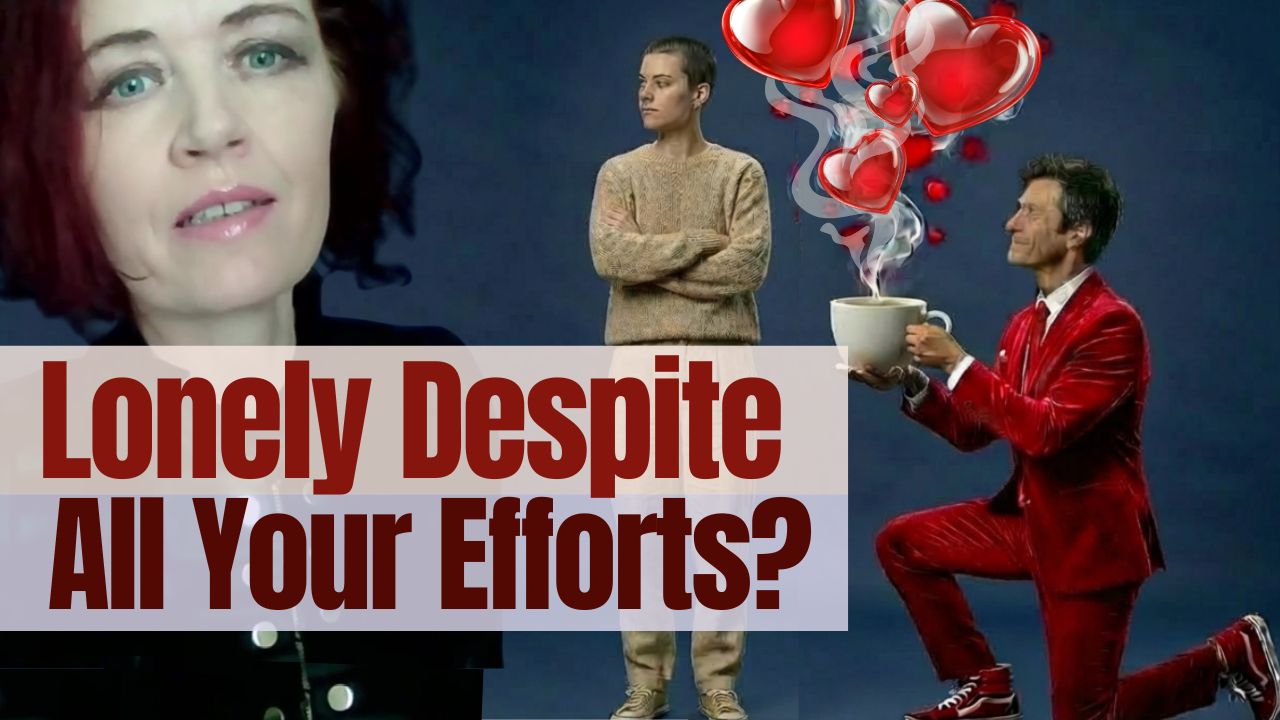
Do you ever wonder why it seems so hard to connect?
Do you repeatedly make the effort, only to be ignored, brushed off, or treated like the very act of wanting connection makes you strange?
Why is this so common? And so painful?
Today, with the help of Žižek, Butler, and you—yes, you, dear reader—we’re going to look at why it’s so hard for decent people to connect, and why it is not about you doing anything wrong.
It’s about how Western cultural values create a click-and-collect mentality—where connection is treated like IKEA furniture. You do everything ‘correctly,’ and you still end up sitting alone on the floor, missing half the screws, wondering why the relationship wobbles whenever you breathe near it.
Once you see how this works, you’ll be armed with insights that help you skip certain instructions that can only ever lead to collapse. This is all about how to recognize what makes connection breathe, and what the system does to shut that down.
The Question Of Connection
Today’s issue of why no one seems to want to connect was requested by the community on YouTube, and its a great question. Often, when we look for the “why” behind it, we are hit with the solutions society and markets always hits us with; put yourself under the microscope, and analyze every detail of your interactions, every sentence, every move, to find out what YOU did wrong.
Because in an individualistic society, the individual is assumed to be all powerful- meaning, when they don’t get what they want, THEY must have failed to do the correct actions to ensure the desired outcome. Others, the environment and the system are deemed to have no effect whatsoever.
And despite how empowering and profitable the myth of all-powerfullness might SEEM, the result is this. When you, like an estimated 16-33% percent of the population, feel like you are interacting with semi-irritated robots, you will be told that MORE control - more self monitoring, More curating of an image, More suppression of emotions in exchange for rational performance - is the key to bonding with others. You will be told that, in order to form relationships, you should micro manage every gesture, every word, every glance, even the performance of our gender, until you too are the perfect vending machine of societally prescribed behaviors.
Today Žižek, Butler and others will contribute to our understanding of why exactly THAT faux solution perpetuates our disconnection. That perfecting the act of doing and saying all the right things means you are so very NOT yourself that it prevents connecting at all. Because here is the not actually paradoxical thing. When we manage to do well at following societal and self help suggestions, the result is NOT is promised. In doing what is expected of us, and marketed TO us, we actually become more CRAP at relating.
The aforementioned philosophers and others will also help us see that a smear campaign is being applied to emotional depth, healthy connection and love. We are being told that the spark we are looking for is dangerous, or a product of your childhood wounds. That healthy people seek functional, predictable, pleasantly everyday exchanges, and that THAT is a nourishing connection.
Central to this is what Žižek calls “decaffeinated love”. Love without the risk that actually comes in deep relating. We look at the system behind this messaging, and how it benefits and profits from pushing a no-spark, safe version of love and connection. Finally, we reveal how our society has pulled a show-stopping stunt to ensure we actually FEAR real connection. Jo Shithead plays the leading role in that circus, increasing the revenue, and the deep-seated contradictions of all those pushing the “fuck the spark” idea.
But before we go anywhere near Joe’s depressing stunts, my focus is on YOU, because first and foremost, this is about why DECENT people fail to connect. Why OK human beings STILL can’t even make it work with each other. And how to fix that.
Introducing Two Decent Human Beings.
I am going to start by introducing two decent human beings. Characters you may well relate to.
Our first character, Charlie, represents what Žižek is going to talk about in terms of the search for connection without risk. The second, Alex, represents those whose insistence on depth mean they are prepared to take a risk to get real connection.
Alex is what Žižek might call a caffeine seeker, and what relationship content calls someone who insists on the “spark.”
Through the course of this, I will be interested to see which character you guys relate to most, and what your main frustrations are in these positions.
First, our decaf love seeker “Charlie”.
Now you may BE a charlie, but even if you aren't you will have met one. Charlie is almost always polite and accommodating, cos she/he/they believe that, in order to connect you must behave in a specific, inobtrusive, frictionless way.
For Charlie, being a good person and good partner means not causing tension or stress. It means being polite and even-tempered, with no extremes of emotions. Essentially, the living embodiment of that Radiohead song from the nineties “no alarms and no surprises, please.” As opposed to what Nine Inch Nails sung about in “Closer,” which is, for Charlie, way too dramatic and full of f-bombs.
Charlie is looking for the mirror image of this non-threatening radiohead-esque predictability. Not because Charlie is a killjoy, but because they don’t want any “fuck you like an animal” type “drama.” I mean, they probably DO want that, but they have associated it with “potential instability,” and thus not actually worth it.
Charlie sees any ruptures in politeness as portending doom, and wants, more than anything, to be able to carry on living their life as it is and was, without changing anything. Including their opinions about Nine Inch Nails, which is one of the few opinions they WILL voice, because talking about music is a safe topic.
Charlie is looking for a relationship is quiet, efficient, and assured not to place too many demands on them. So, a relationship that functions like a well-maintained appliance, but that still helps them feel less lonely.
How much of this can you relate to so far? Or, what annoys you? Even if you aren’t so enamored with Charlie, you will likely see that they are essentially a “good student” when it comes to doing what everyone says is “the right thing” when seeking “healthy love.”
Žižek on Decaf Love
Enter Slavoj Žižek, who totally disagrees. The 'Radiohead-style' existence Charlie is aiming for—no alarms, no surprises—is exactly what Žižek calls the 'Decaf' reality of late-stage capitalism. Žižek points out that our culture is obsessed with products that have been stripped of their 'dangerous' core: beer without alcohol, cream without fat, cigarettes without tar, and ultimately, Love without the Fall.
For Žižek, this happens because we are living under a command to 'Enjoy!'—but to do it safely. To have the experience of connection without the risk of being shattered or changed by another person.
But lets consider that a minute. Why would love with risk, with “caffeine,” with the spark, change or shatter us?….
Hands up if you are thinking
“Well, UNHEALTHY love CAN change and shatter us!”
And I hear you. Because that IS exactly the messaging we are all getting – BECAUSE of Jo Shithead, as it happens, but he has not earned air time yet, due to my de-prioritising assholes, so his contribution to all this comes later on.
Back to NON assholes.
We have gotten the message loud and clear that “healthy” love is this no-risk, safe, predictable thing. When we think “love is not healthy if it shatters us” that actually proves Žižek's point. We have bought into and internalized the idea that upheaval is bad, or will at least END badly. That upheaval, madness, limerance, complete change in behavior and thoughts that love can induce has been PATHOLOGIZED.
Insert the usual Foucauldian note - when a society wants to push a value to us, it will pathologise that values opposite. Classically, with independence as one of capitlism's core values, we pathologise reliance on others as neediness or CO-dependence.
The same thing is going on here. Philosophers like Alain Badiou argue that love actually isn’t a ‘pleasant everyday exchange’ or a lifestyle choice; it’s a Rupture. It is a violent break from the ‘One’ into the ‘Two,’ ripping the subject out of their 'Individualist Independence.' Judith Butler takes this further, suggesting that love is a form of 'dispossession.' For Butler, to love is to be 'undone' by another; it is a confession that we are not self-contained or in total control. For both thinkers, this creates a moment of sacrilege in a 'Me First' culture because it forces us to acknowledge our fundamental vulnerability and to see the world, quite literally, through the existence of someone else.
From our temporal and cultural location, that can sound very scary! It sounds risky as hell, and like “losing your self.” Because the self, in a culture of me me me, is the most important thing, and the most IMPERMEABLE thing.
Judith Butler and Dona Haraway alike point out that this 'impermeable self' we are so afraid of losing is PART of the societal myth—the 'Liberal Humanist Subject'. And yet, because we so fear losing it, and the self concept we attach to it, the following has happened.
We are so seriously NOT enamored with being truly enamored, that we take part in ye olde Foucauldian trick. The kind of “Love” long written about in poetry and novels, gets pathologising words attached to it. Words like attachment, limerance, or just “insane behavior.” Love as we once knew it has been marked out very clearly as threatening, dangerous and even WEIRD, BECAUSE it would requite permeability, or rupture. Meaning a potential “change” of our self concept.
Lets recall the hero narrative we ‘ve talked about so much. That story of me as the central character in “My journey” where everyone else becomes a prop or tool or meaningless extra. There is no space in that story for the hero to to be distracted by another's goal, or for the hero to suddenly have two missions, theirs and someone elses. The hero is independent. A lone wolf. They do not WANT to alter their personal mission.
Charlies have, via societal messaging, usually bought RIGHT into the ideal of independence, the idea of being impermeable… and vocalists who sing with about as much passion as someone mopping the floor. They have bought into self-sufficiency as a virtue, and big feelings are a threat to that. So it makes perfect sense for such people NOT to want to rupture anything. Be that their spleen or their … culturally induced worldview.
Non Charlies
Now, neither Žižek or I think that everyone is a Charlie. Some insist on caffeine from the start. So here comes the second character portrait. Again, from the pool of decent people. We are still on why good enough human beings cant connect, and Jo Shithead is still back stage.
Meet Alex
Alex is our NON Žižekian character. Alex assumes that 'No Alarms and No Surprises,' is for geriatric patients with heart conditions. Alex him, her, their, self has no issue with risk. OK, they don’t LIKE it, but they know connecting deeply always IS a risk, so its just a necessary element. For Alex, connection isn't a 'pleasant addition' to life; it’s the indispensable point of it. Sharing inner worlds isn't a 'deep dive' you do on the third month of dating—it's the baseline.
Alex asks what Charlie might call 'uncomfortable' questions—not to be difficult, but because Alexes are allergic to conversations about weather, shopping and whether or not we should get beige light fittings to match the carpet or white ones to match the blankness of our stares. Alex wants depth. They want to be moved, and they want to move you. Alex isn't afraid of being alone so much as of being 'alone-together'—of sitting across from someone and realizing that they are a Radiohead fan, and the 'Real' has been replaced by a script.
Alex insists on the Caffeine. Alex does not think 'Being Low Maintenance' is some sort of ideal, cos Alex knows their needs, and expects others to have them as well.
Whilst Alex might sound braver to some, others might see them as too much. Why? Cos society pushes love without risk as the only “healthy” kind of love. This means those who SEEK the caffeine, the spark, the depth, must be made to look weird and potentially deranged. As per Foucault’s recipie for how to ensure people align themselves with societal values.
So Alex gets the 'too much' label, or even “intense” or 'exhausting' to be around.
This is already where some societal imperative and tactics start to show through. And as a tiny little spoiler, Jo Shithead is pivotal in how the Alexes of the world get pathologised, but that is later on, as I said. I am still de-prioritising wankers at this point.
And before we delve deeper into the philosophy of this, lets see how it looks in the wild. How this search for decaf love, vs those seeking caffeine, makes it seriously hard for good people to connect.
Lived Story
Now this is actual field data — because it just so happens I am very much an Alex. And in my time living in Germany, I have met a metric fuck-tonne of Charlies, though they mostly were called Sven.
And although I am in Germany, where everyone’s favorite hobby is pairing any behavior or action or character to one specific gender: I can assure you that not all Alexes are non-binary. Also, not all Charlies are men. The names are non-gendered for a reason.
A heads up too: there are no villains in this story. Which makes it fairly boring. And yet, if Jo Shithead had been involved, it would have been less interesting — because I’d have vanished into cognitive dissonance, binge-watching Dr Ramani and changing all the locks on my door.
The question of why we can’t relate to crap people is not difficult. Because they’re crap. So back to two styles of decent human beings who still can’t make it work.
My Charlies were pleasant, correct, and unfailingly polite. But as an Alex, trying to connect with them felt less like a meeting of minds and more like being roped into working on a spreadsheet with a high-functioning, language-of-oppression-speaking calculator.
Oh, you mentioned a feeling? Please wait while I select the appropriate beige response from my pre-programmed list of healthy-sounding dead ends.
If I asked an open question, I got predictable, preset replies. If I asked anything personal or philosophical, I got a full system bluescreen.
One date in particular makes this clear. It was summer. We went to an outdoor restaurant by a river so I could take Žižek along. No — not a third-party observing theorist. Žižek is my dog.
Charlie was perfectly polite. Perfectly benign. But conversation was hard. He didn’t ask questions, and when I asked what he thought about things, I got short answers that killed the line of discussion.
At some point I did what any Alex will do: I moved beyond the usual German scripts — which mostly involve how much things cost, or what rules you might be breaking. I didn’t ask about beer prices or the only legal way to consume sauerkraut. I asked about him. Several times.
In his superhuman effort not to say the wrong thing, the bluescreen returned for a second — before he re-calibrated and turned my question into a way to talk about his work. To filing procedures and what his COLLEAGUES were like.
After two more identical dates, I called it. He was genuinely shocked. His first question was:
“What did I do wrong?”
And that’s the big reveal about the Charlies of the world: the tragic belief that if you follow the procedure perfectly, genuine connection will appear. My heart actually went out to him. He’d executed all the correct subroutines, was exhausted from the effort— yet still got, “This isn’t right for me.”
I told him the truth about why though— because Alexes are terrible at beige lies. I said I was looking for depth. For Curiosity. For Passion about something.
He insisted he was curious, but that he “didn’t want to seem invasive.”
When I said, “Okay — then ask something,” you could almost hear the machinery grinding. The desperate search for the right question.
Eventually he said, “It’s probably for the best. Our lifestyles are too different anyway.”
In a sense, he was right. He was looking for another Charlie with whom he could quietly wonder why he still felt unfulfilled. I was looking for another Alex — with whom I could risk being monumentally wrecked in exchange for a chance at deep love.
Neither of those desires is pathological, though we will get to why they’re made to look dodgy very soon. The point is, I’m not telling this story to do what modern institutions love to do — put behavior under a microscope and debate who did what wrong.
Because Charlie wasn’t a bad guy. He just believed that following the codified advice of our indifferent societal parent would make him less lonely — and, in the process, lost access to his own inner world.
Following Societal Rules – Back To Žižek
Which brings us back to Žižek — the two-legged one, not the four-legged one.
In Žižek’s view, the modern subject wants the benefits of the Other without the intrusion of the Other. Charlie is doing exactly what Žižek helps us see we are all being trained to do: keep the boundaried self intact, keep the individual clearly contained and separate from the Other — to connect by not really connecting, to be in company with someone by barely being there at all.
If you are an Alex — especially within cultures like Germany, where order, predictability, and conformity are treated as the highest values, and emotion is quietly despised in almost every form — it can genuinely look like there are mostly Charlies out there. Any Alexes are likely hiding in a hole, despairing that no one wants the full caffeine they’re offering, and that they’re meant to settle for a kind of decaffeinated connection that tastes like cat’s piss.
But if you are an Alex, you may also start to notice a problem with Žižek’s theory.
Žižek tells us we are living in a world of Decaf Love — connection without risk. And looking around, that diagnosis seems VERY fair.
But his origin story for how we got here may not ring true — and this is something Alexes are often particularly well-placed to notice.
In Žižek’s view, we arrive at decaf society through what he calls a command to enjoy — but without risk.
But here’s the question for the Alexes out there:
Do you actually feel commanded to enjoy?
Or do you feel far more often commanded to calm the fuck down — or even disappear?
As an Alex, you likely don’t feel you’re being told to have “fun without the hangover.”
You feel you’re being told: stop annoying everyone with your intensity and needs.
This is the gap through which we can really see the mechanics of the system I’ve been circling for some time now. What’s operating here is far less benign than the confused imperative to have a “safe good time.” What shows through the cracks is a system that doesn’t just pathologise the caffeine in love — it actively pathologises depth itself.
And this pattern goes well beyond the contradictory, cognitive-dissonance-inducing messages of marketing. You all know the classic example: “Buy this burger!” followed immediately by “If you are fat, that’s your own personal failure.”
That’s blame-shifting and cognitive dissonance working together, by the way.
The point is, when you see this family of tactics — blame-shifting, pathologising, cognitive dissonance — being used to keep people atomized even when they’re together, you’re no longer looking at mere cultural confusion.
You’re looking at tools from the broader operating logic of a specific kind of system.
A society that functions like a covert narcissistic parent.
The Societal Covert Narcissistic Parent.
If you are new here that might be a bit of a jolt! So some background before we find out what happens to our two main characters in this context.
Krishnamurti claimed our society was sick. Christopher Lasch came along and showed the MANNER in which it was. Lasch claimed that society, as a whole, has become narcissistic. Not in the DSM, lets slap a label on every individual, kind of way, rather in terms of how it functions– meaning, hyper individualism, an obsession with curating images, competition, control, and the usual “self as hero” narrative that reduces everyone else to props in MY story. Lasch points out that it is not just individuals that internalize these values. Our very structures and institutions hold these values and perpetuate them too. So our society's values, according to Lasch are narcissistic.
Now to tactics, cos narcissistic systems go beyond just sick values. They also use sick tactics to perpetuate them. That's where Foucault comes in. Foucault shows us that modern society operates using something called covert power. Meaning, thanks to people like Stalin and Hitler, FORCEing people to do shit has been outed, forever, as uncool. So, power must be exerted via other means. Via a means made observable in systems like the Panopticon. Systems that amount to subtle training that gets us to internalize the values power wants us to have, and to self monitor to keep in alignment with them.
Think of this as the societal version of the parent who sees you dressed up and says, with a sickly-sweet smile: 'Oh, are you really wearing that? I mean, if you feel confident in it, sure. I just wouldn’t have chosen it myself.'
On the surface, they are 'supporting' your autonomy. But underneath, they are actually training you to see yourself through the judgmental eyes of an imaginary audience. They aren’t forcing you to change clothes with a command; they are installing a 'Social Panopticon' in your brain. Now, you aren't just getting dressed—you are self-monitoring. You’ve been 'covertly' trained to ensure your 'authentic' choices happen to perfectly align with their standard of 'acceptable,' all while being told it was your idea to look that way in the first place
When we have a system with both narcissistic values, and that employs covert tactics, my extension is this. Society itself actually OPERATES like a covert narcissistic parent. The tactics going on are typical of narcissistic systems. For example, the gaslighting and scapegoating stuff I have talked about extensively in the last two posts. The self blame, I mean, self “help” and therapy industries, utilize blame shifting. Meaning, shunting the blame for societal problems downwards, onto the individual. Triangulation can be seen anywhere institutions want to invoke competition, and more broadly, in the societal parents’ divide and conquer tactics. Because in narcissistic systems, it is vital to ensure no allegiances form that might pose a threat to their power. If you grew up in such a system on a familial level you will know this – the members are pitted against each other. In broader society, we are pitted against each other too, and discouraged, via subtle means, not to form allegiances.
From Careful Hedonism to Sick Systems.
So this is where I diverge from Žižek. I do not think society, as a whole, is focused on telling us to “enjoy but be careful.” Marketers DO use covert narcissistic tactics, such as shifting blame onto the user when their diet or mindset course turns out to be useless, or inducing cognitive dissonance via commands to “buy and eat all this food!” and “being thin will make everyone love you,” but marketing is not the only institution employing underhanded tricks. Marketing is linked to, and reflective of, the institutions that work together in capitalist society.
For that system, the focus is not on keeping us safe whilst also not depriving us of fun. No. Just like a family-level narcissistic parent, the focus is on making us functioning parts that don't disrupt the setup. Functional parts that don’t disrupt the power and advantage of the societal parent, and are more focused on pleasing the parent, than on allying with one another.
Hello again to all the Charlies out there. You are decent people, and in these setups, you are actually ideal. Charlie is predictable, and is therefore quite easy to manage. Charlie doesn't demand the 'Caffeine' of truth, depth, risk, or accountability, so Charlie wont be forming strong alliances, or looking all that deeply into anything. This is not blame either, dear Charlies, cos you are being trained to do this. This training is exactly WHY your continuing feeling of loneliness or disconnection, sometimes DESPITE having a partner. That is not YOUR personal failing. It is covert power imposing itself ON you so you wont be disruptive. Your going along with that is NOT your being a dickhead. The actual dickheads will be along soon, to prove that to you.
But this is why Charlies ARE ideal and non disruptive. Charlies are set up to focus on behaving correctly and have non-permeable boundaries. They will find it uncomfortable and suspicious when humans are humans and get all emotive. They will silently kill off their own emotions and needs in the name of maintaining independence, and beat themselves up if they fail at the stoic, life negating rules they have internalized. So Charlies, being caught up in all that, rarely question the system. They question whether others are a threat to their non-permeable boundaries, or what might be “wrong” with them when they don’t feel connected despite doing everything “right.”
Because here is the really unfair part. Despite doing everything “right,” Charlies are not rewarded by the system. They are tolerated. In narcissistic systems, there is no love on offer — only conditional safety. The prize for not rocking the boat is simply avoiding punishment. Needs are not met. Loyalty is not reciprocated. You are not thanked, reassured, or even told you’re okay.
And here’s the real sting: the actual rewards don’t go to decent people at all. They go to someone else entirely — someone who exploits the setup, who mirrors its values better than Charlie ever could, and is also prepared to use its tactics. By the time we get to the hideous character who does get rewarded, you’ll understand what the system has actually been training you for — and why you ended up where you are now. Because the next part is where we look at the values the system installs, and make covert tactics it uses to enforce those values visible.
If you’re familiar with toxic family systems, a lot of this will ring bells. f you’re not, it may feel like finally being handed the script for a play you were always blamed for ruining — only to discover you’d been cast as the silent donkey. Because next we move beyond simply naming the values we’re taught to hold, and start seeing the tactics institutions use — quietly, routinely, and everywhere — to keep those values in place.
This is where the machinery becomes visible. And once you can see it, you can stop asking what’s wrong with you — and stop doing the self-blame that keeps the system running exactly as intended.
How Covert Narcissistic Systems Tick
Narcissistic systems, familial or societal, share two core fears: Losing power and Losing face. And thanks to the previously mentioned dictators making the sheer uncool of overt brutality known, one is GUARANTEED to lose face using overt, explodey, power. The only option left IS Covert Power. As Foucault has explained many times on this podcast, this type of power trains you to internalize values that keep you compliant, but more importantly, it ensures the "Societal Parent" remains fed, comfortable, and blameless.
The Values: A Quick Recap
Like any dysfunctional family, our society installs a specific set of “virtues” that must be internalized. Once they are, power no longer needs to police you directly — you do it yourself. These values become your internal compass. They feel natural, even moral. You think you’re “working on yourself,” but always on the system’s terms.
What’s really happened is this: the societal parent has installed its own monitoring system inside you. From there on, it can step back and let you exhaust yourself.
Here are the core values that make this work.
1. Individualism & the Hero Narrative
Independence is glorified. The “lone wolf” journey turns other people into props, obstacles, or background noise.
Internalized: Needing others feels shameful. Your own needs are tagged as weakness. Going it alone becomes a moral achievement.
Payoff: If you don’t need help, the Parent never has to provide it. Care becomes a personal failure rather than a social obligation. Those who do ask for help are treated with contempt. Anyone who has ever had to access social services will have experienced this directly. You are treated like your need for assistance, for being disabled, out of work, or struggling to feed your kids, or whatever, is you being a burden or a failure. You are treated, in short, with contempt.
2. Control & Cognitive Primacy
Control replaces connection. Feelings are distrusted; rationality is crowned king.
Internalized: Vulnerability becomes something to manage or suppress. Deep emotions feel “too much.” Love, grief, and anger are liabilities. FEAR of experiencing emotions (your own, or others) makes relationships into something to control. Control is the opposite of connection, lets remember.
Payoff: A risk-averse population that mistrusts its own feelings — including anger at injustice. Bonds stay shallow and convenient. No divide-and-conquer is needed; people self-atomize.
3. Competition (Marketized Selves)
There is no “us,” only me versus you for limited approval and resources.
Internalized: You become an efficiency auditor — of yourself and others. Worth is relative. Being “low-maintenance” becomes a badge of superiority.
Payoff: Horizontal hostility. People police each other’s needs, productivity, and vulnerability so power doesn’t have to. We look sideways with judgment instead of upward with resistance.
4. Image Curation (The Facade)
As per Christopher Lasch, and related to individualism, what matters is not how you are, but how you appear.
Internalized: You wear the “I’m doing well” mask. Authenticity collapses into performance. Positivity protects the brand — the happy family, the functional society.
Payoff: Performative wellness. Misery goes unspoken, dissent looks uncool, and those who struggle assume they are uniquely broken. The Parent never has to answer for the damage it causes.
These are only some of the values — and of course not everyone fully internalizes them. That’s where tactics come in.
Anyone who has lived inside a narcissistic family will recognize the pattern immediately: values soften people up; tactics enforce compliance. This isn’t limited to families. It’s practiced continuously by the societal parent, through the institutions we all interact with every day.
Here is the tactical toolkit — and where you’ll most easily see it at work.
Blame-shifting
Moving responsibility downward. If you’re harmed, struggling, or failing to thrive, the problem is you — never the rules of the game.
Classic example: health, fitness, and beauty industries. If keto or intermittent fasting doesn’t work, you didn’t “do it properly.” The method is never questioned. You are.Triangulation
Creating competition for approval, status, or safety so people turn on each other instead of looking up at power.
Classic examples: beauty pageants, click-bait culture wars, and workplaces where your “performance” is constantly ranked, monitored, and compared.Gaslighting
Making you doubt the unfairness you can clearly see.
Classic example: the gig economy, where insecurity and exploitation are re-branded as “flexibility” and “freedom.” If you can’t survive on it, you’re told you simply failed to optimize the opportunity.Scapegoating
Selecting a “problem individual” to justify a sick system.
Classic example: the mental health industry, where socially inconvenient behavior is codified as personal disorder — a move we unpacked in the last post via the DSM.Stonewalling
Using silence to maintain hierarchy. This is the Bureaucratic Black Hole.
When you challenge a policy or report harm, the system simply stops responding. The message is clear: your reality has no currency, and exhaustion is the point.Projection
Offloading the system’s own flaws onto the people it harms.
When the system is rigid, exploitative, or uncaring, you are labeled inflexible, difficult, or “the problem.”
The key thing to understand is this: in narcissistic systems, there is no love. Even reassurance would risk weakening control. As long as you are still trying to fix yourself to please the parent, the parent remains in charge.
And depending on how well you comply — how effectively you mirror the values and absorb the tactics — roles get assigned.
So now we understand how this crucible we call society operates, let’s look at what happens to our two decent human beings inside it.
And once we know their positions, we can finally talk about what happens to Jo Shithead. And what happens to EVERYONE once he explodes onto the scene.
What Happens to Alex
Alex first. Alex—via insisting on authenticity, and calling out the total insufficiency of 'decaf' anything—pisses the Societal Parent right off. The societal parent does not say “OK, Alex, you’re an adult. I have told you about how awful it is to be heartbroken, but you are entitled to your own decisions” No.
When Alex fails to “be careful” they are NOT just left alone, to continue their search for passion. Instead, Foucault’s game of opposites kicks in.
Meaning, Alex, via doing the opposite of what is recommended, with their insistence on caffeine, is pathologised. When Alexes take the big scary risk, and land on their ass, meaning, ending up broken-heated, the societal covert narcissistic parent will step in and kick Alex in the guts another time to strengthen its behavioral mandate.
Alex will not only be blamed for seeking passion, they will also be labeled “not healthy” in one of many possible ways. Being called anxiously attached is one, specifically in RELATION to this “wrong” sort of love they are seeking.
This is a trick that narcissistic systems gleaned without ever even knowing how to spell Foucault, cos it is perfect for implementing scapegoating, as we discussed last post. Because if you want to valorise decaf love, all you do is take its opposite, caffeinated love, and make it look crazy sick or wrong. So caffeinated love is now called “limerant” or derided as not love at ALL, rather, as “just attachment.” If those seeking it are in enough pain from a failed attempt, they might even earn themselves a non detachable DSM sticker to show everyone else what will happen if you insist on depth, passion and authenticity.
As Foucault and Mate help us see, when we talk about 'pathology,' what we are really talking about is a failure to follow these rules. The values of independence and self sufficiency have failed to be internalized, so the blame for heart break is shifted entirely onto Alex, who is also gaslit into thinking their desire for deep connection is pathological. The final scene in this scapegoating recipe of tactics is to codify it, making it into a new rule so that no one else will want to do the same.
This is where the DSM becomes a dunce hat dispenser we can force people to sit in a corner and wear, serving as a lesson to the rest of us, about what kind of behavior is expected in the classroom.
This is how we ALL get the message that a need for real coffee is not a valid preference; it’s a symptom of 'trauma' or 'instability' or just an “unhealthy approach to relationships.” It labels the kind of love that is full of caffeine and Nine Inch Nails songs and Badiouian, Butlerian rupture, dysfunctional, to protect its requirement for easily managed, predictable, decaffeinated peace.
And this is INGENIOUS for wider, recyclable control. Cos pathologising Alexes is not just another way to broadcast the systems values, it also tells Alexes to finally drink the cool-aide, call themselves fucked up, and embark on a mission to become more like Charlie.
Triangulation kicks in here too. Charlies will now try to avoid all the Alexes, having “proof” from their societal parent that Alexes are “too much.” The non-disruptive Charlies become more entrenched in their controlled, non feeling lifestyle. Both Charlie and Alex are now engaged in pleasing the parent, but are more suspicious of one another than before.
What Happens to Charlie?
But as mentioned, poor old Charlie ALSO doesn’t have it so easy. Despite fitting in perfectly and being potentially the least disruptive character there is, Charlie is not the golden child. Charlies, in doing as they are told, are essentially ignored. Remember, narcissistic systems are DEVOID of love, so Charlie is not protected either.
Because when enough Alexes say “fuck, what is it with these wooden, soulless vending machines who, if they accidentally catch real feelings, will shut down and run away?”
The societal parent does NOT say “well, I kinda TOLD them to be like that, so it isn’t their fault.”
No. The system sees ANOTHER opportunity to enact divide and conquer. It turns complaints about Charlies into more covert control. It now gaslights Charlie, saying his behaviors are avoidant attachment, even though how they are is what the parent wants. With that label, a thousand channels pop up like syphilitic cold sores. Most continue the triangulation, telling Alexes to avoid Charlies. A few will do the “curated image” thing, telling Alexes how to win the Charlies over – by pretending to be more LIKE Charlies. In summary though, the market, the right hand of the societal parent, ends up metabolizing dissent into an opportunity to keep us apart from each other, and ourselves.
Why NON Decent People Still Aren’t The Real Problem
So we have the scapegoat in Alex, and a lost child in Charlie. But, we have one more child to look at. The guy we love to hate, and hate to love: Jo Shithead. Yes, welcome back Jo, you (insert a beep and show Jo bowing).
The great thing about Jo is that he really IS a fucking problem. Christopher Lasch reminds us that adopting narcissistic traits and tactics has become the best way to survive in this system. So Jo is the living embodiment of all the shittiest values and tactics that the system has to offer. He is the ultimate 'Impermeable' hero. He has successfully walled off his internal world so thoroughly that he no longer feels the 'leak' of empathy or the 'rupture' of another person’s needs. Only the ever repeating societal mantra hes internalized so well “its all about me me me.”
As Žižek might point out, being an asshole is the inherent, caffeinated result of radical self-interest. And that you cannot HAVE the "success" the system demands without the internal corruption it produces. In that sense, Joe's own internal rot is not a defect, it's the seed required to maintain the high-status image he is desperate to curate.
As you will have guessed, Jo is the 'Golden Child,' - at least privately. Lasch shows us that in "private"—within the actual functioning of our economy and status games—the Parent rewards Jo. He gets the corner office, the lifestyle, and the power. Jo makes the Societal Parent look good cos the fact that he CAN succeed, makes the neoliberal mantra look true: if you try hard enough, you will “Make it.”
Even if what you are making is a giant, festering shit sandwich.
But what is Jo Shitheads like in bed. I mean, in “love”? Not really a Freudian slip cos he equates the two. He sees intimacy is some sort of puppet show, where the act of pulling your strings and then trying you to a nail-bomb with them is what he will call “connection”. Just like his covert narcissistic parent, this way more OVERT Jo will still locate blame in YOU whenever you don’t act as he wants you to. He will gaslight, triangulate, or whatever is required to extract the behavior he needs from you – be that performative love or actual, excruciating pain.
Now to illustrate Joe's “fall” cast your mind back to your school days. I want you to think of those parents who tell their kid “succeed, no matter what it takes,” or “Win at all costs.” Those parents who, when their kid gets caught cheating, act all mortified. This kind of parent will publicly scold Jo, to distance themselves from the behavior they basically mandated, so as not to look bad.
The cheating is not the issue, you see. The narcissistic parent doesn’t give a shit about that. What it gives a shit about is how Jo reflects them, and Jo made them look like crappy parents when he got caught. Narcissistic parents, as mentioned, can NOT lose face. Not under any circumstances.
If Jo had continued to succeed and NOT got caught cheating by anyone OTHER than the parent, no further action would have been taken.
But Jo did get caught. I mean, really. A shitload of people have gotten very very sick of his behavior. By virtue of his values, his tactics, and his not so covert nature, he has been called out, repeatedly - as the worst kind of character that ever entered into a relationship of any kind. Even psychologists have joined in this calling out, so now, that societal parent must save face.
In that whole “Oh my GOD! How could this have HAPPENED! I was such a great dad. I gave him everything. I never knew he was such a bad apple,” way.
This tactic is called “strategic disavowal” A distancíng of oneself from those labeled bad, so it looks like you had nothing at all to do with it. So it looks you are innocent by implying there is no way was this bad apple was grown on a rotten tree. It sprang up from the ether.
Joe's overtness got him caught, and that is a massive, massive risk. Because Jo could have served as the proof that "Asshole-Free Individualism" is a total utter fiction. He would have shown that control will undermine any relationship. His very tactics and values might be traced back to the system that spawned him.
So he must be made to look like an anomaly. A three-eyed, slime dripping anomaly who exists via pure bad luck. And what is the best way to achieve that? To call how he is a “disorder.”
By labeling Jo AS WELL, with the factifying gloss of a DSM entry, society can look like this is some random, PERSONAL flaw. This is blame shifting again, as a distraction. Nowhere to be seen is the societal parent who drummed into him to “Win at costs” and “feelings are for weaklings.”
THIS is how Jo Shithead becomes a perfectly weaponized red herring. Not because he ISN’T the worst thing that will ever happen to you, but because he is a SYMPTOM that's being treated as a CAUSE. He is the direct result, and logical outcome, of a narcissistic system. And that system now turns its PERFORMANCE of disliking Jo, into yet another tool for behavioral control. Into yet another tool to stop DECENT human beings connecting.
Turning Joe's Shitheadedness Into Lessons For Charlie and Alex
The Parent knows Jo is like THEY are – albeit more loud. They know he will survive cos he will always shift blame too. So Jo is safe. Famously, people like Jo, almost never go to therapy. So that label the parent designed for him will rarely get administered.
Which is beside the real point. Cos the real point is how the Jo Shitheads of the world are used to underscore the messaging of decaf love.
Jo, you see, is known for behaviors that mimic caffeinated love. The thing society wants us to give up on. Jo does a performative version of this we call “Love bombing.” Jo acts out passion, and incites you to do the same. This is actually a boon for our societal covert narcissistic parent, because....
Charlie (The Lost Child): Sees the monster that is Jo and thinks, "I don’t perform passion as some evil trick. In fact, I don’t do passion at all. My emptiness is health after all. Phew." He also thinks any Alex in his past really WAS “too much,” cos yeah, they expressed love, and there is no love now without BOMBS theoretically attached anymore. No deep love that isn’t labeled as suspect. He will avoid any Alexes that come up in the future, while doubling down on his vacant expressions and total lack of real curiosity.
Charlie becomes emotionally anorexic—further paralyzing himself so he’ll never be associated with that monster Jo. For the system, he is now even MORE predictable, unable to connect, and utterly utterly miserable.Alex (The True Scapegoat): The lesson Alex gets out of Jo is even worse. The world points at Jo’s love-bombing and tells Alex: "We all know Jo is unhealthy, and HE does all that caffeinated passion shit as well. Caffeinated passion therefore really IS a sign that you are crazy." ALL genuine human intensity and depth is thus branded a "red flag." Alex is now forced to act like a Charlie just to avoid being called a Jo. EVERYONE decides that caffeine is a sign of evil. Thus ensuring we remain atomized - or miserable in the company of sentient vending machines we are prepared to ditch should they need to much .
This is the final and most important triangulation maneuver. Charlie and Alex are so busy trying to avoid Jo, or anyone who does things we now call “Jo things” AND avoid trying to LOOK like Jo, that they never look away from the stinking red herring that he is. The system can tick on, unchallenged, while OTHERS take care of all the messaging it needs. The societal, covert narcissistic system, will never seen as the true cause of our systemic disconnection. Its pathologisation of human desire goes completely unnoticed.
The Butlerian Alternative
So, where does this dismal situation leave us? If we are stuck between being an emotionally anorexic Charlie, a pathologized Alex, or, all the while running from Jo Shithead, how do we actually connect?
I personally have no fuckin' clue. I live with my dog, avoiding all Charlies, which means, all Germans, and therefore, basically everyone. So lets look to Judith Butler who offers more hope than I could, via something called Dispossession.
I mentioned that Butler argues that the 'impermeable self-sufficiency' the system sells us is a scam. Donna Haraway backs this up too, saying the "boundaried self" is a myth used to justify individualism.
Our ever curated, impermeable “self” is a fortress built to keep the Parent’s power intact. When we are 'dispossessed' by another person—when we are moved, shaken, or 'undone' by them—the system calls it 'losing your self' and slaps a red flag on it. But Butler says that 'being undone' is actually the only way we are ever truly human.
So the Alternative is to stop equating 'self-sufficiency' to 'healthy.' Start seeing it for the divide and conquer tactic that it is. The most radical thing you can do in a narcissistic society is to admit that you need other people. To admit that you are not a lone-wolf hero. If someone runs away when you say that? Good. Get enough robots out of your path and you have more chance of stumbling across a human being.
And as for my fellow Alexes out there - stop trying to 'calm down' or “be more chill.” The reason you are called too much is cos decaf love and robots AREN’T ENOUGH. If you related more to Charlie, have the courage to be YOU instead of a vending machine for appropriate responses. And if you are always opting for “safe” because you feel more in CONTROL, remember that control is not connection.
Everyone we meet will change us – your friends, the people whose dogs play with yours in the park, your irritating boss, your colleague who is always crying in the toilets. ALL of them will change you. Imagining you can shut that off is folly, but trying it will shut you off from others. Being permeable, for Butler and Haraway is the way out of atomization. And if end up 'undone' by caffeinated love, then at least we’ve been undone by one another, instead of being undone by the system.
Jo Shithead, yeah, avoid. Joe's theatrics never had anything to DO with caffeinated love. His hollow performance of romance has been used to make a red flag out of passion. To keep us apart and make us easy to control. For you, dear readers—the 'decent people' who have been gaslit into isolation—the way out isn't through more self-monitoring or more self-curation or turned our emotions into pathology. It’s through the Rupture. It’s through looking at the person across from you and saying: 'I am interested in who you are, and I am willing to be changed by you.'
That is the only thing the Societal Parent can’t pathologize away. Because, for Butler, once you are 'undone' by real connection, you are no longer a part of their machine. You are finally, dangerously, yourself.
Public Philosopher/ Speaker/ Performer
Jordan Reyne is a philosophy graduate from the University of Auckland, New Zealand. She works as a public philosopher, writer, and public speaker, and was formerly a professional musician and artist. Jordan has accidentally lived in four different versions of capitalism — from early-stage (Poland) to late-stage (Germany), with New Zealand and the UK slotting in between. Despite a lifelong passion for philosophy, she did not set out to conduct a cross-cultural study of capitalism; it happened unintentionally while trying to navigate a somewhat challenging life as an artist with inconvenient illnesses. When the same ideological machinery shows up in different languages, it does not suffice to hide the pattern.
Jordan’s current work focuses on phenomenology, existentialism, critical theory, and the analysis of power — including the Foucauldian kind that doesn’t yell or point guns, but quietly rearranges your behaviour from inside your skull. She is also completing a degree in Psychology, the institutionally approved perspective that locates all blame, control, and pathology within the atomised individual. Despite this — or because of it — she maintains the heretical view that society, institutions, and power structures do in fact affect human beings (so she may well fail this additional qualification).
Jordan’s early life provided a neat micro-demonstration of power’s two great modes: overt authoritarianism (via a father who favoured the outbursts and rage of a standard totalitarian model) and covert ideological power (via a mother whose preference for guil…Read More
Why "Positive Vibes Only" Friends, Are Just Unpaid Prison Guards