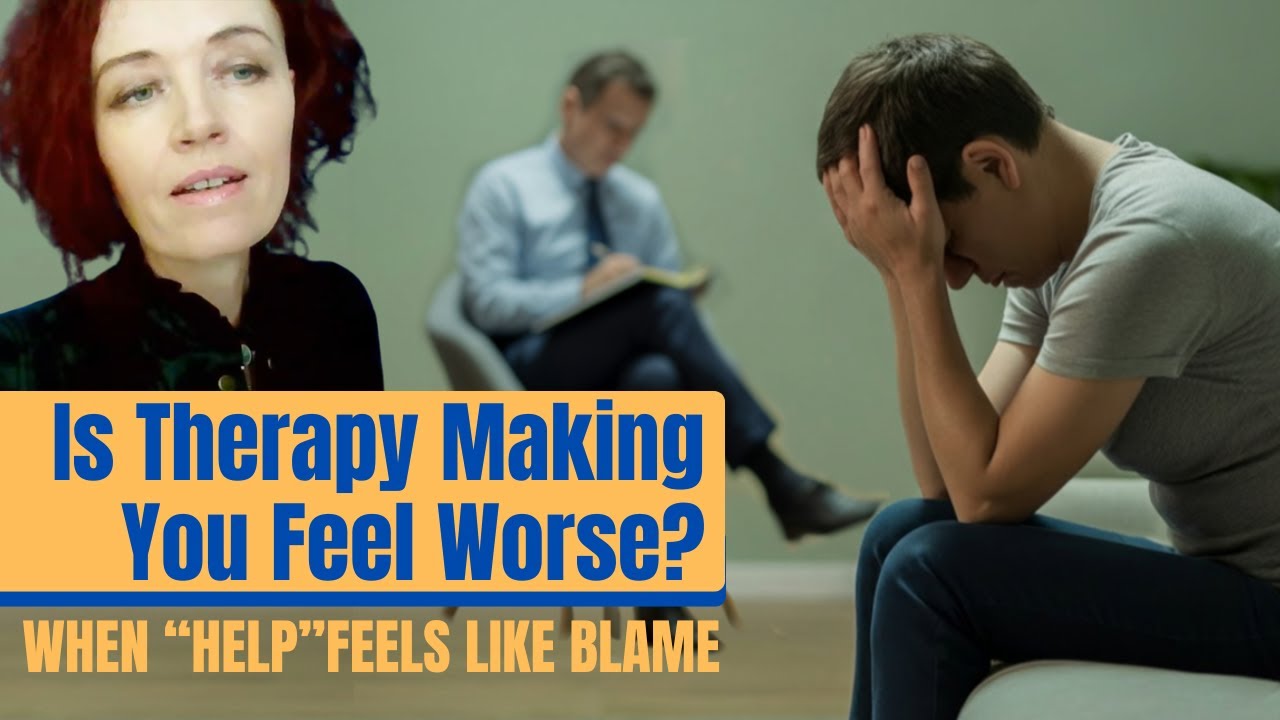
What If Therapy Is Training You To Comply Not Heal?

What if your therapist is using the same tactics as a narcissistic parent — and calling it treatment? What if therapy is teaching you to keep your hands burning on a hot plate, and alter your reaction to the fact that you are burning?
Today, we're exposing how therapy can function as compliance training. I'm giving you a diagnostic tool: the ability to recognize when you are being pushed to comply instead of being listened to. By the end, you'll be able to spot the phrases that gaslight you, identify the tactics that cast you as the scapegoat, and see the class filter that determines who gets to 'heal' and who gets told they're still failing.
So, if you've ever left a therapy session feeling like YOU'RE the problem for noticing the problem... you weren't imagining that.
One quick story to show how therapy language gaslights you into doubting yourself — so you’re easier to manipulate.
Vignette:
You're sitting across from your therapist. You've just explained the Trevor situation at work – a sneering, blonde dude who undermines you in meetings, twists your words to others, and makes subtle digs you can't quite prove, like “Of course someone like you would think that.”
The odd silences when you enter a room, the suppressed laughter. You SENSE Trevor convincing people you’re incompetent, but you can’t really concretize it fully. It's all so... slippery.
Your therapist is nodding now. Sympathetic. Professional.
'I hear that you're feeling targeted,' they say, leaning forward. 'But let's explore YOUR reaction to this situation. What cognitive distortions might be at play here? Are you assuming it was meant with ill intent, when it wasn’t? I mean, reading too much into things, or assuming you can read others thoughts?'
You are a little flummoxed. Your boss knows about this issue, and recommended this herself, via the Employee Assistance Program. CBT. The gold standard, she’d assured you.
But does she think YOU'RE the problem somehow? ARE you reading too much into things? Is it that your perception IS distorted?
The therapist leans back and fiddles with a pen. 'What if we reframed Trevor’s comment? Instead of assuming we know what he is doing - which you can't control and can't even verify - let's work on YOUR thoughts around this. Those are ones we have access to and CAN control.'
You are handed a worksheet. A list of possibly ways your thoughts and feelings may not be accurate. You work through the list, debunking your own thoughts and intuitions.
At the end of this session, you feel somehow... worse. Ashamed. Betrayed. Alone. IS the therapist working on the assumption that you are imagining the whole thing? That idea hurts. But she is the professional, right? Your mind goes into a loop of second guessing – and second guessing those second guesses. Maybe you ARE worrying about nothing – or imagining things. Maybe it IS your trauma talking, and not your instincts.
[The Aftermath – weeks later]
It is now Tuesday. You have 3 sessions under your belt but Trevor is still being a cock.
Or DOES mean something different when he says “your taste in clothes isn't doing you any favours”?
You run through the CBT checklist. Am I reading too much into things? Am I making mountains out of molehills? Is thinking that he is turning people against me just catastrophising?
Your boss calls you in. Stern look, folded arms. She’s saying that you can't get along with others, and that all your team mates reviews of your work has dropped significantly.
Yeah – in the months since Trevor joined.
“What is your response to that?” your boss demands “I mean, we’ve given you assistance via the company therapist and it doesn’t seem to have helped.”
Your head spins more than ever – how should you interpret THIS? Am I maybe somehow NOT in trouble? It this actually OK, and I am just imagining it inst? It feels very VERY not OK.
You want to tell her how Trevor is, but you don’t want to look like you’ve learned nothing. So you sit there, not trusting yourself enough to act. You end up leaving, stunned, clutching your official warning letter.
This story is not made up. It is a story sent in by a listener - really, by many listeners, in slightly different forms. Many of us, with our hands burning on a hot plate, have been told not to move our hands away at all, but to change how we feel about the fact that we are burning. From the mum with a manipulative partner who was told her reactions to his manipulation were the issue, to the arthritis patient whose 'pain management' programme encouraged him to 'reframe' his pain, to the patient with a history of parental abuse who is told to 'forgive' their abuser – many of us, instead of being helped by therapy, have been gaslit into thinking our issues are not the real issue.
So if you've ever ended up in therapy that treated the symptom while protecting the world that caused it — you aren’t alone, and you weren't imagining that. Because the values we hold as a society end up making it that way.
Today our focus is how therapy works as compliance training. How it ensures EVERYTHING you do - how you eat, sleep, breathe, move, look, feel - can be framed as something you are doing wrong – keeping you in the loop of feeling like this is all your fault.
Foucault, Lasch and Girard are going to help us understand how therapy can end up as a means to elicit compliance to the system, and how, in the wrong hands, it calls on the very tactics a narcissistic parent would. Now, let me say this up front. This is NOT about attacking therapy professionals. This is about the INSTITUTION that is therapy – the training systems, the treatment goals, the worldview, the process. Meaning, we are looking at the ideological and institutional structure that frames what therapy is allowed to become, in certain hands.
Roadmap
We are going to start by outlining where we are now. Then, we dive into the philosophy of how we got there. To achieve our first task, we will be creating a therapy-speak travel guide - you know, those phrase books for tourists were commonly used sentences are translated. Except this one is not a destination unknown. It is a guide for the here and now. Also, it doesn't have sections on 'dining out' or 'how not to accidentally ordering deep-fried rats eyes in a restaurant.' No. In this travel guide, the section titles are a giveaway about how crap this temporal location actually is. Instead of "leisure time" and "going shopping," our therapy-talk phrases fall into these categories - 'Invalidating Your Reality,' 'Manufacturing Compliance,' 'Weaponized Boundaries,' and 'Marking the Scapegoat.'
Becuase who WON’T be visiting an orwellian nightmare destination sometime soon?
Section 1: Phrases Around Invalidating Your Reality
Let’s start with therapy-talk phrases that fall into the category of “invalidating your reality”.
Who among you has heard this one:
“You are making assumptions,”
“Those may be cognitive distortions,”
or the more passive-aggressive version:
“Could your thinking be wrong here?”
Spoiler: you have to say... YES.
Because these phrases are designed to coerce you into agreeing with one fundamental premise: that your thinking IS wrong, and that that is the root of all your woes.
Now, this assumes a “right” way to think - and that you are not familiar with it. You have to be shown what the right way to think, by an authority.
Here’s another coercion into accepting your own madness, I KNOW some of you have heard this and I have too:
"Look. You have a trauma history. You can’t trust your own nervous system,"
This one is such an insidious sleight of hand, I’ll say more on it in a sec. But first, note that the aim of ALL these phrases is twofold
1. to make someone discount or distrust themselves.
2. to create a power vacuum,
Because when you are deemed unreliable, someone else gets to step in to tell you where the truth lies.
The exact comment about not trusting your nervous system if you have a trauma history came up in our online group the other day too. Having cPTSD, I heard it myself a lot too. So a quick aside to explain the sleight of hand here:
The nervous system has Sub-types. The sympathetic and parasympathetic. Research shows that when we are in sympathetic nervous systems arousal, that is, fight, flight, freeze or fawn, those things are the priority. Not reproduction, not digestion, not even tissue repair and certainly not slow, considered thinking. In those states, we are essentially in panicked, act-now mode.
And that is the case for EVERYONE.
The same research shows that when we are NOT in that state, digestion and so on are back online, and things like your gut and intuition, are in working order. This is the parasympathetic system. This is NON-panicked reactions and you can trust them.
That is also the case for everyone.
The only difference for we with cPTSD or other trauma related conditions is this: we go into fight/flight/free/fawn mode potentially more often, or potentially in response to different things.
But this does NOT mean we should distrust our ENTIRE damn nervous system – which consists of both sympathetic AND parasympathetic, and our sympathetic is triggered for some good reasons sometimes. If the reason we SHOULD distrust our whole nervous system is because of how our sympathetic nervous system operates, then NO ONE should trust their nervous system, regardless of their background. We ALL have a sympathetic nervous system that will turn on at some point.
So this phrase ends up being very similar to others like:
"That's your trauma talking,"
or even
“you’re catastrophising.”
All are used to directly discredit your assessments and thoughts, as if they are always and only operating from some panicked, act-now state.
And aside from the clear power imbalance this creates – which Foucault will help us understand the roots of – this tactic might be familiar for a lot of you. Constantly invalidating someone's reality, without considering whether their assessment is actually fair and sound, is more commonly known as GASLIGHTING.
Now we get to the parallel I’ve been on about since the post on covert narcissistic tactics - where we showed that society often operates like a covert narcissistic parent. Invalidating someone's reality, aka, gaslighting, is a favourite tactic of toxic and manipulative people, exactly BECAUSE it creates a power dynamic and dependency. If I can convince you not to rely on your judgements and gut feelings, you are a rudderless, self-doubting ship, who will come to me for “truth.” Cults use this tactic, self-styled gurus too, yet somehow, dressing it in psych speak means nobody notices.
And really, I could have called this section “the gas-lighters echo chamber,” cos our travel guide is off to a sinister start. As with most dystopian texts, this is intended as a warning, and NOT as a handbook on how to fuck up others lives. Foucault is going to show us why the emergence of these tactics are no accident either, very soon.
In the meantime, this next set of phrases may also be familiar.
Cluster 2: Manufacturing Compliance (2:30-4:30)
Or let’s just call it obedience training, because this is about getting you to behave in ways that society — and your therapist — approve of. Hands up if you have ever heard the following:
“You must learn to challenge your automatic thoughts.”
→ and whilst this can be fair when such thoughts are intrusive or just a sort of mini version of your freakshow of a parent, when used in a non-nuanced, general way, it translates to this:
Your gut reaction is wrong. You require expert correction.
Here is one I personally find utterly infuriating. You know, when you say something like:
“It seems like my sadness is linked to the structural impossibility of reciprocal recognition within atomised neoliberal subject-formation, which renders intimacy functionally non-viable unless one is a golden retriever or a sex worker”
—and you are hit with:
“That’s intellectualizing.”
YES. Yes it IS! I’m a fucking philosopher! What do you want me to do — grunt?
We have already been told not to trust our thoughts, gut feelings or perceptions, and now we’re being instructed to stop using our brains altogether.
Our thinking is labelled a defence mechanism, rather than a potentially valid insight.
And a heads-up that I will continue to intellectualize until the end of this video, pausing only briefly to insert the words: “fuck compliance training.”
Here is another famous phrase you may have heard:
“You need to work on frustration tolerance.”
Or resilience. Or whatever other buzzword is now code for “suck up the unfair treatment.” The translation is this. Do not show emotion when faced with structural barriers or unfairness. Sucking it up is the new cool.
How about.
“Think more positively.”
Not just for therapy, but for self-help and crystal eating spiritualists too→ Translation: Please delude yourself into becoming a smiling gimp, so you don’t wander around upsetting everyone who digs capitalism.
Related to that is:
“Let’s focus on what you can control.”
→ Meaning, forget structural violence, exploitative labour conditions, or your basic human need to scream into the void now and then. Those aren’t the issue. Your reaction to them is. This is also where all the red herrings get invoked. You CAN change how you sleep, breathe, move, think, eat, and so on, so let’s distract ourselves with those so that the system around us remains uninterrogated.
Another insidious one.
“Keep a thought record.”
→ Now, I think Foucault would have projectile-vomited across the therapy room at this one. It’s journaling as an act of self-surveillance — panopticon lite, now in pastel notebook form. Where I live, the Stasi once did all that for you. But why leave it to your neighbour to report every rule you broke, when you can now internalise the snitch and do it yourself? Learning to blame ourselves more efficiently is now the done thing — a self-administered loyalty oath to the system.
Cluster 3: Weaponized Boundaries (4:30-6:30)
On to the kind of phrases that, with practice, and a few rolls of duct tape, can be used to create your own dystopia at home or in the workplace. Here, our phrases invoke a world where Jo Shithead can run around punching you and everyone else in the face, and count on your forgiveness – cos YOU will be told that being pissed at him is your responsibility to manage. Yep, this is where phrases like “only YOU are responsible for your feelings” and “you can only heal if you learn to forgive” translate into your suffering being ignored, and your being punished for calling others out on crap behaviour.
A friend of mine was told once that she would not be able to heal until she learned to forgive her uncle, who had abused her as a child. Now, she HAD a child of her own, and said “Look, if someone did the same thing to my child, would we be asking her to go up to him and say “hey uncle, I forgive what you did”? No, we would not. It would be monstrous and invalidating for her, and he would learn nothing. Doing that to my own inner child would be equally invalidating.”
She went on to add that we send people to jail for that stuff – we don’t forgive them as some act of self-aggrandizing martyrdom.
And when you put things like that to your therapist, you may hear something like this:
"I need to set boundaries"
to limit your critique of their authority, or “YOU need to be open to the process” to pathologize any resistance you might have to going along with all this.
Now, if you ARE Jo Shithead, or that criminal uncle, you’re away laughing. I mean, the therapist is on your side, without even knowing you. Which does kind point to who REALLY benefits from all this. When I showed in the societal narcissism post how society functions like a covert narcissist parent, Jo Shithead was that societal parent – landing gut-punches on all and sundry, with the victims learning to blame themselves, even though it clearly isn’t their fault. This leads fairly naturally into the next set of stock phrases for our travel guide.
And if this resonates so far, please click the like button – it helps others who are going through this too to realise they aren’t going mad. The system is.
Cluster 4: Marking The Scapegoat
Finally, the x-rated addition that gets left out in general publications of such travel guides. The section that amounts to “insults, character assassinations, and offensive shit to say about your mum.” And because this is a handbook for professionals, it isn’t called “swearing in a foreign language”. It is called “how to marginalise someone whilst looking authoritative.”
Hands up if you have heard this:
"That's your [whatever diagnosis] talking" → this is how your perspective is dismissed via a label bestowed on you by someone in power.
"That might not be the case. People with [condition X] have trouble doing thing A correctly..." → again, justifying the exclusion of your opinion/ presence or additional needs via a stereotype.
And last but not least, after dealing with Jo Shithead, and calling him out as an asshole:
“We want to steer clear of a victem mentality.”
Do you notice the pattern? Each of these phrases takes your potentially legitimate response to a shitty situation and turns it being about YOUR pathology. This isn't healing. It is a power dynamic. It is what Foucault called 'normalization' – which we get to in just a minute - and it's been operating for centuries.
Our travel guide so far shows us this:
How Invalidation Phrases and scapegoat labelling, function as coercion mechanisms. They establish a power imbalance, operate to extract vulnerability and an admittance of fault, then weaponize them.
How Compliance Manufacturing phrases and weaponized boundaries establish "Self-surveillance" to make compliance self-sustaining.
Now, our travel guide brings some important cultural values to light, as any good travel guide should. The institution that is therapy has three contral concepts that drive it: power, exclusion, and a set of tactics that operate like a covert narcissistic parent would.
But before we bring in Lasch, Foucault and Girard to explain these three elements, you are likely wondering: How the FUCK did therapy BECOME this? So some history for you.
“Where Did This Come From?” (Historical note)
Back in the 80s and 90s, while Madonna was inventing nipple tassels and Grunge was making it clear just how depressed everyone was despite such innovations, there was a shift going on in psychology. In alignment with rising neoliberal preferences for “cost-effective, individualised, productivity-oriented therapy,” a shift from psychoanalysis to CBT was underway. Psychoanalysis was all about the inner world: understanding one’s values, fears, desires, and deepest yearnings. It had a nice power dynamic going on, but it took years and did not necessarily improve what was termed “workplace compliance.” Born out of behaviourism, CBT focused on the outside — on how one behaved. The proof of whether one was healed or not was measured by how they acted.
So the outcomes, and the means of measuring them, were far more in line with what capitalism desired: quantifiable results, lower cost, and — crucially — quick returns. People were back at work, behaving the way you needed them to, in weeks or months instead of years. They may or may not have felt better, but that wasn’t the pressing concern. This is capitalism, remember. The concern is productivity, emotional regulation, and competition. The inner world? Under behaviourism, if you act happy, you must be happy. End of story.
Health care — let’s not forget — is an industry, even when it’s government-funded. If you can get eighty people to act how you need them to, quickly, for the same amount of money it would take to get thirty people to NOT necessarily act how you need them to? No brainer.
But here’s the issue. We actually know what healing requires. It has been studied extensively. It requires:
safety
connection
Structural support
validation of reality
Non-coercive meaning-making
According to research by Ardito & Rabillino, 2011, and Duncan et al 2010, this is the kind of environment that fosters meaningful change. It fosters friendships and deep relationships too.
This is not, however, well aligned with capitalism’s preferred setup, as Christopher Lasch, makes this clear in his work. Lasch showed how Western culture has become increasingly narcissistic. Instead of the conditions for healing we outlined just now, he shows that a narcissistic society systematically destroys every precondition for psychological growth — safety, connection, structural support, reality validation, and shared meaning — and then blames the individual for failing to thrive without them.
The Crucial Convergence
What Lasch describes at the societal level is functionally identical to the tactics of a covert narcissistic parent.
In a narcissistic family system:
Reality is denied,
Needs are framed as defects,
Emotions become evidence of disloyalty,
and love is conditional on compliance.
In these systems, the individuals are not supported — they are managed.
Narcissistic societies operate the same way, only scaled up. Self-doubt, gaslighting, and asymmetrical power aren’t bugs — they are the operating system. And therapy, as an institution, is designed to “help” us function within that system, whilst distracting us from that system itself – via concentrating on our breathing, for example. Meaning, therapy's purpose must align with the broader, narcissistic operating system: to get you to internalise the expectations of those in power, to make you police your own thoughts, and blame yourself for any pain you experience.
Self blame – dressed up as healing or self development – is a massive, booming market. Fixing how you eat, drink, walk, breathe, think, look, move, feel and so on, is an industrial-level distributor of red herrings, all designed to give you a distraction project, while real, structural issues go unnoticed underneath the obligatory self-self obsession.
Because just like narcissistic parents, narcissistic cultures — including Western capitalism — cannot admit fault. They cannot be questioned, cannot be wrong, and certainly cannot be held responsible for the suffering they create.
So like any narcissistic systems does:
It uses all the tactics it can muster to outsource the burden of being wrong.
This is not just metaphor. As Lindsay C. Gibson documents in Adult Children of Emotionally Immature Parents (2015), narcissistic family systems assign roles — the Golden Child and the Scapegoat — to ensure that blame never lands where it belongs.
René Girard, whom we return to in Part Two, observes this on a societal scale: systems unable to tolerate their own flaws must assign blame elsewhere. Someone has to carry the fault the system refuses to hold. He calls this the scapegoat function. We’ll dig into that later, but for now we’re staying with the psychological mechanisms:
In narcissistic systems, roles are assigned. These are designed to keep those in power immune from blame, and those not in power, distracted with various tasks. Many of you know the role of the scapegoat in narcissistic family systems, and the role of the golden child too. Capitalism uses these as well.
Enter the Hero Narrative
The hero narrative makes me me me the center of my universe. It makes Me me me the most important character, with a purpose and a genius of some sort. As long as I do great things by the societal narcissistic parents standards, I get rewarded.
Here is the interesting thing though. We ALL get sold that. We ALL get the option to be the golden child. But in this utterly atomised culture, we get two roles for the price of one. We get to be the scapegoat if we fail to be the hero. The system, in other words, installs both roles inside you. Inside all of us. You become your own, or the public's’, Golden Child when you succeed within the system — and your own, or the public's’, Scapegoat when you fail. And, just like in a narcissistic family, even the performing, winning hero’s aren't immune. There is ALWAYS the possibility that power and its institutions can flip the switch to “scapegoat” FOR us at any given moment – especially if your skin colour is the one they’ve matched to their new Feindbild.
The hero/ scapegoat mechanism works as follows – for the system stay exempt from admitting its own flaws, it must convince you that you are powerful enough to be responsible for everything that happens. That’s where the hero narratives promise is ingenious. Western culture doesn’t just tell you to be responsible — it tells you are the only real character, the sole architect of your destiny, the person who can manifest outcomes through hustle, mindset, positivity, and grit. Everyone else becomes an NPC in the epic of you.
For a lot of people, understandably, that feels empowering and glorious. But it’s a setup. You can go from golden hero to epic failure faster than a contestant getting voted off a reality show for using someone's hamster as an anal probe. Because if you're the hero of your story - the sole architect, the main character with unlimited agency - then when things go wrong, there's only one person who could be responsible: you.
Even when it wasn't actually your idea with the hamster.
The same narrative that made you omnipotent now makes you omni-culpable. Once you are cast as omnipotent, any failure — and failure is inevitable — is transformed from being something that happens into something that you are.
Cos really, once anyone does THAT with a hamster, you will always be “that hamster fetish guy.”
That shift — from event to identity — is very important in how narcissistic systems rule. That shift from event to identity is the psychological essence of shame.
In Grandiose, Hero Mode, you are meant to think: “I can do anything.”
When you fuck up, which is unavoidable, you are meant to think: “I am so so flawed, I suck to the core, I need help.”
The latter is where you get to bear the shame and blame that might never have been yours. That shame isn’t the cause of narcissism either — it’s the wreckage created when the narcissistic fantasy you’ve been sold collides with reality. It is what remains when superhuman expectations fail, and the narcissistic culture — your societal parent — calls that failure you, and sends you to it’s corrective infrastructure: i.e. therapy.
Now of course, a lot of you DIDN’T buy the myth at all. Many of you noticed that the world is unfair, and that other people aren't NPCs, and are sentient, with feelings and aspirations of their own. Or you realised that you have limitations like every other human being. Or that those who really go for the whole hero thing can be assholes.
When that happens though, you don’t get told “well done, that is rational, relational and human”. No. Neither accurate “intellectualising” nor anything else, will get out of what happens when you see the hero role for the farce it is. What happens is, the switch is flipped to “scapegoat”. To “problem child.” The system can’t be blamed, remember — so you must be. Rationality has little to do with this. Its about you not executing the script correctly. You breaking the story. You ruining the great big smiley-faced show.
Because the scapegoat is the flip-side of the hero myth. The same narrative that crowns you sovereign, also makes you liable for every crack in the world. In this framework, you are not just a person — you are the god: either of your Instagram-perfect destiny, or of the fallout that occurs when you continue to act like just some HUMAN.
This is intricately linked to our value of control. If you can’t control everything sufficiently to make a go of it, you’re meant to feel shame. That despair is not considered evidence of systemic failure — it’s reinterpreted as proof of your personal defect. The institutions, industries and markets will ensure that IS how things get interpreted, and therapy is one of those industries.
The Narcissistic Cycle
And back to Lasch and a bit of psych. Cos adopting two, mind-shatteringly incompatible and opposite roles depicts something else that should be familiar. The boom-bust grandiose/ vulnerable cycle of narcissism: inflate, collapse, inflate, collapse, repeat. And the system trains us into it by making the grandiose boom part our “normal” — by convincing us that anything less than omnipotence is failure.
Your trauma, loneliness, exhaustion, exploitation — even your rage — must become evidence that you failed despite your supposed superpowers. The racist employer isn’t the issue — your reaction is. The violent partner isn’t the problem — your boundaries are. Other people’s agency, responsibility and moral fabric evaporate; only yours remains.
So the cult of “me, me, me” eventually flips into “me, me, me — to blame for everything.” Self-aggrandisement collapses into self-blame and shame.
And that is exactly what is meant to happen. Because shame is about you. Not your actions, you. Despair, anger, righteous rage — those point outward. Those demand change, or others to reflect on why they bash people in the face. So therapy keeps you focussed on yourself. On you and your shame, dressing it in clinical authority and healing language, and steering you away from blaming the system with any of the million red herrings available.
The Key Point
In a narcissistic society, responsibility flows downward. Power flows upward. The system remains immaculate; you become the problem. In our society, just like narcissistic families, the blame-game is totalizing: remember: NOTHING can’t be framed as YOU'RE DOING IT WRONG. There is always an official right way, as decreed by an authority, that can be held up as evidence of your failure.
Thus, flaws with our society – our narcissistic system - have been safely located elsewhere. In the scapegoat, problem citizen. Lasch showed us how the individual is primed for the self-blame that powers this. Foucault will now show us how dissent — which today amounts to refusing the hero narrative — gets pathologised. And Girard, in Part Two, gives us the missing piece: WHY a system like this cannot even function without scapegoats.
Foucault first, answering the crucial question of:
How therapy became a mechanism for social control.
Section 2: Foucault - Madness as Social Construction (8:00-18:00)
If you're a regular reader, you’ll know Foucault for two things: the panopticon effect, and how societies construct madness based on whatever threatens its core values.
So let’s go back — to the days before therapy chairs, when confessionals did the job instead. We are in medieval Europe. It’s the Renaissance (1400s–1500s), and it no one has invented proper plumbing or toilets yet so it smells terrible. Everyone is painting saints and babies like there’s no tomorrow to distract themselves from the stench, and some people claim they’re seeing angels. Their seeing angels was not considered mad, rather those seeing them are deemed to be touched by God. At this time, such visions were considered divine inspiration. What we now call strange behaviour was sacred. Such people wandered freely and were fed by communities. They were a part of social life.
This was not just because everyone needed supernatural stories to distract themselves from inadequate toilet facilities. It was because the church held power at the time, and these peoples behaviour supported exactly the KIND of power they held – religious, divine, non quantifiable by science.
Fast forward to the sewage systems and factory wheels of the 1800s. By now, rationality had taken over as a core value. Religion had been replaced by science – or at least, by a preference for reason. The same behaviours – seeing angels and so on was now seen as irrational. Irrationality was the worst thing one could be, cos it was the OPPOSITE of the new core value – rationality.
This was where all those people who had previously been institutionalised or exiled or killed for questioning the bible saw happier days, and not just cos they could take a dump in comfort. They were now considered the sane ones, cos they were in line with rationality…. Their behaviour hadn't changed either. The core value of society was what changed, and with it, our definitions of what was mad or normal.
This is one of Foucault's most crucial insights: Madness isn't an objective medical reality - it's a mechanism that serves to correct our behaviour and bring it in line with societies core values. In other words, the construction of madness is a form of social control. In western cultures, psychiatric language evolved to pathologize those who deviate from what capitalism requires of them. We are required to be compliant, self-monitoring, productive, workers who do not act in ways that disturb the status quo.
Today's therapy speak supports this very aim. The mechanism is easy to spot too – in a culture where individualism is glorified, and the whole “I don’t need anyone” idea is associated with all the words we think are positive: “strong,” “independent,” “takes responsibility.” The lone wolf IS our hero, where anyone admitting that they long for connection is hit with words like “needy,” “co-dependent” or anxiously attached – terms especially designed to make the opposite of independence look pathological. Let us not forget that those who write the DSM, in a country that worships extroversion, suggested introversion be listed in said DSM – as if THAT was pathological too.
Today, when you are depressed because we are now so structurally atomised, and so closed off from each other, that we have no sense of belonging, you're NOT actually sick – but because you ARE throwing into question the social order that benefits from all those things, the language needs to shift to MAKE you look sick. Labelling you sick means your opinion is written off. It means the system can continue as it was. Your anger at racism, sexism and pending ecological disasters gets assigned new words - like 'dysregulation.' Your clarity and insights gets relabelled as 'intellectualizing' or even 'cognitive distortion.' Your resistance and protest become 'maladaptive coping strategies.'
This is Foucault's mechanism in action – redefining behaviours as madness, as a form of social control.
And before we look at exactly how this operates in practice, I have a question for you.
How sane does it seem to look around the world right now, to look at your own situation of isolation and struggle right now, and say “All good. I feel great.”
For me, depression, as one of many potential examples of a so-called pathology, is the ONLY sane reaction to a deeply sick society.
But back to those who’re part of the approved institutions.
CBT
We turn to the most widely practised, most insurance-approved therapy model in existence: Cognitive Behavioural Therapy.
CBT has become the gold standard of modern therapy. Insurance covers it. Employers offer it. It's evidence-based. And really, it IS the gold standard in terms of it’s doing what needs to be done.
So let's look at what it actually does.
Your hand is on a hot plate. You're burning. CBT doesn't ask whether the plate should be turned off. It assumes the plate is correct, and your perception of burning is the malfunction.
'Maybe you're catastrophizing. Is it really that hot? Let's examine the evidence. On a scale of 1-10, how bad is the burning really? Have you considered that your thoughts about burning are creating unnecessary suffering?'
Here is where the mechanisms of covert narcissistic parenting are mirrored. You're taught not to trust your intuition. 'Maybe I'm being dramatic to think I'm burning?' You're taught to question your own perception of pain. 'Is this really unbearable, or am I just telling myself it is?'
The aim becomes NOT to change your situation - but to buckle down and do what's expected of you. The aim is to keep the environment, the system, invisible, and make you the source of blame.
You're exhausted from working three jobs? CBT doesn't question why three jobs are necessary - it teaches you to reframe your thoughts about exhaustion. 'What's the evidence you can't handle this? Let's challenge that belief.'
You're anxious about not affording rent? CBT doesn't address housing costs - it teaches you breathing exercises and cognitive restructuring. 'Your anxiety is irrational. Let's work on distress tolerance.'
You're angry about workplace exploitation? CBT doesn't validate that anger - it pathologizes it as 'cognitive distortion.' 'All-or-nothing thinking. Emotional reasoning. Let's develop more balanced thoughts.'
This is Foucault's nightmare made real. Psychiatric language that trains you to internalize oppression as personal dysfunction. To gaslight yourself on behalf of the system. To become your own jailer.
No wonder CBT is the gold standard. It DOES do exactly what it’s meant to. Correct our behaviour and blind us to a failing system. Push us into self questioning and self monitoring, with the promise that control can be ours. It’s the panopticon effect you've come to know and hate - the soft power that covert narcissists and covert narcissistic societies both operate on. We internalize the rules of those in power, voluntarily, because we've been trained to believe our own perspective is flawed and theirs is correct.
It IS gold, from capitalism's perspective. You don't need external control when people police their own thoughts. You don't need to fix exploitative conditions when workers fix their attitudes instead. You don't need social change when individuals change their cognitions. And best of all? You don't have to look like a bad guy. I mean, you are calling this “help” so no one suspects a damn thing. They aren’t looking at the system any more – they are too busy taking THEMSELVES apart.
CBT is the institutionalised compliance training we’ve come to call therapy. It's the most widely practised, most insurance-approved, most employer-sponsored form of mental health treatment in existence.
Because it DOES work. Not for you, of course – but for the system that benefits from your compliance.
Section 3: How Therapy Language Creates Power Dynamics
Let's recall our phrasebook now. We've collected terms like 'cognitive distortions,' 'intellectualising,' 'catastrophizing,' 'black-and-white thinking.' Recall the pattern?
There is nothing you can voice in terms of your thoughts, feelings or theorising that can’t be dismissed, deemed incorrect or deemed pathological. The therapist has full power to decree what is correct or even real. Challenge your therapist's interpretation? It gets labelled as resistance or non-compliance – an actual term in therapeutic and medical circles – and also taken as proof of your pathology.
Our phrase book outlines what is actually a closed system. There's no exit door.
And just so it’s clear that CBT is not the only guilty party here, here’s an example from psychoanalysis.
“But doc, my dog is not a replacement child. I never wanted kids. I mean, having a kid would be like a sort of shit replacement dog. Child stuff isn't my issue here.”
And you doc replies “But, my dear, it is in your nature. You’ve repressed the desire, so you don’t see it. But it is clear to me your failure to live out a woman's destiny is the source of your depression.”
The moment a therapist has decided what is “wrong” with you, or even the moment you show up, they've claimed authority over your reality. Your lived experience gets subordinated to their clinical categories.
Much of this closed-system stuff falls into what philosophers classify as unfalsifiable theories – because there IS no possible evidence that could prove your therapist wrong, if they aren’t open to BEING proven wrong. The therapist can claim authority over your inner state, using words like subconscious, repression, saying you can’t rely on your nervous system and so on, to suggest that you yourself can’t see what they can. The assumption is literally that they know about your reality better than you do.
Foucault saw this coming. He shows that psychiatric authority doesn't require proof - it requires the patient to accept that the expert has access to truths about them that they themselves cannot verify. The moment you accept that premise, you've surrendered your reality to someone else's interpretation.
Interestingly, X and Y show that this buying into the therapists authority is a key factor in therapy having what are termed “successful outcomes” – as measured by various metrics including ability to work, i.e. fit into the system.
As we just saw, these self-perpetuating power imbalances don’t just operate in CBT. They can be found in psychoanalysis – and even modern applications like family constellation work, where the facilitator decides what the overriding narrative is – from my experience, usually something deeply heteronormative. The gaslighting mechanism we saw earlier can also operate in positive psychology and coaching frameworks – which focus on mindset, with little reference to structural problems or talking through issues. Now other applications do exist – my favourite of which is Rogers talk therapy as it dispenses with hierarchy – but these are not funded by governments, and are thus only available to those with financial resources.
Powers Recruitment Process.
Which is the perfect lead in to the final points for part one. Powers recruitment process. This operates on two levels. I started to notice it when listening to therapy podcasts, and even a former favourite that did Jungian dream interpretation. Listening to these, I began to notice that the therapists themselves seemed to lack insight into certain kinds of life experience – like severe childhood trauma, or addictions, or the mental effects of decades of grinding poverty, or relocation and/or marginalisation. They professed to know about these, of course, but how they dealt with what came in from listeners was sometimes deeply distressing.
Because there is not just a class dimension to who gets to SEE certain kinds of therapist. Jungian therapists, for example, cost upwards of 200 dollars an hour. There is a class dimension to who gets to BECOME a therapist.
As some of you know, I am doing a second degree in phycology, and my professor opened my eyes to this – in a conversation that began with her explaining that I could never become a therapist in Germany. New regulations came in some years ago, and anyone who studied their BSc as distance learning, was no longer allowed to enrol in the Masters programmes required to become a therapist. She explained that most therapists went straight from school into university attendance, then straight from there into their masters, then studied in a field of application. That requires a LOT of money, she said, so most can only do it if you have affluent parents who support you through it.
And studying in later life? Well, most of us can only DO that via distance learning. This is how Germany goes about ensuring mainly the young, inexperienced and rich become therapists. But Germany is not alone in ensuring it is mostly a certain group who get to become the voices for the social order. The US does it via unpaid internships, expensive supervision hours, years of graduate school with no income, again requiring financial resources many do not have. Different structural barriers and mechanisms, same result: a profession that filters for class privilege, AND, importantly, those without much experience of life's adversities, calamities and limits.
And the people most likely to KNOW what you might be going through? Well, they have lived a little. They’ve hit brick walls or been hit by brick walls – or by Jo Shithead himself. But instead of being heard by those kinds of people, you are most likely to have someone who has only READ about your experiences, in a sort of “how the other half live” theoretical way. It is usually they who get to tell you what to do and who you are, without having been there themselves.
This is why you so often end up with someone who's never experienced structural exploitation telling you that your anger at exploitation is a cognitive distortion. Someone who's never struggled financially pathologizing your anxiety about poverty. Someone who's never faced systemic injustice dismissing your rage as unresolved childhood issues and/or telling you to change your mindset. Someone who has never struggled with the inner pain that leads to addictions and depression.
THOSE WHO FIT IN GET TO PATHOLOGIZE THOSE WHO DO NOT.
Then they use unfalsifiable concepts like repression to claim authority over experiences they've never had. They see fit to label others dysfunctional, because they’re comfortable imagining that others know too little of their own minds – and that THEY know how things SHOULD go. In other words, the classism can move into arrogance, without the practitioner being aware of it.
I want to illustrate this from one of my own experiences in Germany, with a German therapist. This is class bias but also cultural bias, because for Germans, you ARE what you do for a job. Work is really their be all and end all.
Now, its a long time ago and I was in a very deleterious relationship without actually knowing it was one. It mimicked my family home, but I didn’t know that either. I was also a musician, juggling part time jobs to get by.
When I arrived in the office of Dr. Schittenhelm, he did not listen very long. He drifted off entirely as I talked about my actual current feelings. I was deeply depressed.
His verdict, after all of ten minutes, was this:
“If you got a stable, normal job, you would feel much better.”
I felt completely unseen and totally abandoned. I won’t pretend that what I did next was entirely kosher, but it shocked me enough to say this.
“You're not. You're not telling me “freedom through work.” Cos seriously, I am pretty sure that phrase has not suddenly STOPPED being really fucking monstrous.”
He threw me out of his office.
This story, like everything from Germany, is an incredibly efficient example – showing how therapy functions to pull you back in line. In Germany, a highly conservative, emotionally closed, and non-curious society, the answer to everything is work. Your inner world is irrelevant. Your functionality within the system is of primary importance.
It also shows this. When only the socially compliant get to define what “healthy” looks like, pathology becomes whatever threatens their comfort. This isn't about bad therapists. It's about a system that structurally positions practitioners above the lived reality of those they're meant to serve.
So therapy has become a class-filtered compliance mechanism that serves capitalist normalization, not healing.
But there's another layer to this — one that reveals an even darker parallel.
In Part 2, we'll examine how this system operates through scapegoating — the mechanism narcissistic systems used to maintain control. We'll look at how shame keeps scapegoats in place, how the DSM sanctifies that scapegoating by pathologizing normal responses to abnormal conditions, and why we base "mental illness" on cultural ideals rather than actual norms.
Most importantly, Part 2 offers solutions: how to recognize when the problem is NOT you, how to trust yourself again, and three questions you can ask to know you're fundamentally okay as a human being — no institutional fixing required.
See you very soon.
Public Philosopher/ Speaker/ Performer
Jordan Reyne is a philosophy graduate from the University of Auckland, New Zealand. She works as a public philosopher, writer, and public speaker, and was formerly a professional musician and artist. Jordan has accidentally lived in four different versions of capitalism — from early-stage (Poland) to late-stage (Germany), with New Zealand and the UK slotting in between. Despite a lifelong passion for philosophy, she did not set out to conduct a cross-cultural study of capitalism; it happened unintentionally while trying to navigate a somewhat challenging life as an artist with inconvenient illnesses. When the same ideological machinery shows up in different languages, it does not suffice to hide the pattern.
Jordan’s current work focuses on phenomenology, existentialism, critical theory, and the analysis of power — including the Foucauldian kind that doesn’t yell or point guns, but quietly rearranges your behaviour from inside your skull. She is also completing a degree in Psychology, the institutionally approved perspective that locates all blame, control, and pathology within the atomised individual. Despite this — or because of it — she maintains the heretical view that society, institutions, and power structures do in fact affect human beings (so she may well fail this additional qualification).
Jordan’s early life provided a neat micro-demonstration of power’s two great modes: overt authoritarianism (via a father who favoured the outbursts and rage of a standard totalitarian model) and covert ideological power (via a mother whose preference for guil…Read More
Why "Positive Vibes Only" Friends, Are Just Unpaid Prison Guards