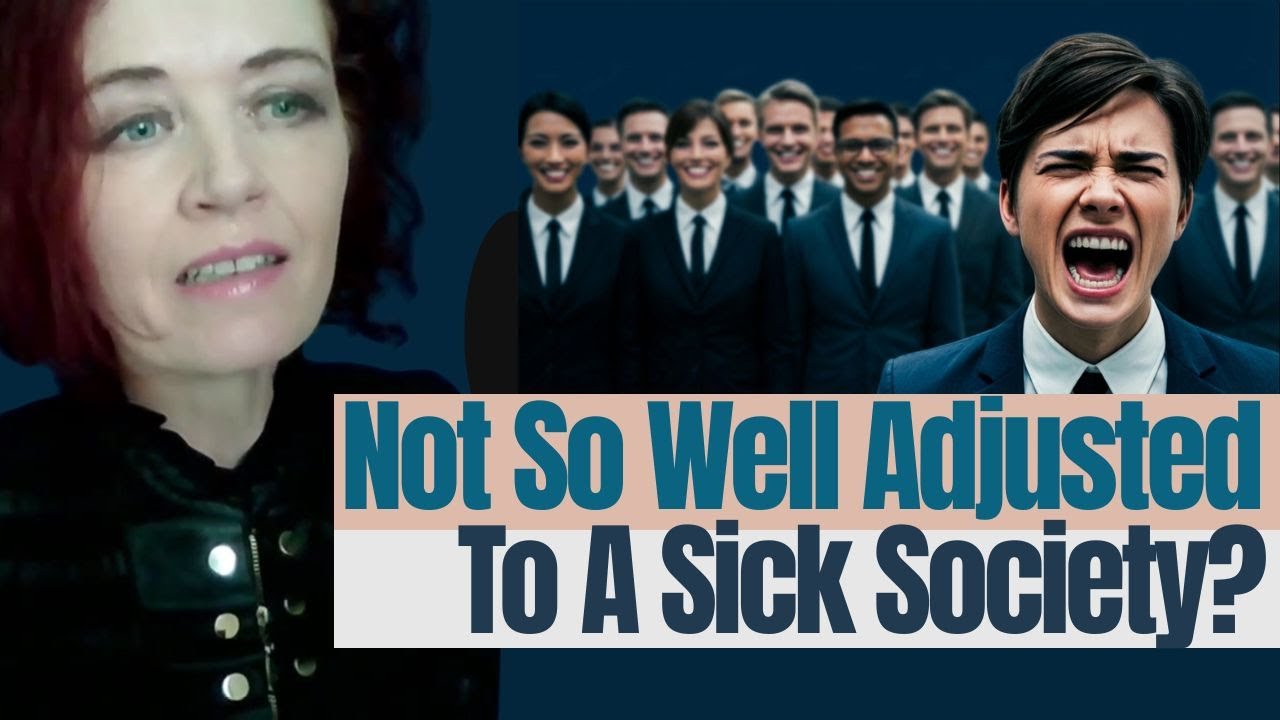
Not So Well Adjusted To A Sick Society?
Have you ever left a therapy session feeling worse than when you arrived? Have you ever felt like the therapist really wasn’t getting what was going on for you, or had somehow made you the whole problem?
When that happens, it hurts. You can feel worse than alone and unseen. You can feel betrayed, because your therapist, of all people, is meant to get it, right?
Last post we talked about therapeutic gaslighting. Today, in part two of our 2-part therapy series, we are zoom out a little – to the societal practice of scapegoating. Why? Because the institution that is therapy is integral to how our culture enacts it, and understanding that helps you stop it.
By the end of this post you will understand the dynamic of scapegoating, where it comes from, why it happens, and why this has nothing to do with your failings. Rather, it is yet another example of how the tactics of a troubled society filter down into therapy contexts. I’m also going to give you a tool you can use to remind and assure yourself that you are actually a decent person – and NOT the root of everybody’s woes.
Re-framing “Failure” To Fit.
We’re beginning with an illustrative story, about why your so-called failing to cope within our current system, is potentially a good sign.
Picture yourself in 1929. There’s a lot of rubble and sad faces, cos the world is still reeling from years of war and death. Somehow, colonialists have still not realised how deeply uncool they are, and capitalism is entering a new phase — triggering financial apocalypses by producing so much junk that even the junk market collapses.
Somehow, through no fault of your own, you have been declared Humanity’s Next Spiritual Upgrade, by a group of wealthy European mystics. Mystics who see “enlightenment” less as a spiritual path and more as a political shortcut — a way to gloss over hard fixes like war, racism, and exploitation, and establish coherent control over how people thought about the chaos.
Around you as their shiny new centrepiece, these men — The Theosophists — build organisations. They distribute crappy pamphlets cos there are no adobe products. And even though they don’t have social media yet, they manage to create a global movement round your pending debut. Thousands travel across continents to hear your first public address – in which you, a skinny Indian teenager, are expected to reveal a unifying, cosmic truth. The days tick downwards until, finally, your debut comes.
You step up to the podium. You clear your throat and say something wise beyond your years:
“Truth is a pathless land. No organisation can lead man to it.”
Jaws drop. So do share prices.
Cos you are Krishnamurti, and what you just said translates to this: Stop forming clubs, stop following gurus, and for fuck's sake, stop trying to repackage domination as enlightenment.
This is not the vibe people were expecting.
And it gets worse, cos you do something profoundly illegal in capitalist metaphysics: You decline monetisation. You decline a line in velvet wall hangings with your face on them and tell thousands of devoted followers to go home. You give back the money. You refuse the throne. And because you technically ARE now the boss of this organisation, you single-handedly dissolve it.
Why?
Because Krishnamurti realised something that sounds like a riddle until all the so-called solutions to your pain prove useless: When a society is sick, the people who refuse to adjust to it aren’t the broken ones.
And out of that realisation comes the line that should be written above every HR office, every school gate, and the front door of every CBT clinic:
“It is no measure of health to be well-adjusted to a profoundly sick society.”
Pause there. Let that sink in.
“Failure” Is Potentially A Sign Of Health
That idea—that refusing, or failing, to adjust can be a sign of health—is the hinge for everything that follows. Because when a society is sick, it follows a specific pattern: it cannot tolerate those who don't bow to it. It can’t tolerate people who won’t—or simply can’t—adapt to its basic premises.
To see this pattern on a micro level, think of a "wellness" retreat where every meal is raw vegetables because the leader believes raw food cures everything from your gut to your past lives. When you finally snap and order a pizza on day three, you aren’t labelled "hungry." You’ll be labelled "disruptive." You’ll be shunned and whispered about behind your back—not because pizza is evil, but because your pepperoni slice exposed the performative charade of loving carrots.
The Name of the Game
When a system is sick, it doesn’t reflect on its own demands. Instead, it reflects negatively on the person who won’t conform to them. In psychology, this is typical of what is called a "Narcissistic System," and one of its favourite weapons is Scapegoating – today's key topic.
Now, the philosopher Christopher Lasch famously argued that our entire society has become narcissistic—not just as a collection of vain individuals, but in its very structure. But I take that a step further: if society is narcissistic, it will act like any narcissistic parent would, utilising the same tactics to keep those in the system behaving as they want.
This means the manoeuvrers we recognize from a dysfunctional home—the gaslighting, the blame-shifting, the stonewalling—aren’t just "family drama" anymore. They are structural tools. They are being used at a massive, societal scale to keep the system’s narrative intact. You don’t have to take my word for it, either—the philosopher René Girard demonstrated exactly how this works through his theory of the Scapegoat Mechanism.
Now all of us live within this system, so if you are someone seeking help or answers, which we often do via therapy, this ends up being very disorienting. There is a reason for that confusion too, and for why you might feel permanently uncertain about whether you’re the problem. Because in sick systems, ambiguity isn´t just a side effect. It’s a tool.
In narcissistic systems, whether they are a family of four or a society of millions, the goal is to make you doubt your own perceptions. When you can’t tell whether the problem is you or the world, that uncertainty creates a vacuum. It is a very specific kind of vacuum that institutions are happy to fill with "answers" that look like care, but actually protect the status quo.
The Role of Therapy
This is the hard truth: Psychology, and the institution of therapy, have been handed the task of "managing" those who are not well-adjusted to the demands our culture places on us. Last post we examined the phrases that reflect gaslighting, blame shifting and marking the scapegoat. This post is a deep dive into how and why scapegoating is what keeps the systems sickness hidden, and allows it to carry on as normal.
As I mentioned last post, this isn't about deriding individual therapists. It’s about therapy as an institution. Psychology and therapy are not a neutral observer standing outside society; they form part of an institution produced within that society—trained in its assumptions – for example, the assumption that individuals function like atomised units of sovereignty, and funded by its priorities. What it considers to be "the problem" is no different from any other sick system: the problem is simply those who can’t, or won’t, do what’s expected of them.
Why YOU Are Not The Problem.
So before we go any further, I want to pause here for a minute. Last post, in part 1, we dealt with the marking of the scapegoat. It turns out that a lot of you have already been told—explicitly or implicitly—that you are the problem. So I want to take a minute here to reacquaint you with the possibility that you’re actually NOT the problem. You are more than likely fine.
Now, being fine does not mean you don’t have a bunch of behaviours and feelings you would seriously rather not have. What it does mean is that you are a decent person. And it might be that you’ve never been allowed to know that.
So—four questions. Thirty seconds. Then we’ll connect this to why the system needs you to conclude that your ways of "not coping" mean you’re broken, even when you aren’t.
These are all Yes or No. Ask yourself:
Am I aware that other people have feelings and aspirations that I effect with my actions? Yes? Great. Give yourself a point.
Do I feel generally inclined to harm others? No? Give yourself a point for that, too.
Do I get pleasure from seeing others suffer? No? That’s another point.
Do I generally feel inclined to manipulate others for my own ends? If you answered “no” to this, give yourself a final point.
The Results There are no more questions. If you got 4 points, you are a decent human being. Seriously. You are not too reprehensible to be loved. You are not an ugly character. You aren't the issue here.
Now, you might still be depressed, lonely, despairing, or some form of brain-fried-from-trying-to-be-like-others. You might have any number of diagnoses that summarize your patterns of behaviour, tagging you as "this" or "that"—but you are not a shitty person.
You have actually done something very, very difficult: you’ve avoided the deep internalization of a narcissistic culture's values—values in which manipulation and "not giving a fuck" have a million admirers on YouTube.
If you got 3 or less? Well, if you answered while thinking of an abusive boss who exploited you to the point that you can’t help but plot their public disembowelment... maybe that’s okay.
If not, though—don't worry, cos you won’t incur a label. "Asshole" is not an official diagnosis, despite being the most important one in terms of our everyday lives. And because most people with a score of 3 or less don’t last five minutes on this channel before posting some form of vitriolic word-salad they’ve mistaken for an argument, I likely haven’t actually insulted anyone.
The thing is, those with 3 or less have likely adapted pretty well to modern ways of being. When they manage not to out themselves by posting moronic comments online, their capacity for ethical numbness and preparedness to throw others under the bus can mean they make great CEOs.
So, chances are, you scored 4 points. You’re capable of empathy and you don’t enjoy causing harm. In short: naming you "the problem child of the universe" is really pretty fuckin lame, considering your non-assholeness.
The Scapegoat Selection Process
But let's talk about the selection process. Because it’s often exactly the decent human beings who end up in therapy—confused, doubting themselves, and thinking there’s something deeply wrong with them. Why?
Partly because they are the only ones prepared to look inward at all.
As Gabor Maté and others point out in the brilliant film Crazywise, if everyone went to a therapist and asked "what is wrong with me?", they would almost ALL walk out with one or more diagnoses. He makes it clear that, when it comes to mental health labels, ask, and ye shall receive. It really is one of the only scenarios where manifesting ceases to be bullshit.
We’ll return to the DSM towards the end, but for now, the important thing is this: We all know there is a yardstick, yet not everyone considers holding it up against themselves. If you are busy getting pats on the back for maximising profit, or for never showing emotions, the comparisons you routinely make are not along the lines of “am I OK?” They are more like “HA, look at that guy, I am better than him.”
This contrast in trainings is akin to the difference between the golden child and scapegoat training in sick family systems. Under golden child training, sure, you may occasionally fall into fear of inadequacy, but you are likely to bluff your way through it with a tonne of annoying bravado. On the whole, with golden child training, you don't go about questioning yourself, cos you've been told, repeatedly, that you are amazing.
But if you grew up in a dysfunctional system on the micro level—meaning your family—the other kind of training may already be familiar. The kind of training scapegoats get.
The training to scan yourself for faults.
To doubt your own perceptions.
To assume that when something feels wrong, it’s because you are wrong.
In a narcissistic society, like a narcissistic family, this preparedness to see yourself as potentially wrong and responsible is the exact vulnerability that’s exploited in scapegoats. You aren't necessarily in therapy because you are the most "broken"—you can be there because you're the one most willing to carry the weight of the question “what the fuck is going on?” But, lest you find out where the real sickness lies, distractions will abound in support of the conclusion you’ve been trained for – that you are the root of all your, and everyone else's problems, and should embark on the projects of fixing your thoughts, feelings, behaviours, expectations, desires and so on.
In short, those spiralling into self doubt have been primed for scapegoating to WORK. You have already practised carrying blame, like some crap deportment exercise where the only acceptable posture is self-erasure. You are fluent in self-doubt. Already inclined to believe that if something isn’t working, it must be because you, personally, radiate a multicoloured, multidimensional, stinking cloud of wrongness. And hurrah for our sick system when you do that, cos it can carry on, unexamined.
In short, our capacity for self-reflection has been railroaded. Railroaded to interpret any and all distress signals as a problem in ourselves, rather than considering that it might be in our conditions or environment. So when society does the same thing dysfunctional families do - handing you its contradictions and calling them your disorder - you believe it without question.
And before we dive into Girard to show exactly why sick societies have always pulled this shit, lets look a little closer at that old yardstick. That thing that we look to in order to gauge the extent to which were fucked. What do that yardsticks standards of “health” really tell us?
Spoiler. Nothing. Except ideology.
Norms That Aren't Norms
As psychiatrist Thomas Szasz famously argued, there is no agreed scientific norm for mental health in the way there is for physical disease — only norms of behaviour a society happens to prefer. This isn’t fringe theory in critical psychology or philosophy either. For Foucault, “mental health” is not discovered but produced through institutions that define, measure, and enforce normality. Sara Ahmed makes a horrifically pertinent observation here too, about how “normal” is a kind of performance. Emotional norms, she says, masquerade as health norms. Meaning, behaving like you are happy, optimistic, and resilient is read as having good mental health. By contrast, Ahmed shows, suffering and non-acceptable emotional displays BECOME personal pathology.
This literally makes us perceive game show hosts, used car salesmen, and people in toothpaste adverts as mentally healthy. So remember to smile like a tool when your boss refuses everyone's annual leave, cos otherwise all the other smiling goons will start hiding sharp objects and sending you to CBT.
BREAK FOR SPONSORSHIP
We do not have a yardstick for mental health or normality, in any scientific, objective sense. And yet the labels “healthy” and “normal” are routinely bandied about – in reference to idealised, non-existent composites designed to confirm your mental fuckedness. I mean, you really COULD be forgiven for thinking that the smiling gimboid norms we have constructed were pulled from someone's ass.
But not actually just ANYONE'S ass. Norms, as Foucault helped us see last week, are pulled from a very specific ass. The ass of ideology.
Because modern power doesn’t operate by force but by quietly organising what counts as truth. It produces norms within sanctified institutions, such as the institutions that are psychology, psychiatry and therapy. It is those within, and well adapted to, these institutions that define “health,” “functioning,” and “normality” — and present their definitions as neutral facts rather than ideological choices.
The norms are not mysterious either. We covered them in the first posts: productivity, self´focus, emotional containment, adaptability, optimism, self-management, competitiveness — in short, being someone who can function smoothly inside western capitalisms dog eat dog setup.
As Foucault makes us aware, what we call truths are produced by institutions. In order to be recognised as truths, they need to seem natural and non controversial. I mean, if psychology hit us with “being dead inside is our model of health cos no one whose dead inside rocks the boat” we’d baulk. Tactics are required – to make ideology look neutral and scientific, and make dissent look irrational, immature, or pathological.
And to ensure that looking closely creates another useful tactic – confusion – none of this is framed as control. Its frame as care. This is not like the OVERT narcissistic parent who shouts “Stop crying or I will give you something to cry about!” when your favourite pet dies. This is the covert one who says “Your being so emotional about this makes me concerned about your mental health, so I am transferring you to a school for the mentally challenged until you come right.”
Under covert power, all tactics must look well intended – like offering you a chance to get back in the in-group, where everyone is very well-adjusted. You are promised acceptance, at some future point, if you just do the work and get back to “Normal.”
The kind of normal Krishnamurti rejected, and Lasch called narcissistic. Yes. That normal.
In a system that requires you be a cog in the machine, Distress, exhaustion, anger, refusal, inability to comply, and all the associated behaviours are reframed as individual defects - rather than as signals that something in the conditions themselves might be wrong. In a system that requires you to be emotionally dead, morally crippled and hell-bent on being better than everyone else, your failure to do all that is not seen as shedding light on systemic problems. Its seen as a problem in YOU.
And really, you'd be forgiven for thinking, “who the fuck would fall for all that shit. I mean, surely I would KNOW if the system was sicker than I was.”
But that is precisely why scapegoating has always been necessary as a structural technique — because it STOPS that recognition. Scapegoating, is as a way of preserving the appearance that the system itself is sane. And that is what Girard lays out so clearly, as we get to now, or at least, as soon as we’ve defined our terms.
What Is Scapegoating
Scapegoating is arguably most well known in the context of psychology – often, in relation to narcissistic family systems, but also any other dysfunctional system. Regardless of which system it shows up in, its definition remains the same. Scapegoating is how dysfunctional people or systems deal with members who won’t just shut up and adapt to said sick systems.
The scapegoat is a sacrificial person onto whom blame, conflict, or shame is projected so that others in the system can preserve their self-image, cohesion, or sense of innocence. In narcissistic systems, the scapegoat is blamed and punished in order to protect the self-image of whoever is in power – meaning, the narcissist, or narcissistic society. The scapegoat’s suffering – their pain, their questions, their fear and even rebellion - is turned into proof that the problem lies in them, allowing the narcissist to look “good,” innocent, or superior.
Now, scapegoating only works if a person can be marked out as different in some way — not because they are actually at fault, but because standing apart in some way is how you “other” someone. Often, this difference is precisely their getting 4 out of 4 on the test we did earlier. Yes, because that often translates into being more sensitive, more reflective, or more willing to turn blame inward when something goes wrong. In other words, they’re often, more empathetic than others in the system. Or even the only one who is at all. The horror of all this LIES in the fact that the system chooses the person with the most conscience to carry the guilt of the people with none.
To see this more clearly, consider Jo Shithead — the oft-used guest avatar on this podcast.
Jo Shithead believes he is the best mango scented home enema kit salesperson who has ever lived. When others sell more mango scented home enema kits than he does, he believes they are doing it to spite him, or that they stumbled on dumb luck. He also thinks everyone admires him, despite the fact he smells of fermenting fruit and excrement, and is objectively insufferable as a person.
Jo Shithead is not a viable scapegoat. He cannot be trained to accept responsibility for anything, ever, even when found guilty in front of a jury. He can’t admit blame, reflect on his actions, or consider that his actions effect others. And for that reason, he’s a total non-starter when it comes to choosing people to carrying someone else’s blame.
Infamously, Jo Shithead will also never end up in therapy. He doesn’t internalise failure — he exports it. And because of that, he will always find someone else to carry the consequences of his piss-poor actions. Now, when therapy and self-help content tells people to take more responsibility, to care more about others and so on, this should really be AIMED at Jo Shithead, cos for him, it’s good advice. But as mentioned, Jo Shithead does not listen to such things.
Instead, viable scapegoats are far more likely to tune into said advice, despite the fact they already take responsibility for everything up to and including the universal heat death.
Girard on Scapegoating
The scary thing here is what Girard confirms about the tactics we see on the micro level, meaning toxic family system, occurring on the macro level. Cos Girard is not just writing about our parents, or our partners or our boss. Girard writes that scapegoating happens on a societal level. Worse, it appears across human societies — not just in those we might easily recognise as cruel or dysfunctional, but in societies of all kinds. His claim is descriptive: again and again, when social tension builds to the point where it threatens cohesion – for example, competing for resources, or, in the so-called attention economy, competing for attention - groups resolve that tension by locating the problem in a person, or group of people.
Now, that universality does not make scapegoating acceptable, healthy or neutral. If anything, it raises a far more disturbing question — one we’ll return to later when we talk about something called mimetic desire. For now, what matters is this: societies have repeatedly relied on scapegoats to stabilise themselves, in place of confronting the real issues that are generating conflict in the first place.
And if this tactic strikes you as lazy, well, that's cos it is. But this next part might at least be a relief – at least for those of you who think “but surely if I hear this so often, something MUST be wrong with me, right?”
No. Girard points out that, when it comes to selecting a scapegoat, the plausibility of the accusation doesn’t matter — as is evidenced by medieval idiots blaming Jewish people for the plague, or Christian idiots singling out herb-growing, unmarried women as some massive threat to God. Validity is actually irrelevant. What matters is function. Once the problem is given a face, the system can carry on without having to look at itself.
Girard helps us see that what changes over history is not whether societies scapegoat. What changes is how they scapegoat.
Enter the wonderfully, ever-expanding, now all encompassing, DSM. That thing becomes a CASE study in the “how” of modern times. As you'll remember, Foucault makes it clear that modern, western power must look benign and concerned, not blood-drenched and Staliny. When scapegoating goes on in our modern context, it can’t LOOK like punishment. In fact, it can’t LOOK like scapegoating at all – even though, as Girard makes clear, every society still does this. Under capitalism, scapegoating must use the same kind of power the system itself uses (meaning, covert power) or it risks drawing attention to itself via some massive, barbarian faux pas.
So Psychology, psychiatry and therapy do what any institution does as covert power. They produce information that's useful to them. They codify it, so everybody thinks it is neutral and scientific – so everyone terms the info “knowledge.” The DSM and ICD are the products, the artefacts, of covert powers codification process, used to neutralise the scapegoating mechanism. Meaning, psychiatry and psychology, as institutions, do not opt out of scapegoating. Embedded as they are in a broader, narcissistic society, they actually inherit it. They are actually required to reproduce it.
But before we look closer at how covert systems codify their tools, let's get back to Girard for a minute. This time with a horde of chihuahuas.
Mimetic Desire
Because Girard came to scapegoating via an interesting route: desire. He also laid down the foundations of his work via insulting everyone – by saying our desires aren’t original. Girard believed we don’t want things spontaneously — we want what we see other people wanting. Desire, for Girard, is a copy-cat thing. Or a copy-chihuahua thing, as we’ll soon see.
Girard calls this copycat desire mimetic desire. Desire that is mimicked.
Now just a heads-up. You, too, might see issues with this part of his theory, but I will outline it anyway cos its useful, and the fact that scapegoating has gone on across societies does not actually ride on this part, even if Girard thinks it does.
So. Mimetic desire. For Girard, when someone glamorous, admired, or socially powerful models a desire, that desire spreads. Suddenly we all want the same things, the same lives, the same symbols.
For example, when Paris Hilton posts a photo of herself with a chihuahua wearing a diamond collar, it isn’t that chihuahuas suddenly become meaningful or that diamond collars answer some ancient canine need. It’s that an object has been marked out as desirable by someone whose desire already counts.
Very quickly, it’s no longer about dogs. It’s about that dog — that version, that level, that signal. The object is limited, access is unequal, and not everyone can have it. Other people stop looking like fellow humans and start looking like obstacles — to the chihuahua, the collar, or the status they confer.
Desire spreads. Everyone wants to look this certain way. Rivalry follows. Tension thickens.
Girard’s key insight is that this tension doesn’t stay neatly contained inside individuals. It circulates. People amplify one another’s resentment, envy, fear, and aggression. The whole group starts to feel volatile — like something is about to explode.
The value of Girard's work is this. He looked at what society does when that pressure is building. He noticed what happens when societies don’t want to look at real causes. When they don’t WANT to question the system that is generating this kind of rivalry in the first place.
Those kinds of societies find someone to blame for all the tension.
And not chihuahuas. Fortunately. They are as innocent as who DOES end up bearing the blame.
And that’s the scapegoat.
Someone the group can point at and say, There. They are the problem. They are the reason things feel wrong. THEY are the reason I can’t afford a chihuahua with a diamond collar! THEY are the reason I cannot get noticed by the world!!
The point is not the plausibility of the accusation. The point is its function.
The function is externalising tension onto a person or group that can be punished, expelled, or demonised — allowing the structure itself to remain intact and unquestioned.
This is where the dark magic of scapegoating happens: the scapegoat doesn’t NEED to be guilty. In fact, overwhelmingly, they aren’t. Overwhelmingly, they are non assholes, who score 4 points in certain tests.
But if the IN-group – the adjusted group - has decided they are the problem, reality reorganises itself around that decision. Everything the designated scapegoat now does, is transformed into evidence. Every failure in comparison to a yardstick that began life in somebody's colon, gets retrofitted as evidence for the scapegoats alleged flaw. Getting rid of the scapegoat becomes the solution. The solution that lets you just carry on doing what you were doing, with zero reflection whatsoever.
And here’s the brutal part that means this shit just keeps on happening.
It works — at least temporarily.
Punishing or expelling the scapegoat genuinely does reduce tension. With the scapegoat expelled or dead, the group feels unified again. Because here is the thing. When under tension, human groups whose identity has been forged through conformity don’t unify around shared essence.
They unify around shared violence
The scapegoat functions as:
A negative centre
A point of convergence
A way to turn chaotic rivalry into order
In Violence and the Sacred and Things Hidden Since the Foundation of the World, Girard argues that:
Social cohesion is achieved not through agreement about who we are, but through agreement about who must be excluded, expelled, or destroyed.
This is a kind of lazy, just-add-hatred identity for those who lack their own ideas, or those whose self-image is borne of groundless fantasy. Like “My identity is that I am enlightened and pure because I only eat raw vegetables,” for example. No knowledge of ones real self is required in the in-group – in the golden-child position on a group scale. All you have to know is who to hate.
And when that object of hatred is eliminated...
The pressure drops. There’s a sense of relief, even moral clarity. The group concludes, You see? We were right. They really were the problem.
For a while at least… then a new scapegoat has to be found.
Yet Girard is very clear: this is not an accident or a moral failing of a few bad actors. Scapegoating is one of the primary ways human societies have historically stabilised themselves. Social order is literally built on sacrificed people — not because those people were monstrous, but because the system needed somewhere to dump the violence and shame generated by its own contradictions.
And this mechanism is ancient.
In parts of Ancient Greece, there was the pharmakos — a ritualised scapegoat, often a marginal or vulnerable person, expelled or killed when the city felt polluted or unstable.
When Rome was under strain, Christians became convenient targets.
When Europe was devastated by plague, communities did not say, our curious mix of religiosity and ignorance around biological systems is such that we have no fuckin clue what is happening. No. They said, we know who did this — and selected a bunch of people they already did not like, and who most certainly hadn't invented flea borne illnesses in a lab borrowed from the future.
And in the early modern period, scapegoating took another of its more brutal and revealing forms: the witch hunts. Most notably and commonly, rage aimed at women not made legible by marriage, at women who were poor, older, healers, socially marginal, aka, not the in-group — were murdered in droves by a religion that had already culled them from pagan folklore.
The system stabilised itself by burning them alive, and then calling the resulting silence order.
This logic has not disappeared. It has simply changed costumes. This is the overt, violent, ranting power, realising it looks like an asshole, and opting for a PR overhaul. For covert manipulation tactics, and plausible deniability. Underneath the painted on smiles of concern, the pattern is always the same. When systems generate suffering they refuse to acknowledge, they find people to outsource the blame to.
Issues That Chihuahuas Help Us See
Now, before we move into what gets codified as pathology, I want to say this: the work we’re doing today is not about denying that you have wounds. It’s about refusing to play the role that a sick society attaches to those wounds—the role of the permanent scapegoat whose "issues" are used as proof that any disharmony in the system is cos of them.
I also want to say this—because chihuahuas are people too, and they expose the crack in Girard’s theory you may have noticed earlier.
Girard thinks all desire is a copy-paste job. But I know some of you are dog lovers like me. Did you want your dog because a pointless heiress had one? Or because dogs are loyal and loving? I am willing to bet you were not "mimicking" Paris Hilton; and that you were experiencing a grounded human need.
I don’t buy that mimetic desire is the fire Girard thinks it is. I think it’s the smoke. Meaning, a sign that we’re in the kind of system where people don’t trust their own internal compass. The kind of system where peoples character and spirit have been flattened, and they need be told who to be and what to do. I.e a a narcissistic system.
And this brings us back to Jo Shithead. Jo is the kind of guy who "wins" at these Mimetic Wars we’ve been talking about. Because Jo has no clue who he really is, he is the perfect vessel for the system's values. He works for a six pack cos the million-followers redneck he gets his dating advice from has one. He buys a flashy car not cos he needs one, but cos he’s seen in all the adverts just how jealous it will make other people. He mimics the "success" model perfectly, and because o that, he’s the very "Model" all Jo Shitheads compete with, in order to be even MORE Jo Shithead than each other.
This creates what I call Mimetic Smog. It’s that thick, toxic cloud of collective anxiety and "un-wellness" generated by a room full of people trying to out-mimic each other for a prize that doesn't exist.
In a system this suffocating, the tension has to be managed. But where Girard says mimetic desire is what LEADS scapegoating in general, I am saying this. Mimetic desire signals a Narcissistic System, and those systems require a specific kind of target—one enforced by covert power. Covert power is not stupid. It is aware that not everyone will wear the scapegoat mantle. So we don't pick a target at random. We have a multi-billion dollar industry to pick out and certify who the 'pollutants' are.
The Institutional Filter
The scary part of Girard’s insight is that scapegoating isn't just a mistake people make; it’s a technology of social order. And in our era, an era of covert power and societal narcissism, that technology has been professionalized in some very specific and insidious way. Specific and insidious ways that protect the covert, narcissistic order.
As Gabor Maté argues in The Myth of Normal, our current medical and psychological institutions treat health as an individual trait, completely divorced from the environment. By doing this, the institution acts as a neutralizing agent. Meaning, it takes our legitimate, agonizing responses to a sick system and reframes them as a "disorder" within us.
This is the pathologising of difference and response – which serves to DE-pathologise sick systems.
If you respond to an environment of isolation and exploitation with despair, the institution doesn't see a "rational response to an irrational world." It sees a "Major Depressive Episode." If you respond to a narcissistic, high-pressure system with hypervigilance, panic attacks, or shutting down, it doesn't see a "survival strategy." It sees "post traumatic stress disorder" or even, totally fuckin illogically, as the late recognition or adult onset of a "Developmental” Disorder.
And as always, the reminder that Jo Shithead isn’t turning up at his therapists' office to put HIMself through this. No, his mindset and manifesting books will ensure that his magical thinking does NOT get him diagnosed as a total moron. Instead, they enable him to be very well-adjusted to the sickness. He can overlook wars, poverty, exploitation, alienation and racism to such a high degree that he can carry on just as he was, selling people mango scented enemas they don’t need.
Because what the institution that encompasses psychology, psychiatry and therapy has done is this. It has pathologized every PERSONAL pattern of response to SOCIETAL level sickness. If you respond, you are not numb. If you react, you make the numb people uncomfortable. You call into question everyone who's so damn well adjusted that they don’t look past their own lunchtime brazillian appointment.
The institution uses therapy as the room where this translation happens. It is the place where the "pollution" Girard talked about—the tension, the rivalry, the exhaustion of the system—is neatly packaged and handed back to the individual. This is what Maté calls the "Myth of Normal": the idea that if you can't thrive in a toxic environment, the toxicity is inside you.
The DSM: The Catalogue of Outsourced Blame
This brings us to the ultimate tool of institutional scapegoating: the DSM.
The DSM is a shining example of exactly what Foucault meant when he talked about the relationship between Power and Knowledge. Power doesn’t just sit there stroking cats to try and look relatable; it produces "Truth."
The institution of Psychology produces a specific kind of knowledge about what it means to be human – biomedical and behavioural knowledge. Existential, phenomenological, interpersonal and systems knowledge, for example, are nowhere to be seen. This creates a "truth" that sees the individual is an atomized unit, decoupled from relational and environmental influence, solely responsible for their own "resilience" and "regulation."
By producing exactly this style of knowledge, we are inherently drawn away from even considering the influence of anything outside of me me me. The institution has done its job perfectly – what it terms “knowledge” has made it impossible to even speak about systemic sickness. Once we have made a problem with your brain chemistry, or your "maladaptive cognitions," the official “truth,” any critique of the system is silenced by the weight of what has now been encoded as the only relevant kind of "expertise." You hear people parrot this all the time – especially those who are trying to prove how rational and unemotional they are, and how superior, by virtue of their “interest in science.” It has become a favourite shutdown tactic of the man who wants to look cleverer than everybody else, by drawling “its all just neuroscience.”
The DSM is the artefact of this whole process. It is the ledger where these "truths" are recorded. It isn’t a neutral map of the human mind; it is literally a catalogue of undesired behaviours. Behaviours that have been decreed a disruption to societies normal functioning – and it almost included being an introvert. I shit you not. Because being loudly and ludicrously happy at people is, as Ahmed points out, what is considered health in our culture.
And to ensure we all know what kind of behaviours we've decreed normal, the DSM logs all that are not. This is literally codified scapegoating. It is the clinical vocabulary needed to "other" the person who isn't coping, whilst looking all concerned. It turns the Girardian sacrifice from an openly monstrous bloodbath, into an unassuming looking "consultation."
This is the manual of "legal" ways to "other" someone. It takes the ancient ritual of the pharmakos and gives it a code for insurance billing.
By categorizing every possible "failure to comply" with the demands of a narcissistic society as a mental illness, the DSM ensures that the system remains the only thing in the room that is "sane." It provides the "scientific" justification for the scapegoat mechanism. It says: "We aren't punishing you for being different; we are diagnosing you for being broken."
The institution of psychology is the guardian of this yardstick. It ensures that the tension generated by a sick society is never allowed to "flow back" and challenge the system. Instead, the more the tension grows; the more we fail to do what is expected of us, longer grow the lists of unacceptable responses to our domination. Each edition of the DSM and ICD grows thicker and thicker, meaning the list of allowed ways to be, grows ever smaller.
The Grand Refusal
When you see that the institution of psychology is effectively the "HR department" for a narcissistic society, the conclusion becomes inevitable and right:
Refuse to consider yourself the problem.
Refuse to accept the blame for a system that thinkers from all backgrounds—from the spiritual rebellion of Krishnamurti to the structural critiques of Foucault and Maté—have already shown is profoundly sick.
The "aha" moment is realizing that your distress is not a sign of your brokenness; it is a sign you are actually still alive. You are not "disordered." You are a human being whose natural patterns of response call out a problem with how we are being asked to live.
Now, I know for some of you, a diagnosis was a lifeline. It felt like finally being told that your struggle is a "known" thing—a pattern that exists in the world. It CAN feel legitimising, even as it actually frames that legitimisation in Delegitimisation by labelling it a sickness. What I don’t want to do is take the recognition part away from you. And I don’t have to. Because distressing as all these behaviours and responses can be for us, they ARE a known pattern of response. They ARE a known way of being human, and responding to the world AS a human. What that translates into is what Gabor Mate says. We have maps of human difference, but we do human beings a disservice when that difference is labelled pathology.
So when the therapist, the doctor, or the boss holds up the yardstick of "normality," you have every right to look at them and say: "I refuse to be the container for this system's unacknowledged shame."
Or
Of course this pattern is called depression. I am trapped on the hamster wheel we have made compulsory to survive, but that is sucking my soul from me. This response is normal.
Or
Yes, I have panic attacks when society repeats pattens of abuse or personal annihilation that everyone refuses to acknowledge. Tonnes of us do. It is a normal, recognised response, to fucking appalling conditions.
You are not the root of the world's woes. You are a decent person who has been trained to scan yourself for faults so that the system doesn't have to scan itself. Put the yardstick down. You are fine. The world, however, has some work to do.
So, the next time you leave a therapy session feeling worse than when you arrived—feeling like you are the root of every problem—remember the yardstick. Remember the smog. You aren't failing a test of health; you are failing a test of compliance. And in a sick society, that failure is the only honest thing left.
Put the yardstick down. I will see you next time.
Public Philosopher/ Speaker/ Performer
Jordan Reyne is a philosophy graduate from the University of Auckland, New Zealand. She works as a public philosopher, writer, and public speaker, and was formerly a professional musician and artist. Jordan has accidentally lived in four different versions of capitalism — from early-stage (Poland) to late-stage (Germany), with New Zealand and the UK slotting in between. Despite a lifelong passion for philosophy, she did not set out to conduct a cross-cultural study of capitalism; it happened unintentionally while trying to navigate a somewhat challenging life as an artist with inconvenient illnesses. When the same ideological machinery shows up in different languages, it does not suffice to hide the pattern.
Jordan’s current work focuses on phenomenology, existentialism, critical theory, and the analysis of power — including the Foucauldian kind that doesn’t yell or point guns, but quietly rearranges your behaviour from inside your skull. She is also completing a degree in Psychology, the institutionally approved perspective that locates all blame, control, and pathology within the atomised individual. Despite this — or because of it — she maintains the heretical view that society, institutions, and power structures do in fact affect human beings (so she may well fail this additional qualification).
Jordan’s early life provided a neat micro-demonstration of power’s two great modes: overt authoritarianism (via a father who favoured the outbursts and rage of a standard totalitarian model) and covert ideological power (via a mother whose preference for guil…Read More

Why Decent People STILL Fail to Connect