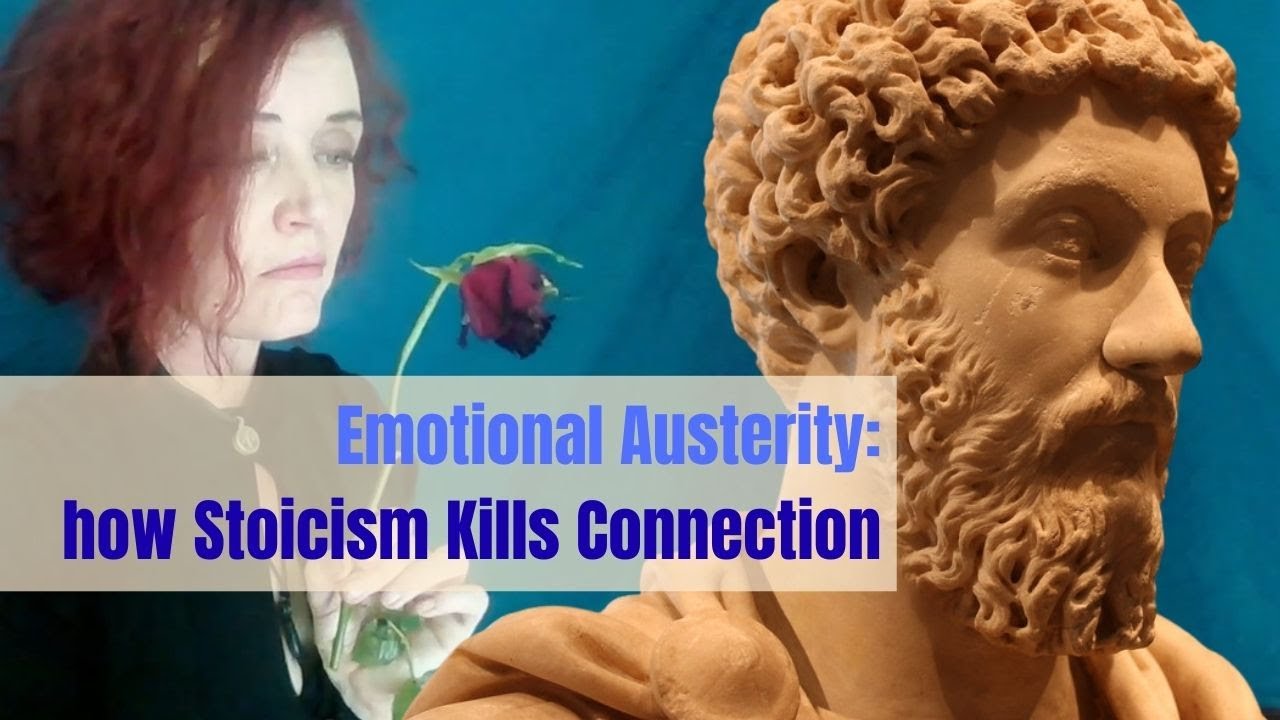
Emotional Austerity: how Stoicism Kills Connection
It makes sense that people are curious about Stoicism again. It’s one of the few tools that admits life is crap sometimes. Compared to Western spiritualism, it feels like a more sober, more realistic, way to come to terms with that fact. The problem is, like any codified coping strategy, it ends up feeding the very system you think it’s helping you endure. And it certainly doesn’t ease loneliness – here, we’re going to talk about why.
A Tale of Stifled Rebellion
Picture this. It’s 9am, and you just got into the office. You’re reading that dreaded email no one wants to receive from their boss: “I’ve scheduled a pay review meeting with you for 9;15.” The speech goes like this.
‘Look, times are tough. I know you are due for a raise, but we all have to make sacrifices this year. It’s not personal — but not this time.” You have kids. Or maybe a dog with health issues. You are barely scraping by as it is, and inflation is at 12%. Said boss sees your dis-ease and adds... “I know you can handle this and will accept this with dignity.’
You feel a burning shame, knowing he’s seen the Marcus Aurelius book on your desk — sitting right next to your copy of Zen and the Art of Not Murdering your Colleagues. And even thought this is the third time you’ve been denied a raise, you go home, deciding to put into practice what you read – to feel noble for taking it on the chin. After all, This is life. This is fate. You will endure.
Here is the thing though. The people the boss goes skiing with? You find out they all got raises. So now you’re trying to do the whole being noble thing while they sip their cognac and laugh about how loyal you are, and grin widely at how easy it is to “manage” employees like yourself. Not to mention how great the word “restructuring” is when you need an excuse to axe everyone over 50.
You’re 49.
So, given how many of you are being duped for someone else's gain, this “noble acceptance” thing is proving somewhat tricky. Especially when your partner, who can only work part time cos of the kids, yells:
“Aurelius, my ASS! Even if I can get more hours, which I probably can’t, how do we get Maja to karate?”
You start to wonder - is not rocking the boat the best reaction? If you spoke up, and others spoke up, maybe things would change. Maybe injustice wouldn’t feel so immovable...
Let’s take a deeper into Stoicism — and why we could really consider it a less glittery, more rational-seeming sibling of Western spiritualism. Like spiritualism, it’s a system of borrowed ideas that, whilst professing to help you cope with the horrors of modern life, still quietly ensures that Western values keep reproducing themselves. Today we’re going beyond the fact that stoicism doesn’t just make us feel foolish for rocking the boat or asking for change — it seeps into our closest relationships too, making us look uninterested, avoidant, and ultimately more alone. I’ve had emails from people who wanted to discuss how stoicism might help us cope better with the horrors of the world. Stoicism is interesting in that it offers a far less narcissistic set of practices than western spiritualism, and doesn’t gloss over the fact that life is often shit. However, there are ways in which it seriously perpetuates both the values of western capitalism, and, more specifically, the power structures that maintain it. All whilst offering us the label “noble” for enabling that.
It turns out that stoicism is another positively packaged school of thought with a dark side. Another coping mechanism whose values are disguised repeats of the usual western stuff. Today we examine stoicism not just as some noble ancient philosophy - but what has unwittingly become another of capitalism’s Trojan horses. A tool for disconnection and apathy. I know, I know. A lot of you LOVE stoicism, and I get it, cos what it professes to offer sounds a lot more realistic, and yeah, not as delusional as stuff like western spiritualism. Stoicism actually ACKNOWLEDGES the fact that existence is not a Sartrean smorgasbord where we can pick and chose the life we want. It is a way more down to earth, no crystals in orifices required, way to manage our misery, or powerlessness, and the inherent unfairness of life. And you know, I commend anyone who is even looking for a way to cope with misery that doesn’t involve the solipsistic egotism or magical thinking of western spiritualism.
But as usual, we still need to look below the surface. Beyond even the system of belief itself, to HOW IT IS USED. How it plays out in the system we are part of, and the values it sets up. How it ends up essentially saying “why fight injustice when you can brand apathy as depth?” Or “Why stop being emotionally constipated, when we can paint ourselves as intellectual and above such dumb desires as connection?” So, what to expect today – apart from me trying not to drop the f-bomb too early and invoking algorithmic wrath.
Today, we will look at the basic tenets of stoicism and how they profess to assist in coping with the misery of life. So a bit of Aurelius, Zeno and Epictetus for you. We will then move into how that philosophy plays out when it’s transplanted from its origin soil into the Frankensteinian corpse that is modern western culture. Ahmed and Nietzsche will all come in there and show us how acceptance and resilience play right into the hands of western capitalism. Ainsworth, Bowlby and Carl Gustav Jung help us understand how indifference and non-attachment feed right into our disconnection, and potentially function to promote (or just mask) avoidant attachment.
Finally, we will look at what to do INSTEAD of grasping for belief systems that can’t help but be warped by the existing capitalist values that we laid it out the first 6 episodes. In short, we will look at how NOT to let stoicism re-enforce your loneliness – even for those of you who holding on to stoicism for dear life.. hm.. and under stoicism life is not that dear. And you can only hold on to it for dear indifference. That could prove interesting. By the end you will see that whist stoicism ISN’T as clearly linked to narcissism, like it’s golden-child sibling, western spiritualism is, it can still be quite a self-centred, self-defeating solution to those seeking intimacy, belonging, or change. And I take it, dear listener, that if you are listening to this at all, you too are seeking at least one out of intimacy, belonging or change – if not two or more. For that you have my respect already, cos it is a search for which bravery is required, and for which sometimes, the hunt for helpful tools just goes on and on and on.
Stoicism 101
Let us start with the usual – defining our terms. So, “stoicism in a nutshell.” You will notice as I go that several of western capitalisms values will pop out. Not the only surprise in this episode, especially if you thought the ancient Greeks were about as divorced from western capitalism as it gets. I’ll be highlighting some issues as we go, so that when we get to Ahmed and Nietzsche it makes more sense.
Control is King – In Certain Circumstances
Central to Stoicism is the idea of control — yep, the capitalist value we discussed that in episode 3. However, for the stoics, this is not control over everything. These guys knew the world around us wouldn’t bend to fit our thoughts just because we mantra-ed and visualised hard enough. They were realists about limits. For them, what we can control versus what we cannot gets sorted into two piles.
It started with Zeno of Citium, who learned first-hand that you really can’t control everything when he lost his entire fortune and livelihood in a shipwreck. Feeling powerless in the face of fate, he decided he could, at least, control his attitude toward what had happened. After reading about Socrates, he basically spent his days chasing down Socrates’ philosophical descendants to push his way into their circles — not in a way that screams indifference either. More in the manner of: “teach me how to be chill — right now, or I’ll follow you around Athens like a stalker.” Epictetus then did us the favour of putting things in gobsmackingly common-sense terms. He said this:
“Some things are up to us, and some are not.”
Think how different things might be is philosophers had maintained that level of simplicity. In any case, shipwrecks, as an example, and according to Epictetus, are not up to us. Being enslaved and half-crippled by a master — as Epictetus was — also fell into the “not up to us” pile. Responding to that situation by writing philosophical treatises, however, definitely earns him the award for “best ever response to a shitty situation.”
Marcus Aurelius made the filing system of “what is up to us and what is not” lots clearer. Our judgments, impulses, desires, and aversions were sorted into the pile of “what we can control.” Pretty much everything else went into the pile of “we have no fuckin' say in this” — our bodies, our bosses, our neighbours, the environment, weather, and people who insist they were Joan of Arc in a previous life. It became a sort of internal vs external split with everything outside of ME being outside my control.
OK, in principle, this wasn’t meant as a perfect binary. In practice, though, it ends up being that confined. The locus of control is not just in the individual — it can only act on the individual as well. You can see the first few potential match-values for capitalism creeping in here. The focus on the individual and the reification of control. More on these soon. In any case, this is what produces Stoicism’s simple ethic: if it’s in you, you can and should master it. If it isn’t, accept it. This is why the Stoic “wise person” is a character who endures pain, accepts fate, and stays calm no matter what. Do note, however, that Marcus Aurelius himself didn’t really manage that. His Meditations read less like serene wisdom and more like a mantra-like outpouring of “don’t freak out, Markus, don’t freak out, Markus. If you lose it we’re fucked. Don’t freak out Markus.”
You can actually think of it as CBT for ancient Greek dudes. You know the whole “change your thought processes cos it is them that is the problem” thing? Stuck in a master-slave arrangement (i.e., a soul-destroying job)? Or a loveless marriage? Sucks, dunnit — and we don’t need to look at changing it, we are here to change your reaction to it!
The problem for stoicism and CBT becomes apparent here. If our context is problematic, it counts as, you now, an “outside thing” so lets not look at altering it. Whilst there is some truth to the fact that we can’t control a violent spouse, or control a boss or bullying colleague, we could still exert some level of control by leaving these contexts, or smearing dogshit on their cars.
For the stoics though, just like modern CBT, Wisdom means focusing on the first box. Our reactions.
Emotions Just Get In The Way.
The next key idea in Stoicism is that reason trumps emotion. Emotions, for the Stoics, are inferior because they are reactions to external things, meaning, things outside your control. They called the passions (pathē) “disturbances” — and crucially, they thought these disturbances resulted from false judgments. Let’s hone in here. An event occurs, and the stoics suggest that we consider that event first. Before doing anything else. If we somehow fail at judging it correctly, emotions will follow of the kind that will disturb us and cause suffering. If we consider the event and come to the correct judgement, then the emotions that follow will not disturb us.
Sound like a Greek and bearded version of Joe Dispenza? Yep. Cos both still maintain an idea referred to as “cognitive primacy”: the belief that thoughts come first, and your emotions follow. In episode 4 we talked directly about how this was undermined way back in the 1980s by Zajoncs research. Following that, neuroscientists and psychologists showed that basic emotions came first, and in many cases, it was cos our lives depend on that. Complex emotions proved to be concurrent with thinking about them. So no, “thoughts” or “judgements” do not come first. Neuroscientists like Ekman, LeDoux, and Barrett have demonstrated this. See episode 4 for the detail and full citations. The issue is…. Capitalism. People selling faux physics new age crossover books, and CBT, all rely on us thinking out thoughts come first, and that we can control them to avoid the “wrong” emotions. There is money in that, and also a way to blame the individual for their own unhappiness in a shitty system. It just isn't an idea based on fact. Neither the stoics nor the self-help industry nor the pseudo spiritualist are up with the actual science there.
But back to the stoics, who at least had an excuse for not having read 21st century scientific papers. For the stoics, anger, grief, desire — all of these were considered irrational, because they came from attaching value to things beyond your control. Now, to be fair, the Stoics did distinguish between “bad passions” and “good feelings” (eupatheiai). I mean, we do too. Anger = bad, happiness = good, but they did it a little differently. For them, the good feelings were feelings that were considered rational — literally rational joy, rational hope, or rational caution. We are going to hold that thought. Because quite aside from what Ahmed and Nietzsche will be saying soon – which is that emotions act as our compass: fear indicating danger, sorrow indicating how much we valued something we have lost, anger indicating unjust treatment, etc - this reminds me of something you may find interesting.
In Germany, the chocolate brand “Ritter” cornered the market with a particularly famous slogan “Quadratisch, Praktisch, Gut”. That means square, practical, good. Trust me, this is related, cos we are speaking of people who seem to have eliminated feeling and who also attempt to behave like rational androids. This is chocolate, OK? I mean, what do you associate chocolate with in your country? Look at adverts from the Anglo-sphere for example. Chocolate is all about sensuality, indulgence and luxury. It is something experiential and enjoyable. BUT, for those who value rationality SO far above all else, as German culture does, chocolate must first be PRACTICAL.
This is likely a modern example of “rational joy.” The purchase and consumption of chocolate is being made on a rational basis here – this chocolate is practical. Other brands were, eww, sensual, erotic. It stirs up feelings. Help! Bad passion stuff.
Here is the clincher though. I would argue that this isn’t joy at all. I would suggest instead that it is like entering numbers in a spreadsheet and behaving based on what it spits out. It is piratical, check. I am hungry, check. I shall eat the chocolate. The point is, once joy has to pass a logic test, it’s no longer joy as we actually understand it. Which really just leaves us with bland bland bland as kinds of allowable feelings.
Stoicism, despite these faux caveats about certain emotions being acceptable, actually privileges reason, control, and detachment, while treating our emotional life with deep suspicion.
This is something to consider that when your kid has to quit Karate cos you didn’t counter your bosses unfair treatment. “Look, honey, don’t be irrational. Your karate lessons don’t pass the logic test of ‘can we even drive you there’ any more. You know how it goes — if it isn’t practical, it can’t bring you the right kind of joy. So don’t get upset. Emotions are inferior. You don’t want to be inferior, do you? It’s just karate. Remember what Uncle Aurelius said? Life is horrible. So trust me, this won’t be the worst thing you experience.”
Lastly, when it comes to the privileging of rationality over emotions, we should remember there actually ARE some beneficiaries to this, and this is what Ahmed points out soon. Remembering that the Stoic ideal is to live guided by reason, not by anger, or grief, or desire, or even joy. Calm detachment is what equates to strength. Without allowing yourself anger – or panic that you cant feed your family - your BOSS will be stoked that you are unmoved by their crapness; that you don’t have the slightest inclination to stick up for yourself, or your colleagues who've been sacked for being 50. Your boss might not frame it as “strength.” More likely they’ll use the words “pushover,” “sucker,” or “who the fuck would get married to that.” We will talk more soon about how detaching from our emotions enables structural violence to continue. We will talk about how stoicism mimics the avoidant attachment style (read, god-awful partner with no ability to connect) following that. But before we do, we need to look at the third tenet of stoicism. The moral element.
Cultivating Virtue.
This is all about “Virtue” as the only good. For the Stoics, the only thing that truly matters is living a virtuous life. This is usually defined as embodying courage, justice, temperance, and wisdom.
What about health, compassion, and relationships, you may ask? Those are things one should be kinda indifferent to. For the stoics, they literally don’t matter in themselves. They only matter in terms of how you use them – as in, how you use them to develop virtue. Yes, relationships have instrumental value, but that is really it. They are tools to be used for other ends.
This is where the cracks start to show in terms of loneliness and disconnection. Your stoic partner, if they;re doing stoicism properly, shouldn’t see you as valuable for being who you are—more as a brilliant prop for stuff like practising temperance. And tour kids? Their developing character and a deepening bond with them is not intrinsically worth anything. It becomes worthwhile when it contributes to ones justice reps, oh and temperance again as well, when they vomit all over your vinyl collection, or keep prevent you from getting any sleep for 6 years. The idea of virtue as the only good renders people in your life is more like gym equipment for your moral workout. It centres yet again on your journey. Your path toward becoming virtuous.
This will ring familiar if you’ve listened to the episode on individualism and the hero narrative, or the one on western spiritualism for that matter. When we start treating people like tools for our own virtue, it isn't just morally questionable. We also kill real intimacy and connection. In other words, this stoic virtue mission is individualism and it’s hero narrative in action.
The ideal Stoic
So to summarise the three key tenets, have
1. control over the self,
2. rationality being the ideal and emotion being suspect, and
3. virtue as the only good.
The first two show s how stoicism fits with capitalist values directly, and the third fits in with the hero narrative and how we instrumentalise others. We now have a fairly good picture of the Stoic hero, if you will. She is kind of non-present. She is serene, unshaken, untouched by the messiness of human feeling. She doesn’t cry when her child dies horribly. She doesn’t rage when she gets paid less due to her gender, age or her skin colour. She accepts whatever happens as “according to nature” and considers herself dignified in her “endurance.” For the Stoic, inner calm is everything. Partner, kids? They’re part of the outer world. And we can’t control the outer world, so trying is kinda dumb— just accept it.
And I know. You may still think all this is appealing if you are thinking of yourself in isolation. If you frame life as just YOU — tightening your belt, stiff-upping your lip, soldiering through the war. But unless you really have been successfully atomised, life never is just you. You’ve got friends, siblings, kids, partners, friends, a dog, a cat, the store clerk you always say hi to — all of whom are affected when you decide to turn injustice into some noble test of your personal character. Stoicism keeps the focus on individual endurance. And just like when capitalism does the same, it blinds us to solidarity. In short, it perpetuates several of capitalisms core beliefs, but can do us the favour of hiding our moral laziness behind a glaze of moral superiority. What it really has to offer becomes this:
“Why risk rebellion when you can just stay home and look profound for doing nothing?”
“Why work on genuine intimacy when we can glorify detachment and disappointment?”
We will deal with each of these offerings in turn, beginning with the quashing of rebellion.
How Stoicism Encourages Moral Lassitude and Wasted Lives.
As usual, the fact that stoicism has it’s issues is not just some random assertion I pulled out of the void. There are well-known philosophers whose theories either speak up against it directly, or that help frame how stoicism comes to undermine change, community and even the possibility of living a rich and fulfilling life.
Sara Ahmed: Why Your Anger Is a Map (Not a Moral Failure)
For example, Sara Ahmed. Ahmed reminds us that emotions are political, and politicized. Anger and pain are seen as negative, and something to be eradicated, for example.
However, for Ahmed, anger and pain are not personal glitches; they’re signals that point to where justice is failing, or where power imbalances exist. In The Promise of Happiness, she shows how western culture divides feelings into positive and negative. Ahmed highlights how certain emotions as cast as negative (anger, unhappiness, refusal) not simply because they are uncomfortable. Rather, because they threaten a social order that benefits from your not having them.
Let's illustrate this. Back to the office. When your boss says, “I know you’ll accept this with dignity” here is the translation: “please metabolize this injustice internally so the machine can keep humming.” Under Stoicism, doing so is made to seem virtuous: regulate the self, keep calm, endure. Ideal for your boss. For Ahmed, this kind of thing is always what power asks for—the kind of emotional austerity that preserves the status quo. Stoicism says “don’t complain, accept fate.”
But Ahmed points out that: sometimes, being the one who complains is the ethical thing to do. Think about it — if your kid gets cheated, if your partner is disrespected, if your colleague is treated unfairly, what’s more ethical? Smiling and swallowing it, or refusing to smooth it over? Ahmed highlights that the person who speaks up is often branded a sort of killjoy—the one who ruins the mood by pointing out what’s wrong. Or who “ruins” the racist joke by refusing to laugh. Or who “makes the family look bad” by pointing out that Aunty Caroline isn’t just the one leaving cat shit on your windscreen, she’s also the one stealing Grandma’s pension money.
Ahmed reminds us that speaking up against unfairness is integrity. It is refusing to let comfort, or harmony, come at the cost of justice. Now Ahmed also talks about the so-called “positive” emotions too. For example happiness. She makes the point that in the same way the so-called “negative” emotions are used to regulate society, happiness is also used as a disciplinary tool. The reification of happiness becomes a demand to be agreeable, upbeat, “resilient.” If you don’t quash your annoyance to appear jovial in the midst of exploitation, you’re framed as being difficult. Stoicism might require a less ludicrously contradictory response – faking indifference when someone demotes us to toilet cleaning duties is arguably less nuts than smiling like a game show host. However, it still works as a way to drafts us into that same role.
The key point Ahmed raises is this: your anger at the unfair raise was never a defect—it was a coordinate. It told you where to push, who to gather, what to name. Quelling that anger? Another example of how capitalism, and the systems it co-opts, like stoicism, train us to detach from our inner compass. This is the take-home from Ahmed: dignity without dissent is just complicity. Inertia in the face of injustice is laziness.
And if she has a message for us, it’s really this:
Be the killjoy. Don’t buy into the script that calls your refusal irrational. Because in a world that profits from your silence, speaking up is care. And disruption? That’s solidarity.
Nietzsche - Stoicism is Self Tyranny
Now, Ahmed helps us see how Stoicism sidelines anger, grief, and complaint as “irrational” — which conveniently makes injustice harder to confront. And if somehow you have still managed to hold onto the idea that stoicism is fine, so long as there are no freedoms, communities, rights or individuals that you actually give a shit about, brace yourself.
Up until now, it just looks like stoicism was a term paper that has been given a C minus. This next guy gives stoicism two hundred years in a barracks latrine, for daring to exist at all.
We turn now to Nietzsche: patron saint of maximizing the number of drinking hours in relation to time spent doing one’s tax return. Nietzsche thought Stoicism was essentially the philosophical version of putting a straitjacket on your instincts. Even his arguments against stoicism embodied it’s antithesis. He had zero patience for performative “reasonableness” and refused to dress up his dislike for stoicism in the calm detachment that both stoicism itself and academia demanded.
For Nietzsche, reason wasn’t some higher, purer faculty. It was just another instinct — and often a weaker one. To privilege reason over passion is to deny half of what makes us human. This links to his idea about balancing the Apollonian and the Dionysian forces. The Apollonian is order, clarity, restraint — Apollo’s neat geometry. The Dionysian is revelry, ecstasy, chaos — Dionysus drunk and dancing. Essentially, for Nietzsche, you need as much Dionysian energy as you can handle, but the appolonian has to be at sufficient levels too, so that the Dionysian stuff doesn’t just destroy you. So Nietzsche wasn’t saying reason has NO place. He saw instrumental value in reason – it had value when it served life, not smothered it. The real weight was in the Dionysian, though. The overflowing, ecstatic life-force that Stoicism tried to strangle.
Its kinda like this. Imagine you just went shopping and bought a stack of wine, chocolate and super life-nourishing food. Yes avocados can be Dionysian ;) In order to carry it home, you need a bag. If you don’t have a bag, everything will fall out of your arms and roll away of break. Reason is that bag. It is the container. What is IN that container is really what has value. The container itself? Only valuable BECAUSE it enables the contents to be held. So when stoicism says “reason above passion”? That’s like saying the bag is more valuable than the food in it. Calm detachment instead of joy, rage, or grief? Well, Nietzsche openly and directly labelled this sickness — and called Stoicism a disease of reason that tries to choke out life’s instinct Yep, no doctorate-length analysis required when it came to what he thought of stoicism, but here is a quote all the same.
“Stoicism is self-tyranny, the violence of reason against nature.”
This quote from Twilight of the Idols, also references the Stoics claim that they want to “live according to nature.” Nietzsche highlights that the stoics had a similar take on nature to people today who have spent their whole lives in gated communities, and would possibly die within 5 seconds were they ever to venture to actual wilderness. Cos what is nature, really? It is not calm, and detached. I mean, unless you you think central park is “nature,” or are in one of those German “forests” where they have literally killed all the wolves and planted the trees in rows according to species. YES. They DO DO THAT HERE. Nietzsche points out that nature is raw, cruel, brutal, painful — and also overflowing, ecstatic, chaotic. The Stoics did not live like that. They didn't embrace THAT kind of nature. Instead they cut the definition of nature until it fit their grid. You will know this trick from previous episodes: it is called rewriting the narrative. The stoics rewrote the narrative to paint “nature” as rational, orderly, indifferent, and serene. Less like honouring nature and more like using it as a cheap shot to prop up their argument.
Which it has to be said, WAS the done thing at the time. This was an epoch when “as nature intended” could still pass as a justification, rather than being recognized as the knuckle-dragging chant of today’s intellectually underpowered conservative contingent it has become. Back in the time of the stoics, people hadn’t yet realised how tautological and logically flawed that argument was. Cheers to Hume and Moore for sorting that out later. Shame the modern dating-advice sphere — and said conservative contingent — still haven’t learned to fucking read.
And this is where Nietzsche’s hammer really hits. He sees Stoicism’s obsession with calm endurance as life-denying. Anger, grief, even desire — these are not “irrational disturbances,” they are life speaking through us. They are our vitality, our compass. To amputate them in the name of “virtue” is, for Nietzsche, cowardice. He would say: if you swallow every insult from your boss and call that noble, you’re not wise — you’re just sick with resignation. Then there’s Stoic “virtue.” Nietzsche saw virtue as a word that was very often used as code for obedience. Whose virtue, he asked? Who benefits when calm acceptance is called strength, and resistance is called weakness? Right — the people already in power. Across the centuries, Ahmed and Nietzsche agree on this. It’s worth highlighting the life denying aspect too – cos those in power, such as bosses, often do a great line in denying you a life, so any behaviours you might adopt YOURSELF to enable that? Awesome – for them. Nietzsche did not greatness when Aurelius praised endurance and obedience to fate. He saw a herd morality in disguise. Virtue is a trick: a way of turning your chains into a performance of superiority.
So of all the ways to unmask Stoicism, Nietzsche is perhaps the most outspoken. Where Stoicism says “rise above,” Nietzsche says: “Stop the faux superiority. Get back down in the dirt and wrestle.” Feel your rage, feel your joy, and for god’s sake don’t mistake resignation for dignity. Because once you’re too “virtuous” to resist, you’ve already handed victory to the system.
Stoicism and Loneliness
I want to turn more directly to loneliness now. I know a lot of us ARE too tired to fight, and might even be thinking “fuck it. I now feel doubly bad, cos I should fight but I am too tired, and time poor, and at least I could feel OK about myself with stoicism” and so on. And you aren't wrong. I mean, being time poor and exhausted is the crucible for all this, and our system makes sure we are all permanently time poor. And that we all feel crap about ourselves. As usual, my REAL concern here is connection. And whilst protecting those we care about, or our rights, or the rights of others, IS part of connection too, I would like to get to the grass roots of it here. To why stoicism, and the behaviours its values demand, will essentially ENSURE AND/or perpetuate your loneliness.
Firstly, imagine this. You’re on a date with someone you actually like. You want to show you’re calm, grounded, disciplined — not needy or desperate or excitable. You’ve read your Stoic blogs, maybe even The Daily Stoic audiobook. So you don’t let yourself light up or look “too keen.” Instead, you sit there, composed, detached, dignified. Nodding politely as they speak, not asking too many questions. When they’re curious about you, and lea in to ask questions, you play it cool. A few words, and nothing that might betray your inner world, or private thoughts. When your food arrives, you eat in relative silence. You might even interpret this as “calm and going well” — like your own relaxed vibe has emanated outwards. Like you’ve pulled off “mysterious,” and “wise,” and that Aurelius would have been proud.
Here is the thing. When you’re on the receiving end of that (as I have been, many times), it reads as disinterest. Under many lenses too. It is not pleasant for either party. While the unfortunate stoic person is wondering why others give up after one or two dates, often those others are thinking “ouch, they were totally bored by me.” or “Maybe they’re unavailable emotionally?” And if they have any self respect at all, they’ll be forced to conclude that seeing someone who has no curiosity in who they are makes zero sense.
But is it REALLY Disinterest?
The problem is, with stoicism here in the mix, disinterest isn’t always just disinterest. The stoic just ensures it looks that way - if the stoic-dater manages to go on dates at all. Sometimes, it really is just cos someone thought stoic composure WAS all admirable and stuff. Sometimes, it’s avoidant attachment dressed up as “Stoic composure,” cos that’s easier than dealing with attachment issues. Or even knowing you have them. And of course, sometimes this disinterest is a TACTIC, like for dickwads who read things like “the game,” and don’t realise that anyone who knows what negging is can usually see through their crap immediately.
Fucktards who read The Game aside, I want to speak to those of us who do see other human beings as other human beings. To those of us who don’t treat connection like chess and are doing their best to connect.
Which means back to our stoic friend, and their dating life. It makes sense that, from the inside, for the stoic, behaving with detachment and calm can feel like strength and self-control. Like doing something RIGHT, for once. The problem is, from the outside, it lands as indifference. It looks like all the things a healthy human being walks away from. Cos anyone who has read anything on psychology or dating, or even just human behaviour knows: when someone doesn’t ask you questions, it means they are not interested in you. If they DO want to connect, on any level other than the physical, they will share some personal information. Disinterest looks like like lack of curiosity and closedness. Check, check. Easy. And goodbye. This signal mismatch means two people who might have gotten on really well, turn away from each other. The one who insists on the stoicism mask will repeat the same ritual with someone else, and wonder why they just can’t meet anyone. Cos unbeknownst to them, they look unavailable, uninterested, and essentially like the prime archetype of “no.”
Needless to say this is great for western capitalism because lonely, disconnected people don’t rebel either. Instead they buy things. Like more books, coaching and dating courses that, should they manage to ditch stoicism or actual stoics, will teach them entirely DIFFERENT ways of NOT being themselves. But I digress. Let’s get to those who DO manage to pair off.
Stoicism: A recipe for Marital Discord
Because what’s worse is, this isn’t even limited to those who are single. Sadly, if you are in a relationship, and adopt stoicism as a stance, it is still guaranteed to deliver. As in, perpetuate your loneliness. Enter an acquaintance of mine. He is finally starting to question the stoicism he adored for several years. Whilst deep in it’s throes, he explained it like this.
Now, I do not have permission to use this, but he is still technically a stoic so he won’t give a shit.
Kidding, I did ask. He said this once in an email. I am sharing it cos I think its well written and that some of you might relate. “Stoicism helps me invoke a sort of numbness. I can detach from everything when that happens. That feeling is how I know I am doing the right thing. It helps me do my duty. It helps me just get on and do what is expected of me. No one badgers me so long I just do what is expected of me.” It is worth adding that this person has been in a loveless marriage for many years, and is on several medications for depression. He and his partner no longer communicate, and both of them speak often of loneliness. He found stoicism and it helped him disconnect, but not repair. It has helped him neither leave nor communicate. To just accept that it will be awful.
I can say all that cos the sad fact is, none of that makes it possible to identify him. There are so many people out there in his, and her, situation. And for those of you who were brought up with Christianity, you might recognise this as a dressed up Christian suffering ethic. Others of you might recognise the communication breakdown, or the crippling fear of conflict. Stoicism aids and abeds these things. It also provides a virtuous looking excuse for fear of conflict and failures to communicate. Importantly, these things are also typical of what I want to talk about now. Avoidant attachment.
Avoidant Attachment 101
Avoidant attachment, is basically a strategy for surviving closeness by shutting it down. John Bowlby and Mary Ainsworth were the first to show how avoidant attachment is learned in childhood, as a survival strategy. Hazan and Shaver later demonstrated, it doesn’t just vanish when we grow up. It comes with us into dating, marriage, and all other forms of intimacy.
Ending up avoidantly attached happens like this. If you grow up in an environment where reaching out for comfort gets you punished, shamed, or ignored, you learn fast that showing need is dangerous. Maybe your parents told you to “stop crying,” “don’t be dramatic,” “god you are oversensitive” or “go to your room until you can be calm.” The lesson is sometimes subtle, sometimes not, but the message is the same: emotions are bad, and if you want to stay safe, you’d better shut them down. In other words, rational, calm behaviour please. Emotions are something to be ashamed of.
Now, as a child, your nervous system adapts. That is the survival part. It learns: don’t need, don’t ask, don’t show. Vulnerability becomes a liability. So as an adult, when intimacy stirs up feelings, whaah! Your body goes straight back to its childhood rulebook: wall it off, cut it out, shut it down.
The thing is this: a lot of people are avoidantly attached. It’s not some rare-edge, have to have spent your childhood locked in a cellar in Belgium thing. It’s a widespread way of coping. I would argue that some cultures actively encourage it. Take Germany, for example, where openly talking about your inner world is SO often derided, dismissed, or labelled as weakness. When your feelings are treated as embarrassing or inappropriate not just at home but across your whole society, it produces generations of avoidant attachers. And stoicism offers a great way of making this look virtuous – of pretending it is not problematic. It is no surprise to me when the people I date here mention stoicism, which they do with monotonous regularity. When a culture or individual is already trained in emotional austerity, and in never admitting anything is wrong, they NEED to find a way to make it look like they don’t have a problem. They need to validate how they are, or even make it look morally superior. Cos that’s a whole lot easier than really self-reflecting. By the way, reflecting on the self is not a favourite pastime of anyone who has learned that the inner world is something to be ashamed of.
Stoicism makes the strategy of cutting off ones emotions and desires look noble, even “healthy.” Because cutting off desire? We can call it “temperance,” and never mention our fear of rejection. Refusing to share ones inner world of feelings? We can label that “dignity” instead of admitting our fear of opening up and being vulnerable. Avoiding curiosity about others? That’s “self-control,” not rigidity or self-focus. Put it all together, and what is really just flavours of fear and shame gets repackaged as “admirable.”
And whist that might seem like a convenient way for avoidants to never face themselves with honesty, it is sometimes just stumbled upon, and feels like a fit. Cos lets face it, not everyone even KNOWS about attachment styles, and when they do, they don’t want to rock up to a date and say “I'm avoidant”. Now we get to the much deeper tragedy. The avoidant actually LONGS for connection. That is the paradox at the centre of this attachment style. They long for connection AND fear it at the same time. The longing does drive them to try, but the fear takes over at some point. This is a fear of the demands that attachment might place on them. They fear loss, rejection, engulfment. The avoidant longs for connection, yet their strategies for dealing with all their fear around it ensure it can never come about. You hold back to feel safe → the other person reads it as rejection → they back off → and you conclude “see, intimacy never works.”
And that’s the sometimes-crossover between Stoicism and avoidant attachment. It’s how both become a self-fulfilling prophecy: the very thing meant to protect you from rejection guarantees you’ll be rejected. Calling these tactics Stoic doesn’t make them into wisdom; it’s makes them plan old loneliness that hopes to look less tragic.
And for those inside relationships, where connection has died or never really existed? Stoicism keeps you doing what is expected of you — by society, by the roles you bear, by your fear of rocking the boat. What it doesn’t do is help you undertake the things that might make life better: like actually communicating your needs, or leaving when there really is something wrong. In these situations, Stoicism doesn’t build strength; it encourages repression. Remember that sentence my acquaintance said — knowing you’re doing the right thing when you cut off your needs, go numb, and do your duty? That’s repression in action.
This deserves a closer look a swell – this repression of what we desire. Carl Gustav Jung argued, what we repress doesn’t disappear — it goes into the shadow. The shadow isn’t just a spooky metaphor either; it’s the psychological basement where all the unwanted, embarrassing, or dangerous parts of us get shoved. Those rejected desires don’t sit there quietly. Jung looked at how they sneak back out, but in more twisted forms. The classic example? The catholic church. Repression of sexual desire. Just look what kind of twisted sexual acts resulted from that, and who had to bear the brunt of a priests great facade of chastity.
And whilst it won’t always be THAT twisted, it still erupts at some point. Through sarcasm, or passive aggression, sudden eruptions of rage, flings with your yoga teacher, self-destructive bouts of spending, drinking, eating, or just that sense of numbness that slides into depression. So when Stoicism tells us to cut off desire, or when avoidance tells us to numb our feelings, what we’re really doing is feeding the shadow. We’re setting ourselves up for exactly what Jung warned about: the return of the repressed. You can call it composure if you want; if you want to paint this as stoicism too. But your psyche calls it unfinished business. And it will come back, usually in ways that don’t look noble at all.
This really is all bitter irony. Emotional austerity doesn’t just keep us from rebelling against the system; it mean we end UP rebelling, somehow, and in twisted, unpredictable ways, against ourselves. We swallow the anger, the longing, the grief — and they don’t dissolve, they ferment. Their new and twisted forms could go off like a bomb of self-destruction at any point, or seep like poison into our relationships, our work, our bodies. And instead of intimacy, what we end up with is distance. Instead of dignity, resignation. Instead of strength, a brittle mask that cracks the moment life pushes too hard.
Alternatives to Stoicism
Have you found yourself in any of this? Have you found yourself drawn to someone only to shut it down because it was too scary? Did you ever chose a “sensible” person instead, where you would not be overwhelmed by your feelings? I feel for you, and it’s how avoidant detachment makes us behave. When we dress it up in stoicism though, it’s doesn’t serve us well.
If not Stoicism, then what? What school of thought should we follow instead?
Here’s the problem — any pre-organised belief system is going to carry the same risks. Why? Cos they get re-packaged. Re-packaged to serve power and the system in one way or another. All of them eventually become a script, a mask, a manner of shutting down feeling and rebellion. So my answer would never be: find a new “school” of thought. With any pre-written idea, we much make sure to ask what values are embedded in it. Question what is being asked of you. If it’s just compliance, and adherence to the values that already do us ill, then rebel. What does rebellion even look like. Well, in the case of a culture that asks you to be rational, or that only some feelings are acceptable - Feel. IN a culture that sells us the lone-wolf ideal and atomisation - Connect. Instead of hiding behind some philosophy’s tombstone, take the risk of being alive. Tell someone you’re curious about them, then actually ask them some questions. Speak the pain that isn’t being heard. Demand better, for yourself and for others. That isn’t a school of thought. That’s just what it means to be human.
Conclusion
Let’s be fair first: Stoicism does have its appeal. Unlike Western spiritualism, it doesn’t gaslight you with talk of “lessons” or “blessings in disguise.” It doesn’t deny that awful, unjust, grinding shit happens. It says plainly: life is painful, unfair, often brutal — and there’s no magic escape hatch. That realism can feel grounding when everything else is shouting positivity mantras at you. But here’s the catch: realism alone doesn’t equal connection. What Stoicism offers in honesty, it steals back in austerity. Yes, it admits the world is cruel — but then it trains you to endure it in silence. It replaces grief with resignation, anger with acceptance, desire with numbness. And what that creates isn’t strength. It’s loneliness.
We began with that “accept this with dignity” pay-review speech: Stoicism as emotional austerity your boss can bank on. Ahmed showed how that austerity polices feeling, so the machine keeps running. Nietzsche ripped the mask off: call numbness “virtue” and you’ve just muted life. And in the most intimate rooms — on dates, at dinner, in bed — avoidant attachment turns that same script inward: stay cool, say little, need nothing. Jung finished the picture: whatever you cut off doesn’t die; it comes back as distance, depression, or destruction. Here’s the headline: emotional austerity manufactures loneliness. Out there, it stops solidarity; in here, it starves intimacy. Your anger — which could have mapped you to allies — gets domesticated. Your curiosity — which could have built a bridge — gets rebranded as weakness. The result isn’t wisdom. It’s isolation with excellent posture.
And no, Stoicism isn’t the nobler upgrade to Western spiritualism. They’re twins in different outfits. Spiritualism sells faux enlightenment (“you can manifest your way out of grief”); Stoicism sells faux cool (“you can reason your way out of need”). Both relocate problems inside you, both reward compliance, both avoid empathy, and both end at the same destination: loneliness. One tells you to “raise your vibration,” the other to “master your passions.” Either way, you learn to stop asking for help and stop offering it. Perfect for capitalism; disastrous for connection.
So what do we do instead? Not a new school — a new stance.
• At work: refuse dignity-as-silence. Name the harm; gather the people; make the demand.
• In love: choose curiosity over cool. Ask the follow-up. Offer one honest sentence about what you felt.
• In community: mutual aid over “resilience.” Resilience without each other is just austerity with PR.
• With yourself: notice when “I’m being Stoic” really means “I’m afraid to need.” Then choose need anyway — with boundaries, not walls.
If Stoicism trained you to accept domination, let rebellion retrain you to connect. Because life is often miserable — and loneliness makes it lethal. We don’t survive by looking profound; we survive by showing up for each other. That’s Emotional Austerity: how Stoicism plus capitalism kills connection — and why Stoicism isn’t the cure for Western spiritualism; it’s the other glove on the same hand.
Keep the tombstones. I’ll take the messy dinner, the awkward question, and the friend who is often erratic.
Public Philosopher/ Speaker/ Performer
Jordan Reyne is a philosophy graduate from the University of Auckland, New Zealand. She works as a public philosopher, writer, and public speaker, and was formerly a professional musician and artist. Jordan has accidentally lived in four different versions of capitalism — from early-stage (Poland) to late-stage (Germany), with New Zealand and the UK slotting in between. Despite a lifelong passion for philosophy, she did not set out to conduct a cross-cultural study of capitalism; it happened unintentionally while trying to navigate a somewhat challenging life as an artist with inconvenient illnesses. When the same ideological machinery shows up in different languages, it does not suffice to hide the pattern.
Jordan’s current work focuses on phenomenology, existentialism, critical theory, and the analysis of power — including the Foucauldian kind that doesn’t yell or point guns, but quietly rearranges your behaviour from inside your skull. She is also completing a degree in Psychology, the institutionally approved perspective that locates all blame, control, and pathology within the atomised individual. Despite this — or because of it — she maintains the heretical view that society, institutions, and power structures do in fact affect human beings (so she may well fail this additional qualification).
Jordan’s early life provided a neat micro-demonstration of power’s two great modes: overt authoritarianism (via a father who favoured the outbursts and rage of a standard totalitarian model) and covert ideological power (via a mother whose preference for guil…Read More

Why Decent People STILL Fail to Connect